Get Full Government Meeting Transcripts, Videos, & Alerts Forever!
Get email alerts on the Artificial Intelligence Energy Data Centers topic
No spam. Unsubscribe anytime.
Gov. Spencer Cox urges balanced AI policy, flags energy strain from proposed data centers
Summary
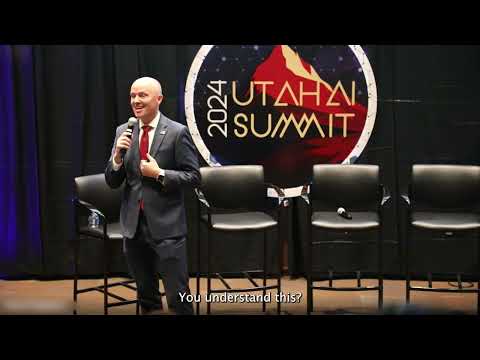
At a Utah Business and Commerce event, Gov. Spencer Cox described state efforts to pair industry and regulators through an "innovation policy lab," warned that large AI data centers can consume vast amounts of power, and promoted Utah's collaborative business culture and energy projects.
Governor Spencer Cox said at a Utah Business and Commerce event that state leaders are trying to strike a balance between encouraging artificial intelligence innovation and protecting the public from its risks, and he warned that proposed AI data centers could demand more power than entire states currently use.
Cox said Utah is emerging as a national fintech and AI leader and described a policy effort to embed private-sector innovators with government regulators in a so-called innovation policy lab. "Could we do that? And we came up with this policy lab idea where we would basically embed the private sector with government to work hand in hand," Cox said. He added the lab would let companies innovate with regulatory insight and reduce uncertainty about whether projects will be allowed to proceed.
The governor framed the approach as one that helps companies "do things the right way" rather than simply catching regulatory violations. "How can we, as government, take that mindset that our job as regulators isn't to catch you doing something wrong, but to help you do it the right way?" he said.
Cox highlighted state partnerships with higher education and technology staff. He praised the University of Utah's work on AI and noted Alan Fuller, chief technology officer for the state's Department of Technology Services, is using large language models to assist staff responding to tax-related calls.
Cox also raised energy concerns tied to the international race for AI infrastructure. He said a proposed single data center campus would require about 1.4 gigawatts of power and contrasted that with other states' usage: "One data center campus, 1.5 times more power than the entire state of Wyoming. The entire state of Utah runs on about 4 gigawatts of power." He said that scale of demand would strain existing supply and raise rates for Utah ratepayers unless energy production is increased.
To address supply concerns, Cox described ongoing and planned Utah energy projects: a large solar-plus-storage development in Emery County, a major hydrogen project in central Utah with Chevron and Mitsubishi involvement, and a 400-megawatt geothermal project in the Milford area. He urged an "abundance mentality" toward energy production so the state can host technology projects without harming residents' energy costs.
Cox framed the broader policy stakes as both economic and societal. He warned AI could both "solve all of our problems" and "destroy the world," and urged careful, collaborative policymaking to preserve Utah's civic culture of cooperation. He pointed to Utah's volunteerism and a study he cited that he said shows Utah rejects "zero-sum thinking," arguing that attitude supports entrepreneurship and collaboration.
The governor also said AI's energy footprint and its potential to manipulate human behavior—particularly children via social media—merit caution. "AI is gonna take that up to a level that is almost incomprehensible... The ability to manipulate human beings and human emotions... is pretty scary to me," he said.
Cox encouraged officials and the private sector to work together on regulation and infrastructure: to allow innovation to proceed with safeguards and to expand energy production so Utah can host large computing projects while protecting ratepayers.
Cox's remarks were delivered as a keynote-style address; the transcript shows no formal votes, motions, or binding commitments arising from the speech.