Get Full Government Meeting Transcripts, Videos, & Alerts Forever!
Get email alerts on the Police Technology topic
No spam. Unsubscribe anytime.
MPD outlines drone program goals and safeguards as Fire & Police Commission reviews SOPs
Summary
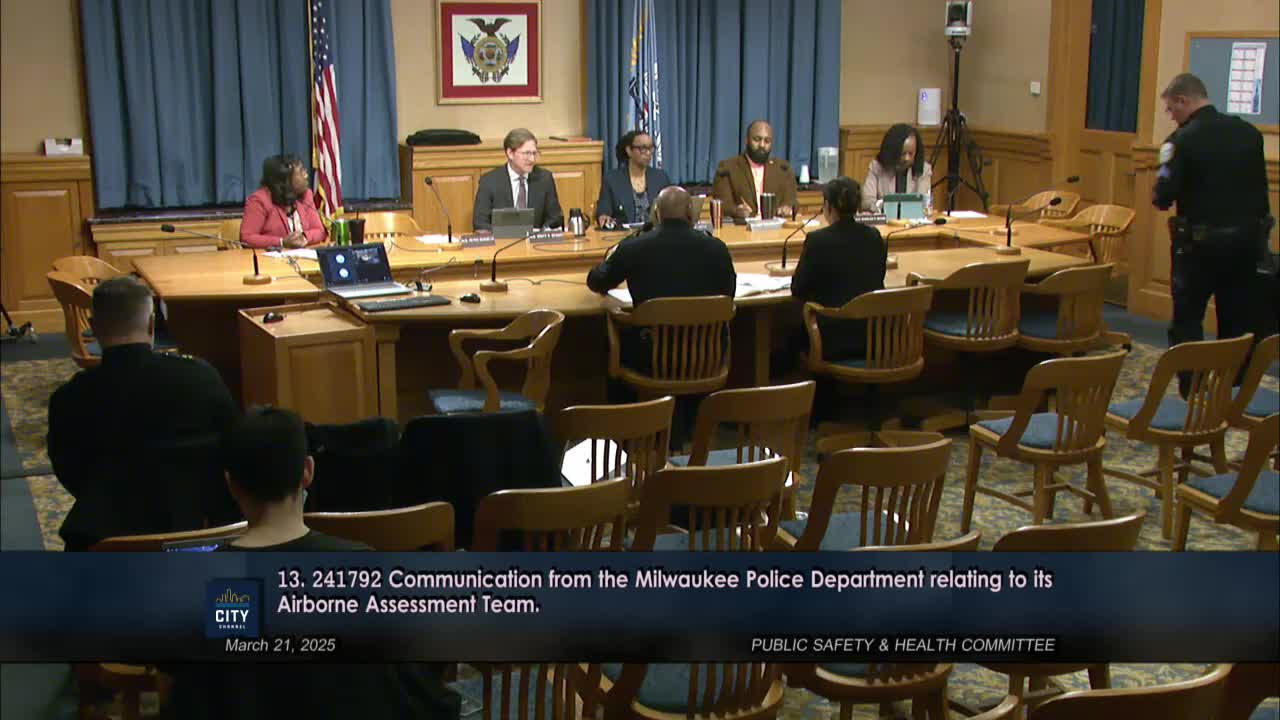
Milwaukee Police Department described the scope, use cases and safeguards of its Airborne Assessment Team (drones) to the Public Safety & Health Committee and the Fire & Police Commission; officials emphasized life‑safety uses, data retention limits and a ban on facial recognition for the platform discussed.
The Milwaukee Police Department briefed the Public Safety & Health Committee and the Fire & Police Commission on a developing Airborne Assessment Team that will deploy unmanned aircraft for search-and-rescue, scene assessment and event management.
Sergeant Christopher Boss, who founded the unit, described use cases that include providing officers with situational awareness in active threat shootings, assisting crash-reconstruction mapping and supporting large-event safety and port security. "This is essentially, can be considered a body worn camera with a different perspective," Sergeant Boss said, describing the technology's role in officer safety and accountability.
MPD officials said the department has flown roughly 250 flights in testing and training and emphasized policy limits: operations will follow an approved Standard Operating Instruction, data retention will match evidence rules, and the department affirmed it will not equip drones with weapons. The department also said the platforms under discussion do not include facial-recognition software and that policy prohibits its use on these drones.
Committee members and the Fire & Police Commission asked about privacy, line-of-sight limits, the use of thermal sensors for search-and-rescue, and whether drones can assist when vehicle pursuits are unsafe. MPD said current operational constraints include line-of-sight and maximum speeds of commonly used rotary platforms; the department signaled it will pursue further training and regulatory approvals for expanded operations where permitted.
After the briefing, Alder Westmoreland moved to place the communications on file; the committee approved the request and asked the department and commission to continue coordination on SOP language, community outreach and a public transparency dashboard.