Get Full Government Meeting Transcripts, Videos, & Alerts Forever!
Get email alerts on the Water Supply Sources topic
No spam. Unsubscribe anytime.
Cedar City weighs Martins Flat well, spring rehab and Coal Creek treatment as water‑supply options
Summary
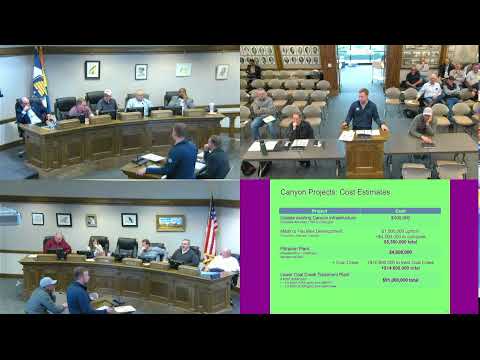
Consultants told the council that Martins Flat is the most promising canyon drilling target; exploratory drilling would cost roughly $1 million and complete development about $4.5 million more if tests warrant. A lower‑canyon treatment plant was estimated at about $10–$11 million; an extensive reverse‑osmosis scheme downstream could exceed $90 m.
Cedar City’s retreat included a detailed look at options to increase supply from Cedar Canyon, where springs and surface flows historically provided a portion of municipal water. Consultants presented a range of approaches — from targeted spring and pipeline modifications to exploratory deep drilling at Martins Flat and large‑scale Coal Creek treatment — with widely different costs, risks and time frames.
Consultant Ridley Griggs and Steve Jones said the city faces three urgent challenges: the state’s chlorination directive, unusually high pressures in parts of the system and declining groundwater levels. On the canyon side, they said Martins Flat stands out as the best candidate for deeper drilling based on geologic mapping and prior test holes.
Exploratory drilling and well development
The consultants described an exploratory bore to the Navajo Sandstone as the way to resolve the largest unknowns. They estimated about $1,000,000 to drill a deep exploratory hole and carry out zone testing; if results are favorable, finishing a production well including pumps and a small pump station would add roughly $4,500,000 (total about $5.5 million). The team said prior shallow testing produced flows of a few hundred gallons per minute but that deeper sandstone units could yield substantially more if the bore intersects a fractured zone.
“Martins Flat is the spot to go,” Ridley Griggs said. He added that the area has mapped faults and other indicators that increase the chance of a productive broken sandstone target; consultants described the project as higher risk than spring repairs but potentially higher reward.
Spring rehabilitation and pipe improvements
Consultants also recommended relatively modest canyon conveyance and control works — valve changes, small pumps to serve canyon customers and targeted pipe work — that they estimated at about $400,000. Those measures would increase capacity through existing transmission (an 8‑inch and a 10‑inch main) and give operators flexibility to route more canyon water to key tanks and to take advantage of spring runoff seasons.
Filtration and Coal Creek treatment options
For treated spring water, the consultants estimated a localized filtration facility at roughly $4,000,000. Treating water directly from Coal Creek — which has higher total dissolved solids and seasonal turbidity — would be more expensive; consultants gave a mid‑range figure near $10 million for an engineered treatment plant that could feed the pipeline upstream of gypsum‑impacted reaches. They also presented a much larger option — an advanced treatment/reverse‑osmosis facility downstream where TDS is highest — with a preliminary budget estimate in the tens of millions (consultants cited a ballpark figure near $90 million) and noted substantial operational complexity.
Hydraulic limits
The consultants warned that the canyon pipeline sizes limit how much of any source can be delivered without additional major pipeline work. They estimated that, with modifications to control valves and pumping, the 10‑inch transmission could convey up to about 2,000 gallons per minute if flow is routed to a nearby canyon tank rather than being fully backed up to higher tanks; an 8‑inch section could carry roughly 1,300 gpm under the revised operating scenario. Those conveyance limits mean a small well producing 300–500 gpm would not, by itself, eliminate peak‑season vulnerability.
Regulatory and timing considerations
City staff said a water‑right change application to make purchased Basin 71 water serviceable in town had faced a protest but remains under review; staff estimated months to process any change. Consultants said well drilling to Navajo Sandstone is achievable but requires specialty drillers and time for permitting and testing; they projected exploratory drilling and testing could take several months, and full development 18–24 months once decisions are made.
Council reaction and next steps
Council members asked for further cost‑per‑gallon comparisons and for the consultants to model how Martins Flat, spring rehab and filtration options stack up hydraulically against other proposed projects (such as the Central Iron interconnect and Port 15/Gemini connections). No formal action was taken at the retreat. Several council members and staff expressed support for authorizing the exploratory drill as a next step to reduce long‑term uncertainty.
Ending
Consultants recommended the city pursue the low‑cost conveyance fixes first (valves and small pumps), and to authorize exploratory drilling at Martins Flat if council supports taking on the drilling risk. They cautioned that Coal Creek treatment is technically feasible but significantly more expensive and operationally demanding than wells or targeted spring work.