Get Full Government Meeting Transcripts, Videos, & Alerts Forever!
Get email alerts on the Water Supply topic
No spam. Unsubscribe anytime.
Cedar City Council weighs master-plan options for long-term water supply, directs budget priorities
Summary
Councilmembers reviewed a city water master plan presenting options — West Pump Station, canyon filtration, several well sites and Pine Valley participation — and asked staff to prioritize funding for canyon filtration, a Martin’s Flat test well and planning for the West Pump Station.
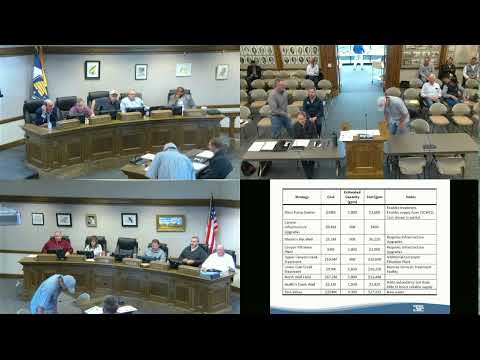
Cedar City Council members spent the meeting reviewing a multi-option water-supply master plan that lays out short- and long-term choices — including a West Pump Station project, filtration upgrades for Cedar Canyon springs, test drilling at Martin’s Flat, a Braffitts Creek well and a larger Pine Valley import — and directed staff to reflect immediate priorities in the upcoming budget.
The master plan’s presenters told the council that the most time-sensitive items are completing canyon filtration to meet state treatment expectations, funding a $1 million test well at Martin’s Flat, and advancing the West Pump Station because of interconnections and chlorination needs. Ridley, a staff member who led the presentation, summarized cost and capacity estimates and described the draft report’s near-term availability: “If we needed to get it to you next week, I think we could,” Ridley said.
Why it matters: City staff and consultants said state requirements to address chlorination and water treatment make some near-term upgrades mandatory. The consultants presented a range of capacity, cost and operational tradeoffs — from low-cost, near-infrastructure options such as a Braffitts Creek well (estimated near $5.1 million) to large regional buys or infrastructure like the Pine Valley project (published Central Iron County estimates used, whole-project figures not Cedar City’s share) — and warned that the city likely cannot meet long-term modeled demand without participation in a Pine Valley import or equivalent new-basin supply.
Key findings and options
- North wellfield: The master plan estimated an “all-in” cost of about $67.2 million for a North wellfield (assumed capacity ~5,000 gallons per minute), with individual well-development budget items of roughly $12 million apiece driven largely by long power and pipeline runs. Ridley cautioned these are planning-level numbers and that detailed design could change them.
- Braffitts Creek: Presented as a lower-cost, near-infrastructure option, the plan’s estimate for a Braffitts Creek well concept was about $5.1 million (test well ~$500,000; development ~$1,000,000; pump house ~$1,500,000 plus a mile-and-a-half of pipe and additional power). The consultant noted the aquifer in that area is already stressed, citing the city’s Groundwater Management Plan, and said a Braffitts Creek well would offer redundancy rather than “new” water.
- Martin’s Flat: The plan showed a $5.5 million estimate for a Martins Flat project (presentation materials used a 700–1,000 gpm potential range; the team recommended a $1 million test well as a next step). Multiple council members supported drilling a test well to gather definitive data before committing larger funds.
- Canyon filtration and Cedar Canyon springs: A filtration project to keep using spring sources was estimated near $4 million in the planning materials. Consultants and staff said filtration is a minimum requirement to continue relying on those springs and that the city had already budgeted $2.2 million toward canyon filtration; staff recommended adding roughly $1.8 million to that allotment in the coming budget.
- Pine Valley and regional options: The Pine Valley import was described as “actual new water from a different basin.” Presentations referenced earlier Central Iron County figures (not Cedar City’s direct obligation) that showed a total project cost on the order of $254 million (older estimate) and a potential Cedar City capacity slice near 9,300 gpm if the city secured roughly 10,000 acre-feet from the project. Staff noted those published figures are dated and likely to be lower if some valleys are removed from the scope.
Costs, tradeoffs and operations
The presentation broke the projects into relative cost-per-capacity comparisons to help the council weigh options. Staff and consultants emphasized that a large share of the cost for remote well fields is driven by power and long transmission pipelines: three miles of line and three miles of power per well were used as unit assumptions in the north‑well examples. The West Pump Station concept drew repeated attention because it enables lower‑pressure chlorination, better interconnection with Central Iron County water, and use of existing Basin 71 water rights the city has already purchased.
Public comment and operational concerns
Jonathan Stout, a resident, asked the council to study reuse of treatment-plant effluent for nonpotable uses; staff acknowledged that reuse and secondary distribution remain on the plan-list and recommended a focused study. Mike Shirts, a fire department official, warned staff to coordinate the planned pressure changes with large industrial sprinkler systems; lowering system pressure without coordination, he said, could force facilities to install on-site fire pumps.
Council direction and next steps
Council members repeatedly identified three priorities to advance in the budget cycle: finish canyon filtration planning and funding, fund a Martin’s Flat test well (the city already has money budgeted for initial work), and study/advance the West Pump Station project — including evaluating funding and borrowing options. Several members urged staff to present the draft master plan for formal council adoption as soon as feasible and to align rate and borrowing discussions so revenue and debt capacity match project commitments.
No formal votes were recorded during the discussion. Instead, council members gave staff direction to prepare budget proposals and a council-ready draft of the master plan that incorporate the prioritized items and to return with cost, funding, and rate impacts.
Ending
Staff and consultants said grant and low-interest loan programs (including the State Revolving Fund, FEMA’s BRIC program, Bureau of Reclamation Smart Water grants and other federal/state sources) could offset costs if the city can match engineering and feasibility requirements in applications. Council members asked staff to return with a budget package and a council-adoptable draft master plan in time to inform the upcoming budget process.