Get Full Government Meeting Transcripts, Videos, & Alerts Forever!
Get email alerts on the Family Meeting Points topic
No spam. Unsubscribe anytime.
House hearing examines bill to create ‘family meeting points’ for supervised visits
Summary
Lawmakers pressed agency officials on March 21 over House Bill 114, legislation that would require the Department of the Family to designate or equip areas inside its family-service centers as “puntos de encuentro familiar” (family meeting points) for supervised visits, neutral drop-off and pick-up of children, and extended operating hours.
SAN JUAN, Puerto Rico — Lawmakers pressed agency officials on March 21 over House Bill 114, legislation that would require the Department of the Family to designate or equip areas inside its family-service centers as “puntos de encuentro familiar” (family meeting points) for supervised visits, neutral drop-off and pick-up of children, and extended operating hours.
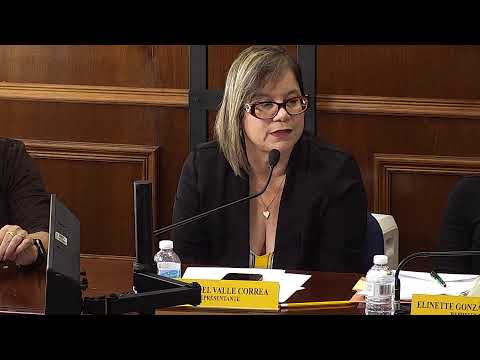
The bill, introduced by Rep. Wanda del Valle, would amend Article 11 of Plan de Reorganización Núm. 1 de 28 de julio de 1995 to require such spaces at the department’s centers islandwide. In a public hearing before the House Committee on Older Adults and Social Welfare, witnesses described the measure’s aims to protect children’s relationships with noncustodial parents while offering supervised, neutral settings for potentially volatile exchanges.
Susan Roy Fuerte, secretary of the Department of the Family, summarized the agency’s view of family services and the proposal’s goals, saying, “La familia es la unidad fundamental de la sociedad,” and describing existing prevention and family-strengthening programs the department already runs. The secretary told the committee the department supports initiatives that strengthen parental bonds but flagged resource and staffing shortfalls needed to implement new, islandwide facilities.
Rep. Wanda del Valle, the bill’s author, cited Renacer Social — a nonprofit visitor-center model based in Cayey — as the concept the bill seeks to reproduce across other regions. “Renacer Social es el ejemplo vivo de lo que es ... un lugar de encuentro familiar,” she said, arguing the model reduces the trauma children may experience when visits are tied to court or police settings.
Officials from the Administration of the Courts, represented at the hearing by Lic. Evangelina Valentín Ferrer on behalf of the director administrative of the courts, urged the committee to clarify in the bill who may access the centers and whether participation would be voluntary or require a court order. The courts’ written comments noted the judicial branch generally refrains from policy judgments but recommended the statute define eligibility, scope of services and whether professional staff would actively supervise visits or primarily provide space and coordination.
Witnesses described several practical issues the committee must resolve before moving forward: where funding would come from, how many trained social workers and specialized staff would be required, whether the courts or Department of Justice should hold operational responsibility in some cases, and how to ensure services reach municipalities beyond the San Juan–Bayamón area.
Secretary Roy Fuerte told lawmakers the department lacks an existing, islandwide network of dedicated meeting-point facilities. She said the department operates similar, but limited, efforts and runs a project called Encuentro (established 1998) that provides supervised visits in a set of municipalities — Bayamón, Cataño, Corozal, Dorado, Guaynabo, Naranjito, San Juan, Toa Alta, Toa Baja, Vega Alta and Vega Baja — and that federal Access and Visitation mandatory grant funds have subsidized parts of that service. Those funds, she said, are limited and services have been concentrated in the metro area.
Multiple legislators asked the department to supply additional information. The committee directed department staff to provide, within 10 days, a fiscal-impact estimate for implementing points of encounter, a list of existing centers and their operating hours, staffing counts (especially social workers), and statistics on populations served. The committee also requested copies of the courts’ “uniform guides” and any protocols that govern referrals and supervised-visit procedures.
Committee members raised safety and design questions for cases involving domestic violence. Lawmakers and witnesses agreed that any program must protect victims and children, incorporate protocols to avoid retraumatization, and include mechanisms for accountability, reinstruction or therapeutic intervention for persons found to be aggressive. Court representatives emphasized that family-unit evaluations and recommendations typically arise from the judicial social unit and that referral practices and parameters vary by region.
No formal vote on the bill took place during the hearing. Lawmakers said they will reconvene with additional testimony from the Department of Justice and further documentation from the Department of the Family and the courts before advancing the measure.
The hearing concluded after committee members thanked witnesses and restated the 10-day deadline for the requested fiscal and operational information.