Get Full Government Meeting Transcripts, Videos, & Alerts Forever!
Get email alerts on the Broadband Franchising topic
No spam. Unsubscribe anytime.
Cities and local governments urge 'Equal Access to Broadband' franchising bill; industry warns of costs and federal conflicts
Summary
Senate File 2045 would modernize franchise rules to include broadband and preserve public benefits such as local public‑educational‑governmental channels; cities supported the bill, cable and broadband providers raised legal, fiscal and deployment concerns; bill was laid over for further consideration.
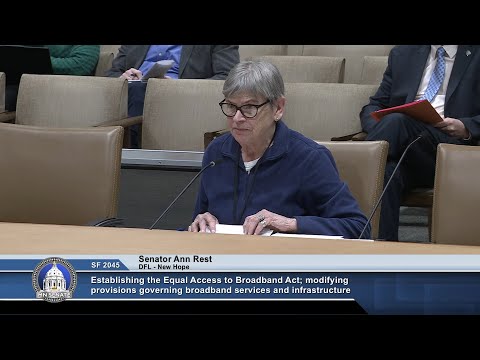
Sen. Rest introduced Senate File 2045, the "Equal Access to Broadband Act," to modernize Minnesota’s franchising laws so local units could require terms of broadband providers similar to cable franchising, preserve public benefits such as local public‑educational‑governmental (PEG) programming, and recover management costs associated with rights‑of‑way.
City officials and local government representatives urged the committee to adopt franchising because they view public rights‑of‑way as a valuable public resource and said franchising would help ensure uniform deployment and preserve local media such as CCX Media. Dave Callister, city manager of Plymouth, said that without franchising there is no guarantee of equitable buildout or consistent quality across neighborhoods.
Supporters said franchising is a tested model that can protect consumers and public benefits while new state and federal broadband grants are deployed. Opponents, including Melissa Wolf (Minnesota Cable Communications Association) and Brent Christensen (Minnesota Telecom Alliance), said the bill would raise consumers' bills through a new local broadband tax (described by industry witnesses as an 8% local tax in testimony) and could conflict with federal law and FCC rules that limit duplicative franchise fees and local regulation of broadband services. Industry witnesses argued the bill could slow deployment and make service less affordable.
Sen. Rest said the bill is intended to refresh franchising law, allow continued local public benefits and coordinate with current state broadband deployment programs. Committee members heard legal and fiscal concerns and the bill was laid over for possible inclusion.
Ending: The committee did not adopt the bill and laid Senate File 2045 over pending further work; proponents emphasized local protections and public benefits while industry warned of legal preemption, cost increases and deployment delays.