Get Full Government Meeting Transcripts, Videos, & Alerts Forever!
Get email alerts on the Dwi Policy topic
No spam. Unsubscribe anytime.
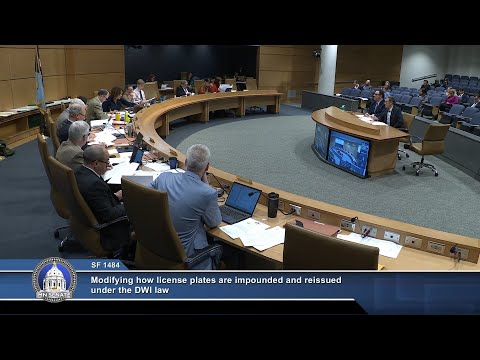
Senate committee considers multiple DWI measures: plate impoundment changes, interlock timelines and expanded eligibility
Summary
The committee reviewed several related DWI bills: a proposal to use tamper-evident stickers rather than removing plates at the roadside, changes to temporary permit durations, a bill to restore or clarify judicial review of ignition-interlock extensions, and a larger reform package to expand interlock look-back and eligibility.
The Senate Judiciary and Public Safety Committee considered a package of DWI-related bills covering license-plate impoundment procedures, temporary permits, ignition-interlock program duration and eligibility, and appellate review of administrative interlock extensions.
Senate File 1484 (Sen. John Lats) would permit law enforcement to place a tamper-evident permanent sticker over license plates subject to impoundment rather than removing and destroying plates on-scene; it also proposed extending temporary permits for vehicles from seven to 14 days in many cases and a 45-day allowance for certain results tied to chemical tests. Defence attorney Charles Siegel, representing criminal-defense organizations and serving on the DWI task force, supported the sticker option and explained practical difficulties that can arise during the current seven-day permit period for people who must install ignition-interlock devices.
Committee members and witnesses debated durability of stickers in winter and the practicalities of installation. Transportation officials present later in the hearing noted broader issues with adhesive-backed tabs and plate durability on some issued plates.
During committee discussion, Senator Watts moved to delete the new 45-day language tied to chemical tests; the amendment to remove that portion was adopted on voice vote. After edits, Senate File 1484 was laid over for possible inclusion.
Senate File 2363 addressed whether drivers may seek judicial review of administrative decisions extending ignition-interlock requirements after reported program violations. Defense attorneys said the Court of Appeals decision in Reece had created a gap by narrowly interpreting judicial review statutes, leaving some drivers without a judicial remedy for contested interlock extensions. The bill aims to ensure judicial review remains available for challenges to interlock extensions. The committee laid the bill over.
Senate File 2068, a larger DWI reform package that incorporated elements of the earlier bills, was presented by Sen. Lats in response to a high-profile crash in Saint Louis Park. The bill would (among other measures) expand the ignition-interlock look-back period from 10 years to 20 years for certain repeat offenders, lengthen required interlock durations for repeat offenders, add criminal-vehicular-homicide convictions to interlock-eligibility pathways, and remove an upfront reinstatement fee barrier for defendants entering interlock. Mayor Nadia Mohammed and Saint Louis Park Police Chief Brian Crowley and Methodist Hospital President Jennifer Meister testified in support, citing recent local fatalities and injuries from impaired-driving incidents.
Defense groups and criminal-defense advocates said longer mandatory interlock periods could create financial barriers that deter program participation for lower-income offenders and urged caution; they supported adding eligibility for interlock to certain criminal vehicular homicide convictions so people would have a legal option to drive with interlock rather than drive illegally.
Senate File 2068, as amended, was recommended to pass and be referred to the Senate Transportation Committee on a voice vote.