
Niskayuna finance committee advances $116.12 million budget proposal with $2.46 million in new investments, 2.29% tax levy
Get AI-powered insights, summaries, and transcripts
Sign Up Free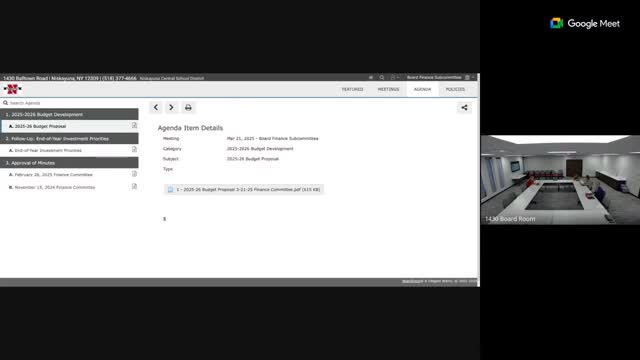
Summary
Niskayuna Central School District finance staff on March 21 presented a recommended 2025–26 budget that would total roughly $116.12 million and include about $2.46 million in new recurring investments and 20.8 full‑time equivalent positions, with a proposed tax levy of about $66.28 million, a 2.29% increase that remains below the district's calculated tax levy cap of 3.58%.
Niskayuna Central School District finance staff on March 21 presented a recommended 2025–26 budget that would total roughly $116.12 million and include about $2.46 million in new recurring investments and 20.8 full‑time equivalent positions, with a proposed tax levy of about $66.28 million, a 2.29% increase that remains below the district's calculated tax levy cap of 3.58%.
The proposal, summarized to the finance committee ahead of the full board's March 25 meeting, draws on projected increases in state aid (including building aid and changes to the foundation aid formula) and identifies district savings and reallocations to support new spending while holding appropriated fund balance steady at 2.58%.
Matt (staff member) said the recommended additions total about $2.46 million and 20.8 positions and reflect priorities identified in community engagement and the district's budget process. "We were able to identify some existing capacity and outline $1,200,000 in new investment," he said, describing a line‑by‑line review led by staff that freed resources to fund several new positions and programs.
Key recurring investments and staffing proposed for 2025–26 include: - Special education: two additional self‑contained elementary special education classrooms (one to serve students aging into the program at Van Antwerp), supplemental co‑teach/resource room staffing at the high school, and increased occupational and physical therapy staffing tied to student Individualized Education Program needs. The presentation also proposed contracting related services currently provided at St. Kateri so the district can better recoup staff time and reduce travel. - Social, emotional and academic supports: an elementary‑level social worker or counselor to serve added self‑contained classes; K–5 Summer Learning Academy funding (about $41,000); one reading specialist for secondary grades covered through existing department staffing; and one additional counselor at Iroquois Middle School to provide three full‑time counselors there as enrollment in grades 7–8 grows. - Curriculum and instructional support: a new director of science and technology, an initial phase‑in of an elementary ELA curriculum (professional development and digital/text resources), and teachers on special assignment (one per elementary school) to bolster building leadership and family support. - School safety and security: budgeted funding to restore a school resource officer program (estimated contract and startup costs of about $115,000), conversion of two part‑time supervising clerical assistant (SCA) roles into full‑time security monitors at the high school, a full‑time security monitor at each elementary, funding for monitor training and credentialing, and a part‑time contracted security director/coordinator estimated at $60,000 to coordinate monitors, training and implementation of Alteris recommendations. - Operations and communications: an additional grounds/maintenance worker, two extra days of communications coverage through the district's BOCES contract (bringing core communications service to six days), and a coordinator for professional learning who would also help relaunch community and adult education programming. - Transportation and technology: recurring costs to equip buses with tablets providing turn‑by‑turn directions and parent "geo alert" notifications, plus licensing and initial hardware costs; the district said the bus upgrades could be piloted and phased in.
District staff emphasized that the safety and security items are part of a layered approach; the school resource officer would be one component alongside internal monitors and a coordinator. Staff also said some investments remain contingent on the final state budget and on contract terms with outside partners.
The finance packet presented a budget summary showing instruction accounting for roughly 52.7% of the total and noting state aid increases of about $3.5 million that largely enabled the recommended new investments. Charges for services were expected to rise in part because the district plans to expand in‑district special education programs and accept contracts from neighboring districts.
Committee members asked staff to clarify revenue sources for the public presentation. One board member requested a clear breakout between federal and state revenue for the full board meeting so residents can see what portion of the district's funding is federal. Staff agreed to add that breakdown.
The committee also reviewed proposed year‑end (one‑time) investments to use positive fiscal performance for items not included in the operating budget, including door hardware and alarms recommended by the Alteris safety review, paving and striping, high school robotics upgrades, pool starting blocks, scoreboard and turf work, replacement of aging signage, IT server and phone replacements, art lab furniture, athletic equipment, a curtain divider for a gym, and other targeted facilities and instructional items. Staff said some projects are already out for bids and staff expect recommendations to the board in April for certain contracts.
Formal committee business at the close of the meeting included approval of minutes. A motion to approve the Feb. 28 minutes passed 3–0; a separate motion to approve Nov. 15 minutes also passed 3–0.
The finance committee presentation will go to the full Niskayuna Board of Education on March 25 for further review and any adjustments before final adoption. Staff noted they will continue to monitor state budget developments and return with additional detail on revenues and implementation plans as needed.