Get Full Government Meeting Transcripts, Videos, & Alerts Forever!
Get email alerts on the Wireless Facilities topic
No spam. Unsubscribe anytime.
Planning Commission approves faux-tree cell site at Palace of Fine Arts over one dissent
Summary
The San Francisco Planning Commission voted 6–1 to allow AT&T to place wireless antennas inside a faux eucalyptus at the Palace of Fine Arts parking lot, after staff and the project sponsor described technical and aesthetic trade-offs and responded to neighborhood notification concerns.
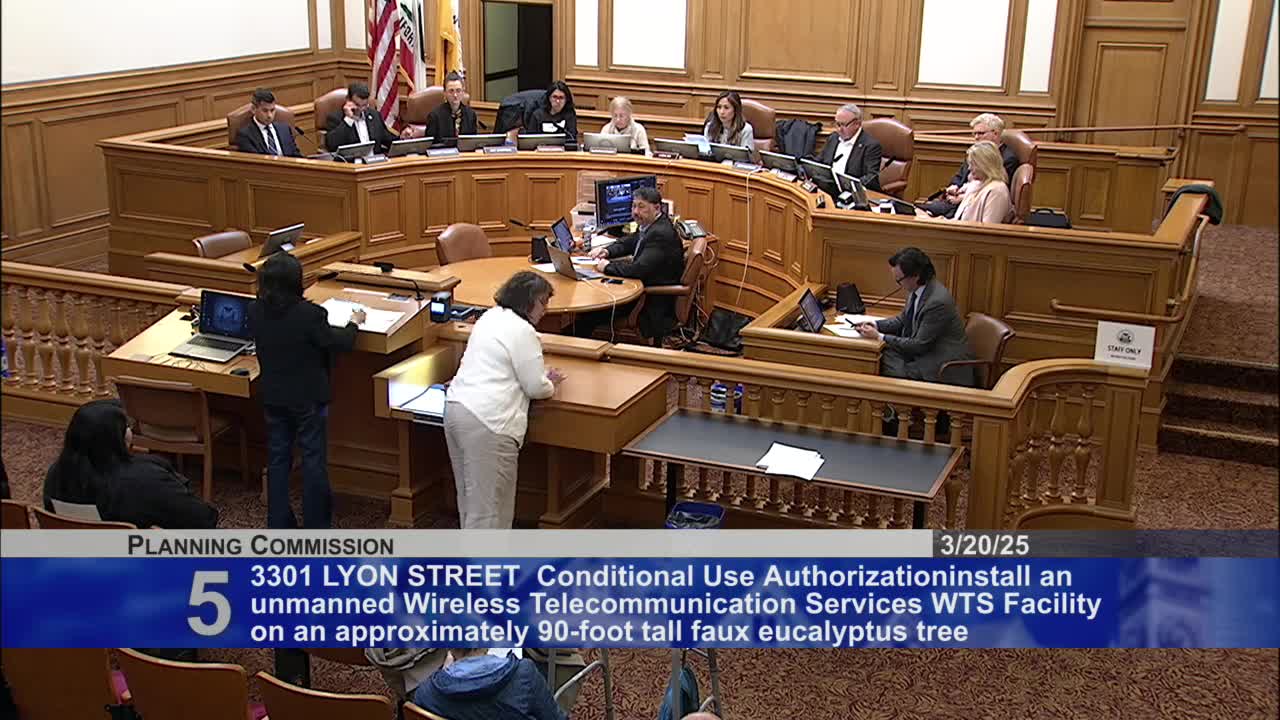
The San Francisco Planning Commission on March 20 approved a conditional use authorization for new wireless facilities at the Palace of Fine Arts (3301 Lyon Street), allowing AT&T to install antennas disguised as a faux eucalyptus tree in the parking lot.
Planning staff described the location as the city and county-owned Palace of Fine Arts site, with Recreation and Parks as the landowner. Mary Woods, planning department staff, said Rec and Park and other city agencies reviewed numerous options and that staff worked with AT&T to identify a “creative solution” in a fake tree to meet coverage and landmark preservation concerns. "The Palace of Fine Arts building is a designated city landmark," Woods said.
Why it matters: Staff and the sponsor argued the facility is intended to improve public and first-responder coverage in an area with known dead zones and high rates of vehicle break-ins. Commissioners weighing visual and community-notification concerns ultimately approved the project with conditions intended to address design, monitoring and outreach.
What commissioners heard: AT&T representatives said they needed a ground-mounted monopole-type solution to cover the immediate area and that a faux eucalyptus offered a better visual fit than a narrow pine-style artificial tree. The project engineer explained that eucalyptus-style faux trees have multiple branches and can conceal antennas at moderate heights more effectively than a singular-pole pine, and cited examples in other Bay Area locations. Mary Woods told commissioners the planning department and Rec and Park had granted a certificate of appropriateness for the design and that public-health and other reviews had been completed.
Several commissioners pressed staff and the sponsor for clearer visuals and for assurances about long-term screening. Vice President Moore said of the visual simulations, “I share the concern ... that those older trees may at some point veil, and what do we do then?” Staff responded that the packet contained photo simulations and that the proposed faux eucalyptus would match the approximate height of surrounding trees; in staff’s description, "The existing trees are about 80 to 90 feet. So I think the actual proposed fake tree is about 80 feet with 10 feet of canopy..."
Community outreach and response: Commissioner Williams pulled the item from consent to raise a Marina Community Association letter that said it had not been notified of pre-application outreach. Staff said a larger notification radius is required for wireless CUAs and verified that mailings and additional notifications had been sent; staff said they would provide outreach documentation to the association. No speakers from the Marina Community Association appeared to testify at the hearing.
Vote and procedural result: On a recorded roll-call vote, the commission approved the conditional use authorization 6–1, with Commissioner Williams voting no. The approval places the item’s conditions and design requirements into the project record; staff and the sponsor said they would continue follow-up coordination with Rec and Park on lease negotiations and final design details.
Next steps: The project sponsor and Rec and Park will finalize lease terms and the sponsor must comply with the planning conditions and any technical monitoring or public-safety requirements identified in the approvals. The sponsor indicated additional visual studies and RF (radio frequency) documentation are available upon request.