Get Full Government Meeting Transcripts, Videos, & Alerts Forever!
Get email alerts on the School Capital Contingency topic
No spam. Unsubscribe anytime.
Commissioners cut school capital contingency top-up to $50,000 after questions about change orders
Summary
After extended debate about how change orders have been handled on school construction projects, the Blount County Commission amended and approved a $50,000 replenishment to the school capital contingency fund (Resolution 253006).
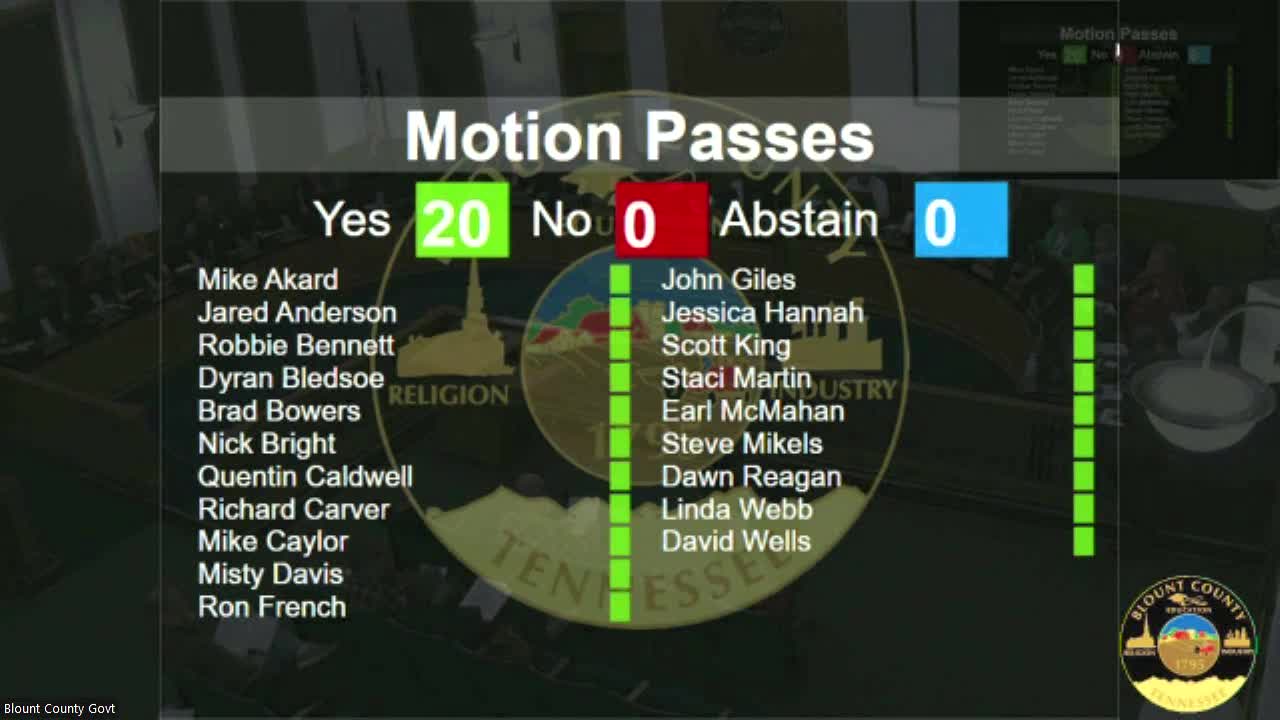
Blount County commissioners approved a reduced replenishment to a school capital contingency fund on March 20, 2025, voting 20-0 to adopt Resolution 253006 as amended. The commission initially considered restoring the contingency fund to $300,000, then to $100,000; an amendment from Commissioner Wells lowered the amount to $50,000 and passed 14-6 before final adoption.
The matter prompted extended discussion about how the county has used contingency funds for change orders on school construction projects and what documentation purchasing and project staff provide commissioners. Commissioner Akhart, who said the contingency fund was created in the education committee, described the fund’s original purpose: “This fund was my brainchild. We created it in the education committee ... so we would have the ability to pay without padding that fund for them to know how much more money they could get.”
County staff provided itemized reasons for recent change orders. A staff speaker identified several large change-order drivers including a fire marshal request for a fire lane extension ($66,000), unforeseen site conditions requiring relocation of water and fire lines, electrical rework tied to furniture purchases, and aesthetic modifications to a facility’s front portico. A county staff member said purchasing now signs off on every change order and described the department’s new change-order form and review process.
Commissioners expressed two recurring concerns: whether some change orders reflected contractor errors that should be paid by the contractor rather than the county, and whether use of the contingency fund had been sufficiently transparent. Commissioners said they want documentation identifying each change order, the vendor, the project, and the reason the contingency money was spent before approving replenishments in future.
The vote sequence recorded in the meeting minutes and on the record: a motion to adopt Resolution 253006 as amended from $300,000 to $100,000 was made by Commissioner Acard and seconded by Commissioner Michaels. Commissioner Wells moved to amend the $100,000 figure to $50,000; Commissioner King seconded that amendment. The amendment passed 14 yes, 6 no. The final adoption vote on Resolution 253006 as amended was 20 yes, 0 no.
Commissioners and staff said the county’s process now requires change orders to be documented, signed by the architect/engineer and contractor, reviewed by purchasing and inspected before approval. Purchasing staff said the county had saved money on at least one item by value-engineering a ceiling selection and that change orders remain inevitable on renovations where unknown conditions exist. Commissioners asked that future disbursements from the contingency fund include vendor names, project identifiers, descriptions of the change, and the justification for using contingency funds so the full commission can review whether the vendor honored contractual obligations.
The resolution’s approval will allow the county to address outstanding change orders through the end of the fiscal year under the smaller $50,000 replenishment; commissioners directed staff to provide the requested documentation on spent change orders in future reports.