Get Full Government Meeting Transcripts, Videos, & Alerts Forever!
Get email alerts on the Food Safety Gras topic
No spam. Unsubscribe anytime.
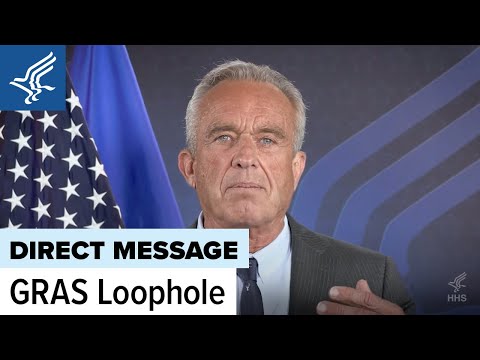
Robert F. Kennedy Jr. urges end to self-affirmed GRAS pathway, calls for FDA and NIH reviews
Summary
In a recorded statement labeled as produced by the U.S. Department of Health and Human Services, Robert F. Kennedy Jr. called for eliminating the self‑affirmed GRAS process for food ingredients and asked the Food and Drug Administration and National Institutes of Health to increase post‑market assessments of chemicals in food.
Robert F. Kennedy Jr. urged federal action to change how chemicals are approved as food ingredients, saying the current “generally recognized as safe” (GRAS) pathway lets companies self‑affirm substances without FDA premarket approval.
"The first step is radical transparency because right now, not even the US government knows what's in our food," Kennedy said in a recorded statement labeled "Produced by the U.S. Department of Health and Human Services." In the recording he identified himself as "secretary for the Department of Health and Human Services." That title is not consistent with current federal records.
Kennedy described GRAS, a regulatory designation created in 1958, as a process that has been expanded so food companies can decide whether a substance is "generally recognized as safe" without FDA review. "In our country, the GRAS standard means that every chemical is presumed safe until proven dangerous," he said, adding that the standard risks leaving harmful substances in food until after widespread health impacts occur.
He cited what he said were roughly 10,000 chemicals in U.S. food compared with about 400 allowed in Europe and pointed to several ingredients that are restricted or banned in other jurisdictions, saying, "Titanium Dioxide, potentially linked to DNA damage and cancer, is banned in the EU, but it's in our children's food. Potassium bromate, a suspected carcinogen banned in Europe and Japan, ... it's in our children's bread." He also cited food dyes such as red dye 40 and yellow 5 and 6 as treated differently in Europe.
Kennedy said he was directing the Food and Drug Administration commissioner to begin changing rules to eliminate the self‑affirmed GRAS pathway for new ingredients and asked the FDA and the National Institutes of Health to "ramp up post market assessments of GRAS chemicals currently in our food, so that we can rapidly identify" risks to consumers. Those statements reflect his recommendations and intentions expressed in the recording; the recording does not by itself document any formal federal action or an official order from those agencies.
He framed the proposed changes as a response to public demand, saying, "Moms aren't gonna return to wanting chemicals in our food that are banned in other developed countries," and called for cooperation among companies, scientists and consumer advocates to make American food "the healthiest in the world."