Get Full Government Meeting Transcripts, Videos, & Alerts Forever!
Get email alerts on the Zoo Funding topic
No spam. Unsubscribe anytime.
Minnesota Zoo asks Legislature for $3.5 million per year to reach 50/50 public‑private funding
Summary
Minnesota Zoo officials and Representative Nolan Bierman asked the House Environment Finance and Policy Committee to lay over House File 2034, requesting $3.5 million per year in state support for fiscal 2026–27 to move toward a sustainable 50/50 public‑private funding model.
Representative Nolan Bierman introduced House File 2034 and asked the committee to lay the bill over for possible inclusion in a future omnibus bill. He said the zoo’s request is for $3,500,000 per year to move the Minnesota Zoo toward a “fifty‑fifty public‑private partnership.”
John Frawley, director of the Minnesota Zoo, and Abigail Mosher, chief operating officer, described the zoo as a 500‑acre state agency operating like “a small city,” open year‑round and reaching more than 1.5 million visitors annually. Mosher said the zoo currently receives about 37 percent of its funding from the state and must earn the remaining 63 percent. “We are the fifth largest zoo in the country,” she said, noting the campus is roughly 500 acres and many structures are about 50 years old.
Mosher and Frawley told the committee the governor’s budget recommendation — about $1,038,000 for the biennium — is far short of what the zoo says is needed to maintain current services. Frawley said the recommended level would force the zoo to consider staffing reductions, higher admission and program fees, reduced hours and cuts to access programs that serve low‑income Minnesotans. “The proposed fundings fall short of covering our existing institutional expenses,” Mosher said.
Testimony described a mix of operating pressures: rising workforce costs, aging infrastructure and expanding regulatory requirements. Frawley said the zoo logged more than 3,000 work orders last year and cited compliance obligations from USDA, OSHA, U.S. Fish and Wildlife Service, FDA and EPA. Representative Schultz asked whether the zoo’s recent treetop trail contributed to higher attendance; Frawley said it has been a significant draw.
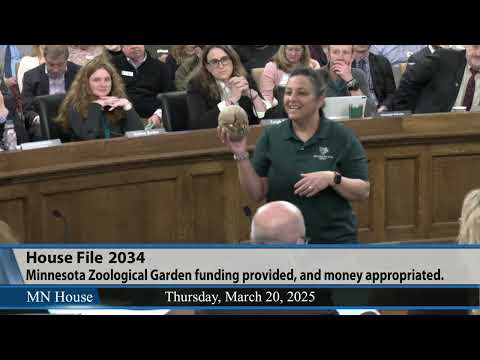
Supporters who testified included Jeanette Dean of the Sierra Club’s North Star Chapter, citing the zoo’s role in conservation and education; and zoo staff who brought ambassador animals to the committee hearing and described outreach programming to schools, hospitals and communities across all 87 counties.
Representative Bierman closed by renewing his motion to lay House File 2034 over for possible inclusion; the chair announced the motion prevailed by voice vote and the bill was laid over. The committee did not adopt specific funding in the hearing and gave no final substantive action beyond laying the bill over.
Ending: The committee took no final funding action on House File 2034; the measure was laid over for possible inclusion in a future omnibus bill and may return for additional hearings or fiscal work later in the session.