Get Full Government Meeting Transcripts, Videos, & Alerts Forever!
Get email alerts on the Area Plan On Aging topic
No spam. Unsubscribe anytime.
Maui County updates 4-year area plan on aging, cites caregiver support, transportation and housing needs
Summary
Maui County Office on Aging told the County Council committee it has completed a community-based 4-year area plan (Oct. 1, 2023–Sept. 30, 2027) identifying caregiver support, social isolation, transportation, housing and workforce capacity as top needs and described funding sources and next steps; the committee deferred formal action.
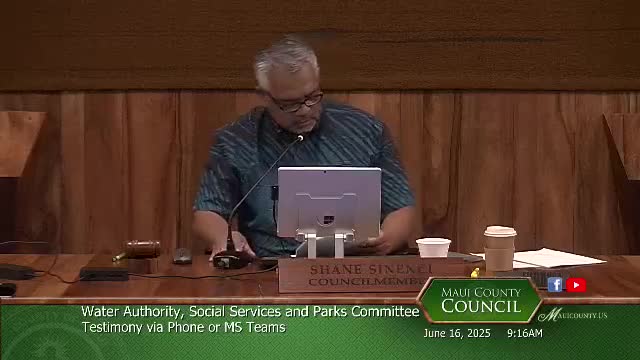
Maui County Office on Aging presented an update on its four‑year Area Plan on Aging during the County Council’s Water Authority, Social Services & Parks Committee meeting on June 16, 2025, outlining the plan’s goals and the county’s approach to funding and service delivery.
The plan, which covers the federal fiscal period Oct. 1, 2023–Sept. 30, 2027, was prepared to align with the State Executive Office on Aging and to support grants and contracts under the Older Americans Act, the county said. Rowena Dagdagandaya, County Executive on Aging, told the committee the plan is intended to guide services for older adults and caregivers and to support contracting with service providers for adult day care, home‑delivered meals and in‑home personal care.
Dagdagandaya said the county’s planning phase included community outreach in 2022 with 470 older adult surveys and 142 caregiver surveys, plus public meetings and stakeholder feedback. The needs assessment identified caregiver support, social isolation, transportation (including inter‑island access), the built environment and accessible senior housing, workforce capacity for in‑home services, nutrition, technology access and fall prevention among the county’s principal priorities.
"We received 470 older adult surveys, 142 caregiver surveys," Dagdagandaya said while reviewing outreach. She told the committee the county is working to grow partnerships with community organizations and to strengthen the Aging and Disability Resource Center (ADRC) to offer centralized information and referral services for people 18 and older with disabilities as well as kupuna.
Why it matters: The plan guides how Maui County applies and spends federal, state and county funds to keep older adults living safely and independently. Committee members repeatedly pressed staff about transportation and workforce limits and asked what the county is doing to reach seniors in rural areas and communities affected by recent wildfires.
Funding and federal advocacy Dagdagandaya provided a breakdown of recurring funding sources used to support services. She said county grants, the State Kupuna Care program and Older Americans Act (Title III) funds together amount to roughly $3,000,000 annually for services, with an approximate split of about $850,000 in state funds, about $890,000 in Title III federal funds and about $1.1 million in county funding. She noted some of those dollars support salaries and administrative costs, reducing the pool for direct services.
The office reported outreach to the congressional delegation earlier in 2025 to describe risks of service disruption if federal funding were cut. Dagdagandaya said area agencies on aging learned the President’s FY26 budget proposed funding Title III programs at FY25 levels nationwide (Title III congregate and home‑delivered meals at about $1.1 billion nationally) and proposed an increase for family caregiver supports. She said federal programs previously discussed for transfer to other agencies will instead be housed under a new Administration for Children, Families and Communities, keeping Title III programs more centralized within the Department of Health and Human Services structure.
Progress, partnerships and next steps The county said it has advanced central access to ADRC services, strengthened partnerships with more than 30 local and state organizations (including the Center for Independent Living), and continued nutrition, caregiver support and home‑repair partnerships (for example, Habitat for Humanity minor retrofits to reduce fall risk). Staff reported monthly outreach to senior and disability groups and plans for an abilities fair and an annual senior fair.
Dagdagandaya said the plan will be monitored quarterly, with continued collaboration with the Council on Aging, MEMA and AARP on emergency preparedness and with the State Executive Office on Aging for funding flexibility and pilots, such as on‑demand transportation options.
Public comment and committee action A resident who identified herself as Ella Makule Haole told the committee she had struggled to secure Meals on Wheels service for an ailing relative, describing difficulties with the intake and telephone processes and with cross‑agency navigation. That testimony was entered during the public comment period for the item.
Chair Shane Senensi closed public testimony and, with no objections, deferred the committee’s decision on the item for later consideration.
Clarifying details: The plan period is Oct. 1, 2023–Sept. 30, 2027. Office on Aging reported approximately 470 older adult surveys and 142 caregiver surveys used in drafting the plan. Reported funding sources include roughly $850,000 (state), $890,000 (federal Title III) and $1.1 million (county) for aging services, totaling near $3 million annually. The plan documents quarterly monitoring and named priorities including emergency preparedness, outreach, accessible housing and transportation.
The committee took no formal vote on the plan during the meeting and deferred the item for future consideration.