Get Full Government Meeting Transcripts, Videos, & Alerts Forever!
Get email alerts on the Community Preparedness topic
No spam. Unsubscribe anytime.
Neighborhood Emergency Response Team seeks volunteers and broader outreach as trainings resume
Summary
San Francisco’s Neighborhood Emergency Response Team (NERT) officials told the Fire Commission that the volunteer program has trained tens of thousands historically but has about 12,000 active volunteers now and wants to expand bilingual, youth and neighborhood outreach.
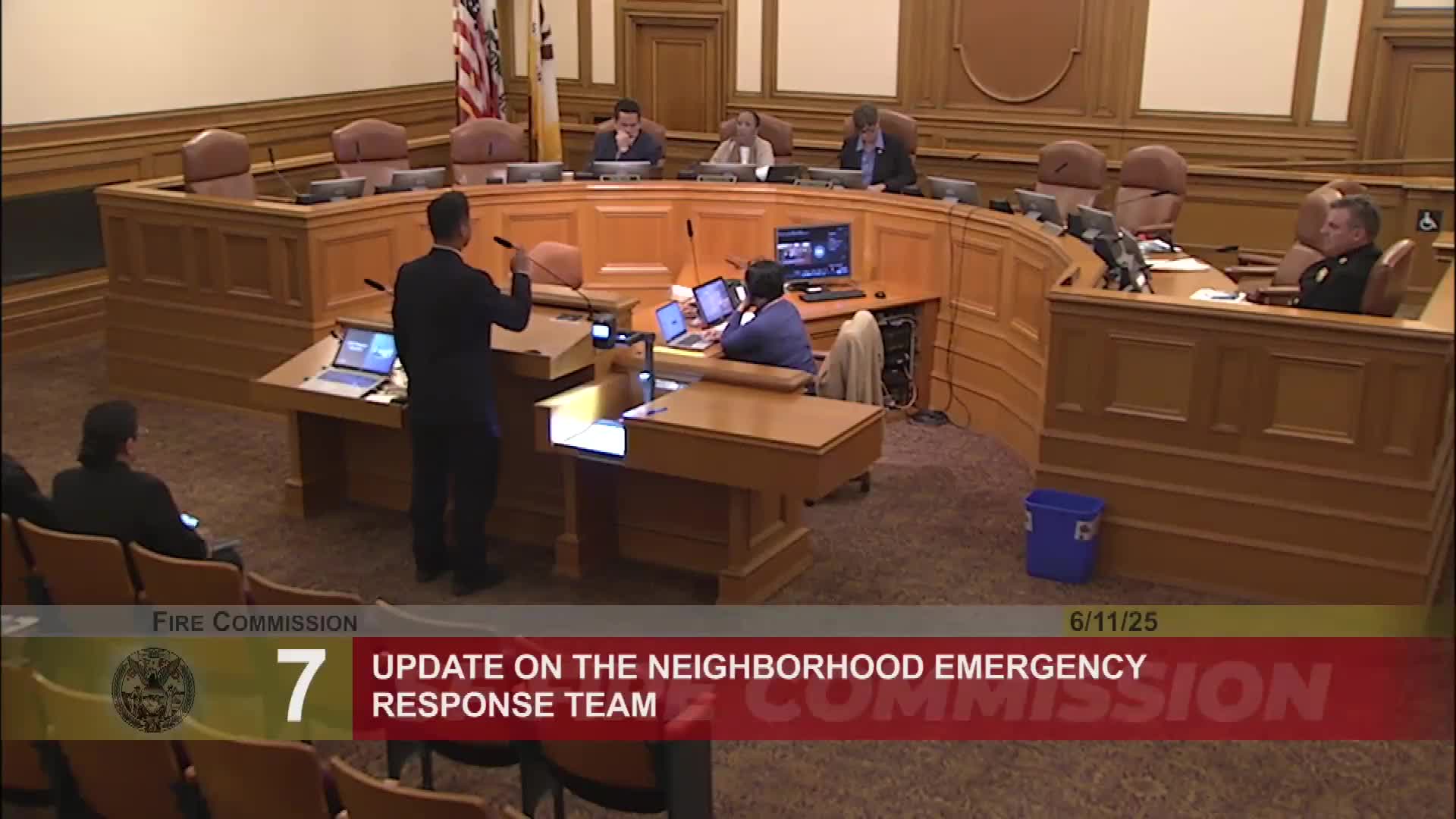
Neighborhood Emergency Response Team (NERT) leaders told the San Francisco Fire Commission on June 11 that the volunteer emergency‑preparedness program is working to expand training and outreach after pandemic disruptions and is seeking more bilingual instructors and neighborhood coordinators.
Brandon Tom, NERT program coordinator, and members of the NERT advisory board described a program that has trained an estimated 40,000 to 45,000 people since 1990 but that the active volunteer base is closer to 12,000. Tom said research suggests about five percent of a jurisdiction’s population trained — roughly 90,000 people for San Francisco — is a good target for community resilience.
“Our mission as NERT volunteers is to do the most good for the most people,” advisory board chair Gary Pegueros said during the presentation. He and other volunteers described free training offerings — a six‑class basic course, ninety‑minute preparedness workshops, Spanish‑language training (Listos), and a map‑your‑block workshop — and the program’s role during past emergencies such as COVID‑19 testing and vaccination sites and 2017 heat‑event cooling stations.
NERT volunteers also said they ran extensive tabling and public outreach, twice‑yearly citywide drills (in April and October), monthly skills days at the Division of Training, and neighborhood coordination (about 51 coordinators citywide). Tom said recruiting and scheduling are constrained by having a single paid NERT program coordinator and that the program is seeking partnerships with community groups, senior programs and institutions such as the YMCA, San Francisco State University and neighborhood organizations to expand reach.
Commissioners asked about bilingual outreach, recruiting younger volunteers and tapping retired firefighters as instructors. Tom said NERT has run Spanish‑language classes and events in Mission and other areas, has piloted training at the Mission YMCA and San Francisco State, and is reviving programs to work with medical volunteer rosters and a Disaster Corps model for mutual aid across the state.
Advisory board members said volunteers contributed roughly 7,600 hours during the pandemic that yielded FEMA cost‑share reimbursements of about $120,000 to the city for pandemic activities. They asked for continued department sponsorship and municipal support so the program can expand training capacity and resume paused programs such as the medical reserve corps.