Get Full Government Meeting Transcripts, Videos, & Alerts Forever!
Get email alerts on the Emergency Medical Services topic
No spam. Unsubscribe anytime.
SFFD reports sharp rise in call volume and outlines training, EOC and EMS developments
Summary
San Francisco Fire Department officials told commissioners that dispatches have risen sharply, ambulance off‑load times improved slightly but delays persist, the department is preparing a new training center and FDOC, and EMS teams reported procedural advances including cardioversion cases and community paramedicine outcomes.
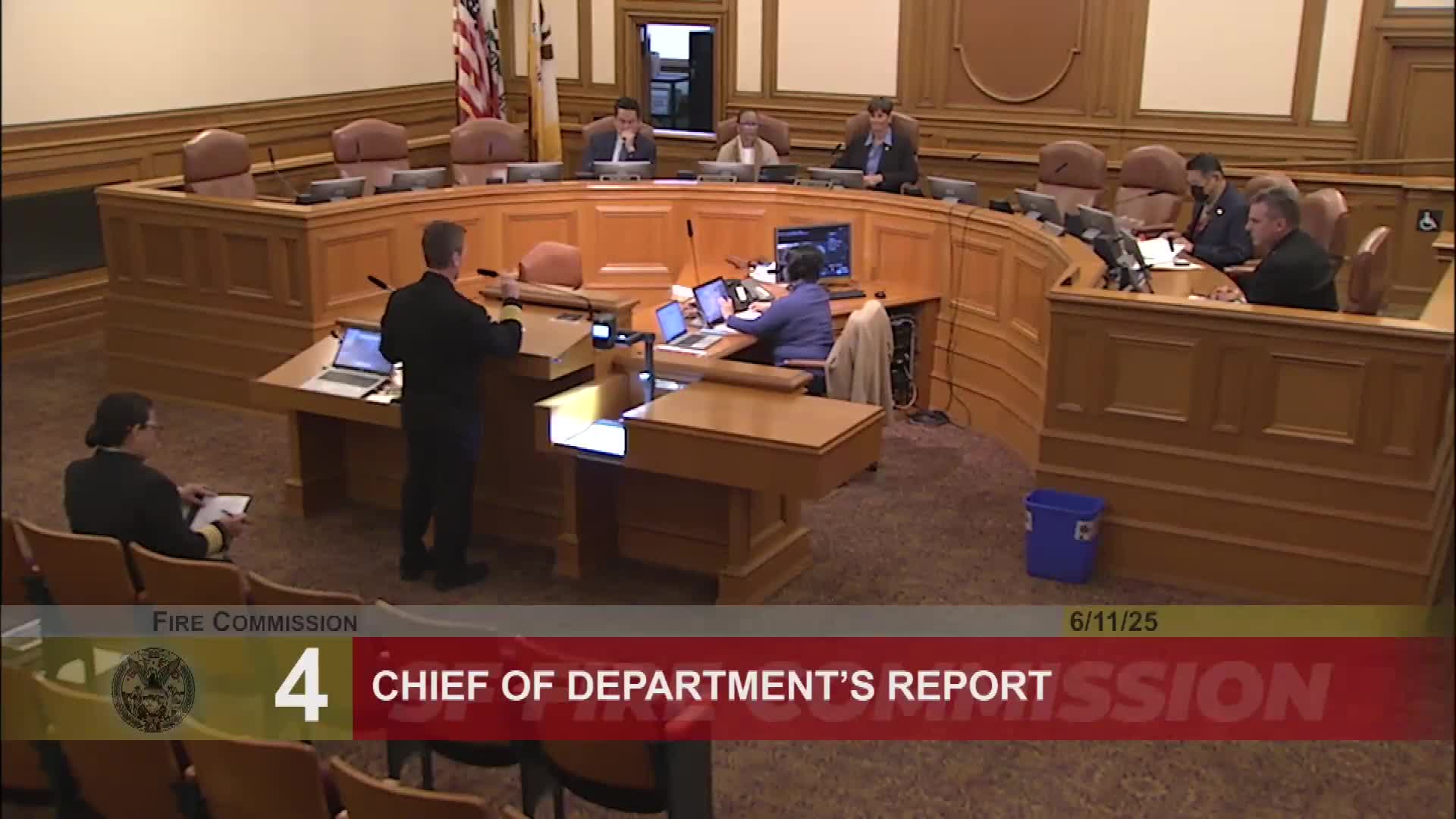
San Francisco Fire Department leaders reported to the Fire Commission June 11 that total dispatches have increased substantially over recent years, ambulance off‑load delays persist despite improvements, and the department is moving ahead on training‑center plans that will include a departmental operations center.
Deputy Chief Patrick Rabbit told commissioners the department logged 5,449 more calls year‑to‑date from May 31, 2023, to May 31, 2025, and that May saw an increase in working fires to 31 for the month and 428 outside fires. Rabbit outlined the department’s staffing of task forces and its coordination with the city Emergency Operations Center (EOC) for planned protests, saying the department has stood up task forces led by battalion chiefs to cover Union Square, Civic Center and the Mission.
“Together with our EOC rep and dispatch chief at DEM, we determine an event box and have our task force leader triage calls with police and respond accordingly within the incident,” Rabbit said.
Deputy Chief of EMS Simon Pang said ambulance dispatches for the city in May totaled 11,853, of which the Fire Department ran 8,540. Pang reported daily averages of about 14 code‑3 (emergency) transports and said that ambulance patient off‑load times have decreased for the second month in a row but that prolonged waits remain: in May there were 660 instances where an ambulance waited beyond the statewide 30‑minute benchmark and 14 instances that exceeded two additional hours.
Pang explained that rescue captains now advocate directly with hospital charge nurses when delays occur and, when criteria are met, can declare an APOD alert to divert ambulances from the affected facility. He noted legal limits on patient destination choices under federal EMTALA rules but said patients who volunteer to go to another hospital may be transported elsewhere if medically safe.
EMS clinical highlights included more frequent use of intraosseous infusions and continuous positive airway pressure, and four cardioversion procedures in May. Pang described one incident in which paramedics administered a synchronized shock that restored a 59‑year‑old person’s rapid heart rhythm and relieved severe chest pain.
Training and preparedness updates included plans for the 130th firefighter recruit academy beginning July 28, renewed marine and helicopter rescue training, and the department’s pursuit of a new training center on Carroll Avenue that will include a fire department operations center (FDOC). The department also reported work to finalize a memorandum of understanding with Brycer, a company the bureau will use to track sprinkler certifications and fire‑safety records.
Commissioners asked about trends in cliff rescues, motor‑vehicle rollovers and electric‑vehicle battery fires; department leaders said cliff rescues are routine in good weather, that rollovers have risen and that fires involving lithium‑ion batteries in electric vehicles present special hazards and can require large water supplies.
Pang also highlighted community paramedicine work: neighborhood street teams and a mobile triage program provided alternatives to emergency department transport, and the department reported 17,000 community paramedicine calls per year. The department recognized multiple EMS staff and volunteers with awards during EMS Week and announced leadership changes, including the promotion of Section Chief Chris Baughn to EMS operations chief.
Officials said the department will include a greater‑alarm after‑action report in the July commission package and continue to brief the commission ahead of upcoming Board of Supervisors budget hearings.