Get Full Government Meeting Transcripts, Videos, & Alerts Forever!
Get email alerts on the Informed Consent Sensitive Exams topic
No spam. Unsubscribe anytime.
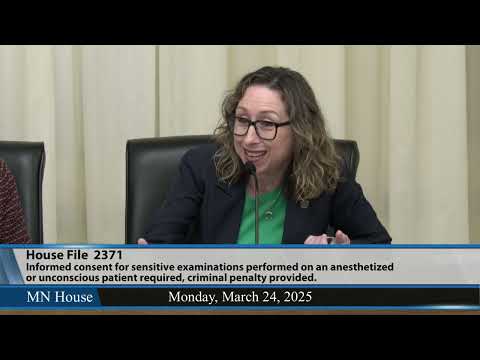
Minn. committee re-refers bill requiring consent for student pelvic, prostate exams under anesthesia
Summary
The committee voted to re-refer House File 2371 to the Public Safety Finance and Policy Committee after hearing sponsors, a RAINN representative, and lawmakers debate requiring explicit patient consent before students perform sensitive exams on anesthetized patients.
Representatives on a Minnesota House committee voted to re-refer House File 2371 to the Public Safety Finance and Policy Committee after hearing testimony and questions about a proposal that would require explicit patient consent before medical students perform pelvic, prostate or rectal exams on anesthetized or otherwise incapacitated patients.
The bill, presented by Representative Robbins and co-presented by Representative Berg, would require that “patients give consent before undergoing anesthetized procedures under which, they could have a pelvic or a prostate exam performed on them by students who are learning how to be physicians,” Representative Robbins told the committee.
Advocates and medical groups cited in the hearing said similar laws exist in other states and that professional organizations support informed-consent practices. Molly Montague, director of state legislative affairs for RAINN (Rape, Abuse & Incest National Network), testified that while the practice is likely uncommon, “these practice exams, unrelated to the procedure that the patient went in for, do happen without the explicit permission of the patient.” She told the committee callers to RAINN’s national sexual assault hotline had raised the issue.
Why it matters: Sponsors and supporters said the measure would make explicit what they described as a best-practice safeguard for patients and would protect survivors of sexual assault from additional trauma after waking from anesthesia. Representative Robbins said the proposal follows statutes in other states and guidance from professional bodies; Montague cited support from the American College of Obstetricians and Gynecologists, the American Medical Association and the Federation of State Medical Boards and said federal HHS issued a memorandum in 2024 encouraging state policies on the issue.
Lawmakers pressed sponsors on drafting and scope. Representative Carroll asked why existing professional obligations for providers would not be sufficient; Representative Robbins said medical students and residents have reported being placed in situations where they were asked to perform exams without confirmed consent and that professional ethics alone had not resolved the problem. Representative Hewitt and Representative Barner raised whether the bill’s scope should extend beyond exams performed under anesthesia to address broader informed-consent gaps in outpatient care.
Chair Liebling warned that the bill, as drafted, could unintentionally criminalize appropriate clinical care if exceptions for clinically necessary exams are too narrow. Liebling pointed to language in the bill that ties an exception to exams that are “necessary for preventive, diagnostic, or treatment purposes” and urged clearer drafting so clinicians are not dissuaded from providing medically necessary care. Representative Robbins and Representative Berg said they would work with Liebling and others on technical changes before the bill proceeds.
The committee recorded a voice re-referral. The chair renewed his motion that HF2371 be re-referred to Public Safety Finance and Policy; members responded "aye," and the motion carried by voice vote. The committee did not record a roll-call tally in the hearing transcript.
The sponsors said they plan to revise language to clarify clinically necessary exceptions and to consider the level of penalty; the bill as discussed includes a gross-misdemeanor penalty in current draft language but sponsors indicated willingness to refine penalties and definitions in subsequent committee stops.