Get Full Government Meeting Transcripts, Videos, & Alerts Forever!
Get email alerts on the Comprehensive Plan topic
No spam. Unsubscribe anytime.
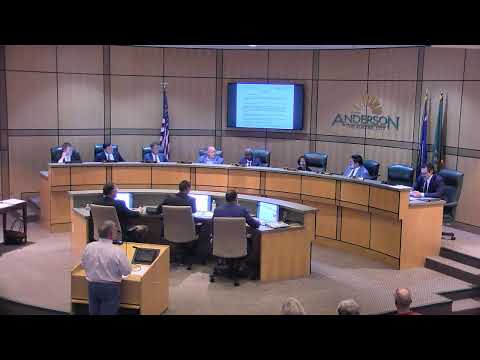
Anderson City council approves first reading of new 20-year comprehensive plan
Summary
Anderson City Council voted unanimously to approve the first reading of a new comprehensive plan that will guide land use, transportation, housing and resiliency for the next 20 years; councilors and staff said the plan is a framework and implementation will require updates to regulatory documents and future public hearings.
Anderson City Council on first reading approved a new comprehensive plan intended to guide the city’s land-use, housing, transportation and resiliency choices over the next 20 years.
The document, which city staff and consultants developed over about two-and-a-half years and posted for public review for several months, was presented to council by Maurice McKenzie, the city’s planning and development director. McKenzie said the plan includes the 10 components required under South Carolina law and that the planning commission has already passed a recommending resolution after a public hearing on Feb. 20.
Councilmembers and staff framed the plan as a policy framework rather than a zoning map. “This document does not state that the property is being annexed into this zoning classification or has been annexed,” McKenzie said, describing the plan as “a guidebook for the future.” Several councilmembers emphasized that individual parcels would still require separate annexation and rezoning applications, public hearings at the planning commission and two readings by council before any regulatory change takes effect.
A public commenter, Michael Gardner, representing the Friends of the Electric City Trail, told the council he had provided feedback and that some trail map items in earlier drafts were inaccurate. Gardner said, for example, “the Whitner Creek Greenway isn’t complete or will not be completed by the end of 2025 to connect all the way to the Westside Community Center” and that some trail-extension statuses shown in a January publication were incorrect. McKenzie and staff said corrections were made after the planning commission hearing but that they would double-check the specific map items Gardner raised.
Councilmembers also discussed how the comprehensive plan will be implemented. Staff said the next major step is rewriting regulatory documents: the zoning ordinance, subdivision regulations and other land-use rules will be consolidated into a unified development ordinance (UDO) designed to align with the new plan. McKenzie said the consulting team is already drafting that language and staff hopes to have the UDO ready “by the end of the year, first part of next year.”
Council discussion repeatedly stressed that the plan is intended to provide a consistent, citywide vision and to avoid “piecemeal” development. Councilmember Stewart asked staff to confirm that annexation and zoning are initiated by property owners; McKenzie affirmed that property owners must apply for annexation and zoning and that any such application would go through the public process.
Mayor and council approved the comprehensive plan on first reading by voice vote; staff said the document is typically revisited on a multi-year cycle and that adjustments can follow as growth patterns change.
Implementation steps cited by staff include preparation of the UDO, insertion of plan language into site-specific planned development district (PDD) documents when appropriate, and continued public engagement through the planning commission and subsequent council hearings.