Get Full Government Meeting Transcripts, Videos, & Alerts Forever!
Get email alerts on the Student Phones Policy topic
No spam. Unsubscribe anytime.
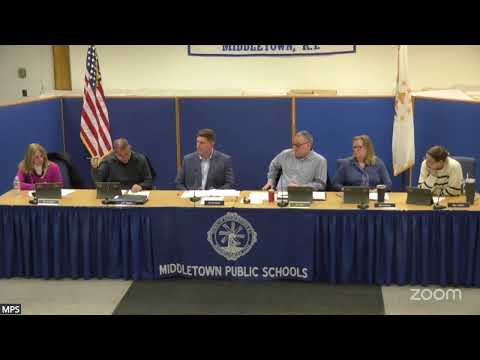
Middletown School Committee approves student cell phone policy; handbooks to be updated at April meeting
Summary
The Middletown School Committee voted 4–1 on March 20, 2025, to adopt a districtwide student cell phone policy with an April implementation date and a requirement that school handbooks be updated and returned to the committee for approval at its April meeting.
The Middletown School Committee voted 4–1 on March 20, 2025, to approve a districtwide student cell phone policy, setting an April implementation date and directing school principals to update student handbooks for committee approval at the committee's April meeting.
The policy, passed after more than two hours of public comment and committee discussion, is intended to restrict student use of personal electronic devices during instructional time. The committee attached a condition to its approval that each school present revised handbooks reflecting the new policy at the April school committee meeting for final review and approval.
Student representative Chloe Tyser presented survey results collected from Middletown High School students, saying the school's initial policy draft averaged about 1.5 stars among respondents. Tyser reported that 77 respondents rated the draft 1 star and 17 rated it 2 stars; roughly 5% of respondents rated it 4 or 5 stars. She said 142 of 176 students provided written comments. "In the end, school is supposed to prepare young people for the real world, and in the real world, there are going to be phones," Tyser said, while urging that phones be "out of sight during class time" but available during lunch, advisory and passing periods.
Barbara von Villas, a former Middletown public school English teacher who submitted a letter read aloud at the meeting, urged stronger restrictions. She referenced public-health messaging and examples from other states, saying, "please do not allow cell phone use in class." Von Villas told the committee she believes limits on phones would improve reading and writing outcomes.
Committee members debated timing and implementation. Several members said implementing the policy after the April school break would not give schools enough time to prepare and recommended a September start, citing communication, training and the need to define site-specific discipline. Tammy Holden and others raised concerns about hiring or assigning staff to monitor compliance immediately, questioning use of funds and the potential for resentment if the change is rushed. One member argued for an April start as a "probationary" period to work out problems in advance of the next school year.
Superintendent Billy (as identified in the meeting) said principals and school staff had been consulted and that the district had modified the proposed policy after student and staff feedback. He said principals will work with teachers and students to tailor handbook language and that the district removed a prescriptive progressive-discipline sequence from the district policy so discipline can be set by individual school handbooks. The superintendent also said the district polled high school teachers; only 19 of an estimated 62 high school teachers responded to that informal poll, a point several committee members cited when urging broader staff engagement.
The final motion approved the policy on second and final reading with the condition that school handbooks be updated and returned to the school committee for approval at the committee's next meeting in April. The committee recorded a 4'to'1 vote on the final motion; a roll-call vote with individual member positions was not read into the record.
What remains: school-level handbooks must be revised to reflect the district policy and come back to the committee for approval at the April meeting. Committee members said communications to families, staff training and clear exceptions will be part of the superintendent and principals' implementation work.
Speakers quoted in this article are recorded in the meeting transcript and include the student representative and public correspondents as noted.