Get Full Government Meeting Transcripts, Videos, & Alerts Forever!
Get email alerts on the Local Governance topic
No spam. Unsubscribe anytime.
Encinitas mayor urges reclaiming local land‑use control, makes homelessness and infrastructure top priorities
Summary
Mayor Bruce Ehlers used the Encinitas Chamber’s State of the City to call for restoring local control over housing decisions, expand homelessness outreach and boost investment in basic infrastructure including pavement and storm drains.
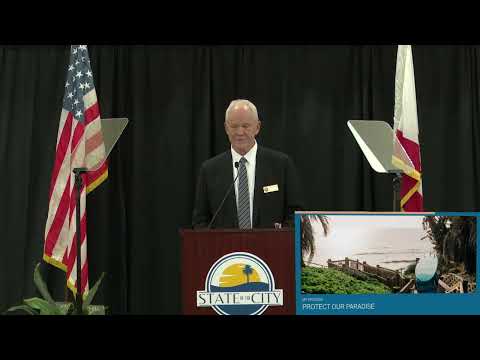
Mayor Bruce Ehlers on Tuesday told the Encinitas Chamber of Commerce that his top priorities for the coming year are regaining local control of land use, addressing homelessness through enforcement and services, and investing in basic infrastructure such as pavement and storm drains.
Ehlers said state housing mandates, including recent changes under S.B. 9, have limited the city’s say over zoning and threatened the character of Encinitas. “It does not include lower income housing requirements,” Ehlers said of S.B. 9, reiterating a point of concern about the law’s lack of affordability mandates.
The mayor framed the issue as one of democratic control and local fit. He said the city will work with regional groups including neighborhood associations and SANDAG to seek changes to the regional housing needs allocation (RHNA) process and that the new council majority will lobby against state laws that “usurp our local control,” as he put it.
Why it matters: Ehlers said state-driven zoning changes risk large developments that, in his view, can overwhelm surrounding neighborhoods and erode the small‑town character across Encinitas’ five communities. He described the general plan — adopted in 1989 — as the city’s guiding document and directed staff reports to explicitly cite consistency with that plan going forward.
On homelessness, Ehlers said the city will pursue a two‑track approach: enforce laws against public infractions while expanding compassionate services. He cited two recent legal changes: the passage of Proposition 36, the Homeless Drug Addiction and Theft Reduction Act, which voters approved with 68.4% support according to the mayor, and a U.S. Supreme Court decision that reversed a Ninth Circuit ruling affecting enforcement of anti‑camping rules. Those developments, he said, bolster the city’s ability to address encampments when laws are violated while continuing to offer outreach.
Ehlers highlighted local resources added in the last year, saying the city increased its Homeless Outreach and Protective Enforcement (HOPE) team by two officers to allow weekday and weekend coverage. He also noted the Buena Creek Navigation Center partnership with the City of Vista and the state provided 12 interim beds for people needing shelter.
Infrastructure was a central theme. Ehlers presented the city’s pavement condition index and argued for increased maintenance funding: the index was 74 in 2018 and is projected to decline toward 65 if the city does not raise repaving and sealing spending. He urged dedicating “an additional million dollars or more of the general funds” to reverse the downward trend.
Ehlers also described aging corrugated metal storm drains across the city, saying many are 50 to 60 years old and that failures two years ago produced six sinkholes that cost $3.7 million to repair. He proposed increasing annual storm‑drain investment from about $250,000 to at least $1 million, and described a plan to line most of the existing corrugated pipes over a five‑year program.
On Leucadia flooding, the mayor said an estimated $51 million in new piping is needed to address a years‑long drainage problem and urged residents to participate in the budget process as the council considers funding.
Ehlers touched on other items: pausing the Santa Fe Drive streetscape project to observe traffic and safety outcomes during a two‑month trial period, keeping Pacific View available as a temporary site for Fire Station 1 after the downtown station was condemned for seismic issues, continuing sand replenishment as part of a long‑term coastal plan, and preserving parks such as a recently restored parcel on Quail Gardens Drive intended for future park use.
The mayor said he will repeat the same address at the next Wednesday city council meeting to allow formal public comment under the Brown Act, which he noted was a reason councilmembers were not all present at the chamber event. “We don’t need to make things more complicated. We need to get back to basics of city functions first and foremost,” he said.
He closed by urging residents to engage in upcoming budget hearings and to provide feedback on the city’s priorities and projects.