Get Full Government Meeting Transcripts, Videos, & Alerts Forever!
Get email alerts on the State Funding topic
No spam. Unsubscribe anytime.
Treasurer warns of shrinking state share; public speakers criticize voucher expansion and discipline reporting
Summary
District finance staff presented updated state-funding analysis showing a long-term decline in the state share of school funding; public commenters pressed the board about voucher spending and inconsistencies in reporting in-school discipline.
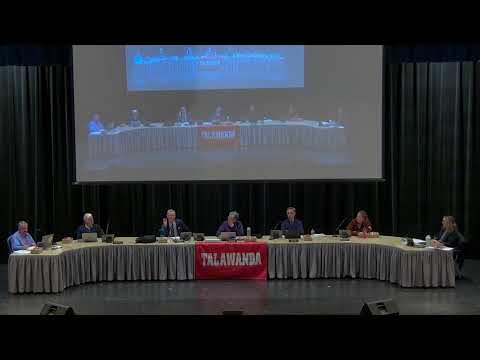
District finance staff presented a detailed briefing on the Fair School Funding Formula and the Talawanda City School District's reliance on local revenue during the board's March 20 meeting.
The presenter reviewed the formula's mechanics — base costs, categorical funding and the state/local partnership — and warned that Talawanda's state share has fallen from roughly 26% historically to about 13.7% in the current fiscal year. Staff said the governor's proposed biennial budget would further reduce the district's state share to about 11% if enacted. The presenter noted district-specific factors used in the formula, including property valuation and income measures, and explained Talawanda's temporary transitional aid guarantee (a floor that prevented the district from receiving less than fiscal year 2021 aid), which currently provides roughly $2.2 million.
Public commenters responded with concerns. A high-school teacher and night-school instructor, Kalindi Webb, described how alternative programs such as night school and College Credit Plus give students flexibility and produce free college credits for students (she reported more than 720 credits from her English CCP course over seven years). Another public commenter, identified as Scotty King, challenged the district's use of the terms "in-school suspension" (ISS) and "in-school assignment" (ISA), saying ISA appears not to be reported to the state and alleging the district might be using ISA to avoid required state reporting. School administrators and the superintendent responded that the district uses multiple disciplinary approaches, tracks incidents in its systems and does not falsify reporting; they said district staff monitor data and investigate patterns, but said the specific EMIS reporting difference (ISS vs ISA) should be addressed privately with administrators if warranted.
Several speakers raised voucher concerns. Members of the public and board discussion cited a recent expansion of state-funded vouchers and said the state was providing full base funding to voucher students (cited at about $8,242 per student in discussion), without means testing; commenters warned that voucher funding diverts money from public schools. Board members urged community attendance at a co-sponsored community legislative forum on March 24 to learn how to contact legislators and discuss the budget.
The superintendent and finance staff committed to present more state-aid detail at the co-sponsored forum next week and to provide comparisons with neighboring districts on request.
Ending: The meeting closed the funding segment by urging residents to attend the March 24 forum for deeper discussion and advocacy steps; staff said they'll circulate the presentation slides and comparative data for other districts.