Get Full Government Meeting Transcripts, Videos, & Alerts Forever!
Get email alerts on the Cpa Application Reform topic
No spam. Unsubscribe anytime.
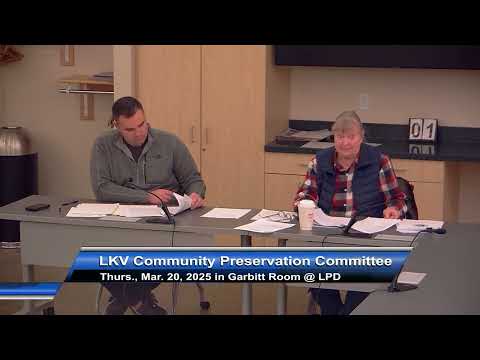
Lakeville committee to add checklist, tighten definitions and historic-funding rules for CPA applications
Summary
The Town of Lakeville Community Preservation Committee discussed revising its Community Preservation Act application packet to add a mandatory checklist, clarify definitions (including limits on “create” vs. “preserve”), and tighten rules for funding historic properties, including requiring intermediary grantees for individual homeowners.
The Town of Lakeville Community Preservation Committee on March 20 discussed revisions to its Community Preservation Act (CPA) application packet that would add a mandatory checklist to the Step 1 application, expand written definitions, and clarify which projects are eligible for CPA funding.
Committee members said the primary changes would front-load key eligibility guidance so applicants can determine early whether a project fits the CPA plan. “Plan must be ready for us,” Nancy, committee member, said when the group discussed putting basic evaluation criteria and a visible checklist on page 1 of the Step 1 form.
The revisions under consideration would: add a one-page cover for Step 1 with three required check items; move the detailed chart to page 2 or an appendix; require applicants to confirm they have read the town CPA plan before submitting; and explicitly list common ineligible expenditures such as routine supplies, mailings and noncapital items. Committee members noted the current instructions say attachments are “applicable,” and that language can allow applicants to omit required materials; several speakers proposed removing or tightening that qualifier.
Members also sought clearer definitions of the terms used across the plan and application. The committee discussed narrowing the meaning of “create” so it does not implicitly allow indoor recreation facilities, movable structures, greenhouses or portable sheds unless those items are clearly part of a capital outdoor recreation improvement. “No indoor recreation” and “no movable structures” were repeated as constraints the committee wants to capture in the text.
Historic preservation guidance drew focused discussion. Committee members said CPA funds cannot be distributed directly to individual homeowners for private benefit; instead, projects tied to historic houses would need an intermediary nonprofit or municipal entity to receive and regrant funds. The committee also reiterated that eligible historic projects generally must be on the town inventory or the National Register, or be supported by a letter from the historic commission and reviewed by the building department for structural concerns.
The packet changes would also move the general evaluation criteria to page 1 and add a short “cannot be used for” list clarifying that single-houseowner repair requests would have to meet additional conditions—such as being accepted through an intermediary and having historic-commission support—before the committee would consider funding. Committee members said they will add the checklist to the plan appendix and circulate an updated Step 1 form in advance of the next meeting.
The committee discussed logistics for applicant help and outreach: applicants would be encouraged to consult relevant town boards (parks, historic commission, open space) before applying and to contact staff with questions. The committee expects the next application opening to remain the same year-over-year; one member said the current Step 1 window opens Sept. 15 and closes Oct. 15.
The committee placed the checklist, definitions, and the “ineligible expenditures” language on the agenda for further drafting and asked a small working group to produce a revised Step 1 cover and appendix language for review at the April meeting.