Get Full Government Meeting Transcripts, Videos, & Alerts Forever!
Get email alerts on the Municipal Finance topic
No spam. Unsubscribe anytime.
Far West treasurer warns sales-tax growth is flattening as council reviews budget implications
Summary
City treasurer presented a budget update showing a year-to-date slowdown in sales-tax receipts, explained how state allocation rules reduce the city's take from point-of-sale receipts, and outlined property tax, franchise tax and capital requests the council will consider when setting next year's budget.
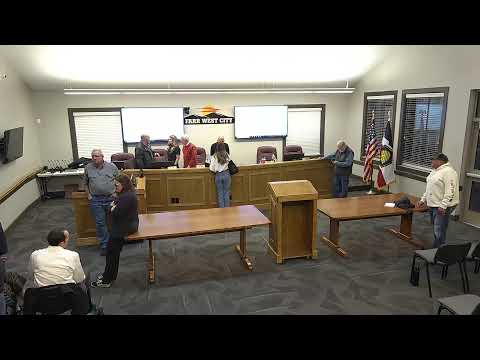
Cody, Far West City treasurer, told the City Council at its meeting that the city's year-to-date sales-tax receipts are beginning to decline and that the way Utah distributes municipal sales tax means Far West receives significantly less than gross point-of-sale collections.
The presentation detailed a five-year sales-tax trend showing a drop this year, the distribution mechanics that split sales tax between point-of-sale credits and a population-based pool, and examples illustrating how much new development would actually add to the city's revenues. Cody said sales tax has in recent years helped cover rising costs but that trend was weakening: “our sales tax is actually dropping for the year.”
Why it matters: Far West relies on a mix of property tax, franchise tax and sales tax to fund public safety, roads and parks. Council members heard that the Weber County sheriff's contract is projected to increase roughly $75,000 next year, and that slower sales-tax growth and a declining franchise-tax base make covering that increase and other recurring costs more difficult without drawing on reserves or increasing property taxes.
Key facts from the presentation
- Sales tax: Cody showed a five-year analysis and said collections have “started to trend down” relative to prior years and to other municipalities in northern Utah.
- Distribution mechanics: When a resident picks up a purchase at a local store, part of the municipal sales tax is credited to the point of sale and part is distributed statewide by population. Cody used December 2024 as an example: the city's merchants generated about $186,322 in gross point-of-sale municipal sales-tax receipts that reporting period; Far West's share of the statewide population pool yielded about $108,000; after the point-of-sale credit (about half of the gross in that example) and statutory subtractions and administrative fees, the city received roughly $197,000 for that month.
- Developer example: Using a hypothetical new business generating $5,000,000 in annual sales, a 1% municipal rate would be $50,000 gross a month. After state allocation rules and deductions the city would capture substantially less—Cody estimated roughly $24,500 a month from that development in the city's general fund rather than the full $50,000 developers often advertise.
- Property tax: Cody showed the city's residential property-tax share translates to about $33.30 per $100,000 of assessed value at the current city rate (the presentation used last year's rates because 2025 rates were not yet set). He said Far West's combined city, policing and fire rate puts it near the middle of local jurisdictions when fire and police providers are included.
- Franchise tax and other revenue: Franchise (utility) taxes are declining as consumer services shift away from legacy cable and landline phone services; staff have been using franchise revenues to subsidize public safety, but Cody warned that is not a long-term solution.
Capital and one-time requests mentioned
- Roof replacement and HVAC/insulation work at city facilities (timing and final quotes not finalized). - Replacement of three public-works trucks and a vacuum-style trailer (rough estimate about $120,000) with proposed cost-sharing across stormwater, parks and sewer funds. - Phase 3 of the public-works facility (price not yet finalized). - Upgrading ballfield lights (estimated about $20,000). - Meadows Park phase 1 work to be largely covered by stormwater and parks impact fees and grants; staff said impact-fee balances are sufficient to cover most of the plan's match.
Council reaction and next steps
Council members asked staff to continue refining the tentative budget and to present line-item detail at a budget work session in early May. Cody said he will prepare the tentative budget for the first May meeting and recommended the council consider approaches (incremental property-tax adjustments or other revenue strategies) to avoid sudden, large increases later.
Staff and context notes
Cody repeatedly cautioned that developer-provided sales-tax estimates should be run through city formulas because gross sales estimates overstate the amount that flows into the general fund after state allocation and administrative deductions. He also reminded council members that property-tax amounts are effectively guaranteed from year to year by the county's certification process and that increases in the city portion typically require a separate public process.
The council did not take a formal vote on tax policy at this meeting; staff will return with a tentative budget and supporting line items for a May work session.