Get Full Government Meeting Transcripts, Videos, & Alerts Forever!
Get email alerts on the Community Inclusion Resolution topic
No spam. Unsubscribe anytime.
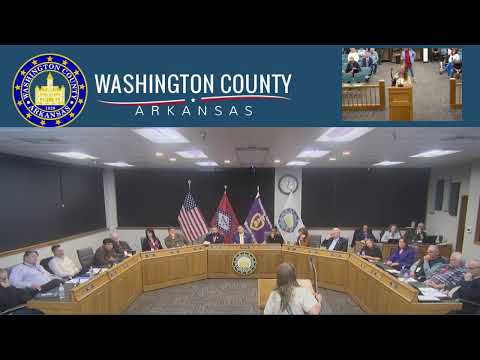
Quorum Court rejects ‘welcoming and inclusive’ resolution after hours of debate
Summary
The Washington County Quorum Court debated a nonbinding resolution declaring the county ‘welcoming and inclusive’ and defeated the measure after amendments and several rounds of debate and public comment.
At its March meeting, the Washington County Quorum Court considered a nonbinding resolution declaring the county a “welcoming and inclusive community for all” and rejected the measure after debate and amendments. The final roll call on the motion to adopt the resolution as amended was 6 in favor and 9 opposed, and the motion failed.
The item came from Justice J.P. Koger, who said the resolution was requested by members of immigrant, refugee and LGBTQ+ communities and modeled on a similar Fayetteville resolution. "This resolution is nonbinding," Koger said. "There's absolutely no way this resolution ... can impose new laws or regulations. Only ordinances can do that. But still, this resolution carries weight. Words matter and symbols matter."
Supporters said the resolution would send a message of inclusion to residents who told court members they felt unsafe. "It gives people grace," said Stephanie Foster during public comment. "It says I see you. It says I recognize that you are having some difficulties ... and I want you to know you're welcome here." Jonathan Nunez, a naturalized citizen, said some residents are "living in a climate of fear" and urged the court to adopt the statement.
Opponents said the resolution either duplicated constitutional protections or risked running afoul of pending state laws. Justice W. Wilson said he opposed the resolution on principle, arguing government should avoid such declarations. "I'm voting no on this," Wilson said. "It's not that I don't love anybody. It's just that if I vote yes, I'm going to be going against ... the majority of the voters in Washington County." Justice Seki urged removal of Article 2 and of language invoking specific groups on grounds the clause could create legal or policy risks for county agencies under new state statutes.
The court considered several amendments. An early amendment to strike the explicit listing of some groups in one clause was proposed by Justice Lyons and initially failed. Members later voted to amend the resolution so that the second whereas would read, in part, "the quorum court of Washington County, Arkansas recognizes the inherent dignity of every person and upholds the rights of all individuals to fully participate in and contribute to our community." That amendment passed, but later motions to remove other provisions or to strike Article 2 failed.
After a lengthy public-comment period that included multiple residents and community leaders urging passage, the court took a roll-call vote on the final motion to adopt the resolution as amended. The clerk recorded votes: Yes — J.P. Koger, Justice Hires, Justice Rio Stafford, Justice Ricker, Justice Massengill, Justice Rivera Lopez; No — Justice Lyons, Justice Eke, Justice Dean, Justice Washington, Justice Dennis, Justice Lemming, Justice Pond, Justice Bruns, Justice Wilson. The resolution failed on the 6–9 vote.
Counsel and several justices referenced pending state legislation during debate. Members asked county counsel to monitor how any enacted law might affect local resolutions and county policies. The court moved on after the vote and adjourned at the end of its agenda.
The exchange included extended public comment from residents who said the resolution mattered symbolically to people who feel marginalized, and from others who said existing law already protects residents and the court should focus on statutory duties.
The resolution was nonbinding; it would not have created new county law or changed enforcement practices even if adopted.