Get Full Government Meeting Transcripts, Videos, & Alerts Forever!
Get email alerts on the Historic Context Statement topic
No spam. Unsubscribe anytime.
Commission adopts early-settlement-era historic context statement for San Francisco
Summary
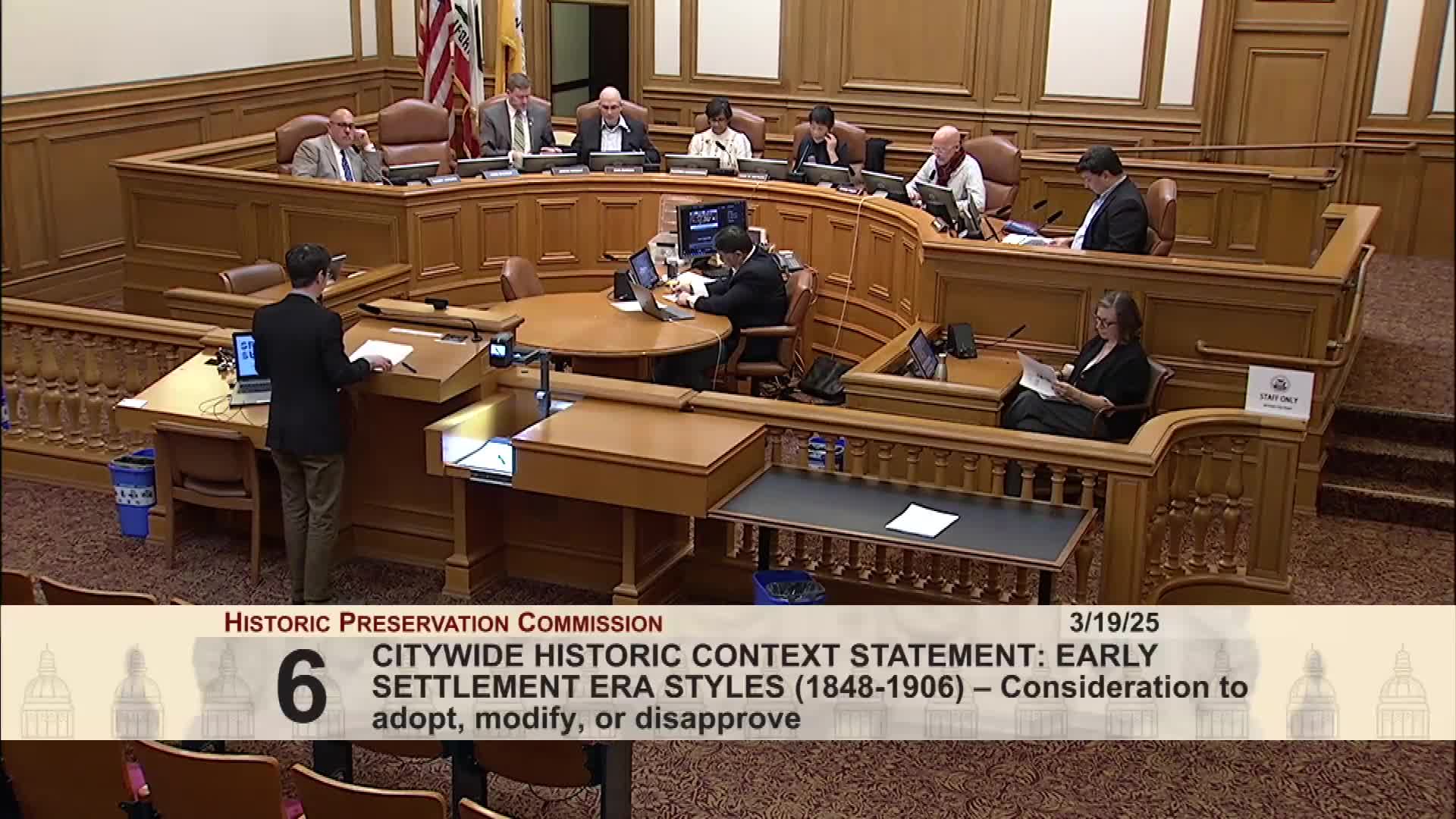
The Historic Preservation Commission adopted a citywide "early settlement era styles" historic context statement on March 19, 2025, formalizing evaluative frameworks to guide identification of nineteenth-century resources for surveys and review.
The San Francisco Historic Preservation Commission on March 19 adopted a citywide historic context statement focused on early settlement era styles (circa 1848'1906), a staff-authored document that aims to guide property evaluations and the San Francisco cultural resources survey.
Alex Westhoff of the Planning Department presented the document and described its scope, saying the statement covers three early settlement styles, identifies existing landmarks and representative sites, and provides evaluative frameworks to guide eligibility under Criterion 3/C. Westhoff told commissioners staff had notified more than 270 parties and received no opposition to the draft.
The document lists examples including Old Saint Patrick's Church (circa 1852, Greek Revival), the Abner Phelps House (circa 1850, Carpenter Gothic), and a circa 1865 folk Victorian residence at 361 San Jose Avenue. Westhoff noted that surviving examples of these styles are rare in San Francisco because many structures were lost in the 1906 earthquake and fires and later demolition; accordingly, staff recommended lower integrity thresholds for evaluation of these early-era properties than for newer styles.
Bridget Malley, a public commenter, thanked staff and urged additions to the bibliography, referencing several nineteenth-century architectural studies she said were missing. Commissioners praised the report; Commissioner Vergara called it "a real pleasure to read," and Commissioner Foley said the document is a living one and welcomed future additions. Commissioner Nagas Warren encouraged staff to proceed promptly with evaluations of unlisted resources.
Commissioner Barone moved to adopt the context statement; the motion was seconded and passed unanimously, 6-0. The commission recorded the vote with Barone, Vergara, Wright, Foley, Nagas Warren and Matsuda voting yes.
The context statement will be used as part of the San Francisco citywide cultural resources survey and to inform property evaluations, historic resource reviews and potential landmark designations.