Get Full Government Meeting Transcripts, Videos, & Alerts Forever!
Get email alerts on the Youth Services Budget topic
No spam. Unsubscribe anytime.
Youth Commission asks supervisors to protect funding for transit, school meals, housing and climate programs
Summary
The San Francisco Youth Commission presented budget and policy priorities for fiscal years 2025–26 and 2026–27 on March 19, urging the Board of Supervisors’ Budget and Appropriation Committee to preserve funding for free youth transit, school nutrition, affordable housing, climate resilience and youth employment amid a near $1 billion shortfall.
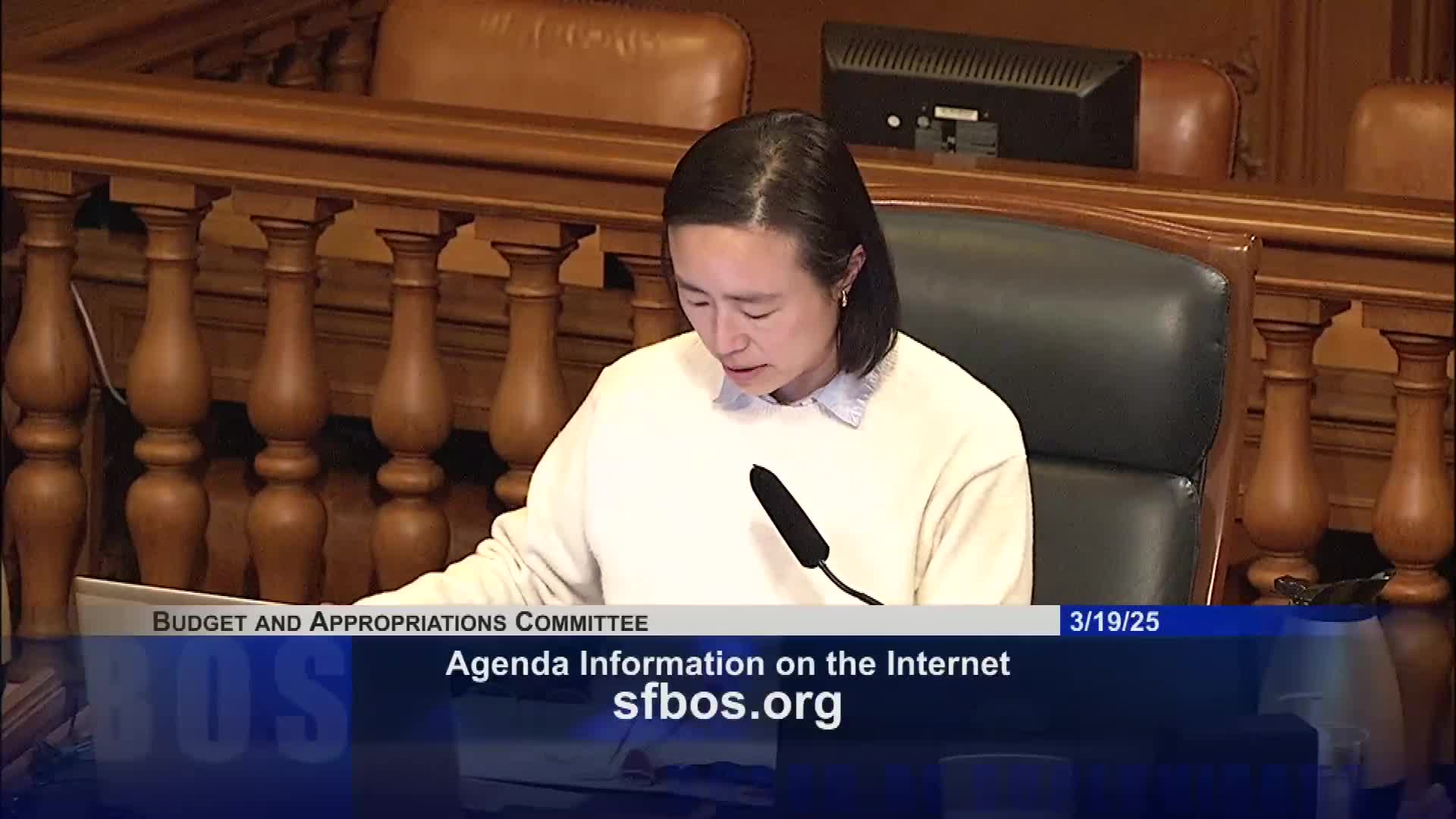
SAN FRANCISCO — The San Francisco Youth Commission told the Board of Supervisors’ Budget and Appropriation Committee on March 19 that city leaders should preserve and prioritize funding for youth programs as they prepare budgets for the next two fiscal years.
"The city is in a near $1,000,000,000 budget deficit," Jason Fong, chair of the San Francisco Youth Commission, said during the presentation, adding that the commission framed its recommendations with the shortfall in mind. The commission presented a report with priorities that include continued support for free Muni for youth, completion of a central school kitchen to improve school meals, expanded affordable and teacher housing, climate-resilience measures for young people and stronger youth employment pathways.
The commission, a 17-member chartered advisory body that represents young people and advises the mayor and board of supervisors, said it conducted extensive outreach this year before drafting the priorities. "We embarked on one of the most, if not the most extensive community outreach initiatives in the history of the Youth Commission," Fong said.
Why it matters: The items the commission highlighted intersect with core city services and the mayor’s and board’s budget decisions. The commission framed many requests as maintenance of existing programs (such as free Muni for youth and school wellness centers) and as investments tied to equity and climate resilience in neighborhoods it identified as disproportionately affected.
Key priorities and details
- Transit: The commission asked the board and SFMTA to preserve the School Tripper service and include Free Muni for Youth in the SFMTA baseline budget. The commission also urged making SFUSD student ID cards Clipper-compatible and recommended preserving transit reliability on routes that serve multiple schools.
- School meals and wellness: Commissioners urged city leaders to work with San Francisco Unified School District (SFUSD) to finish a central kitchen project intended to improve meal quality and to restore a school food advisory group. Supervisors noted a related school bond the board advanced that includes funds for school nutrition; during committee remarks a supervisor said roughly $22,000,000 in the bond would focus on a central kitchen and school nutrition programs.
- Housing and homelessness: The commission prioritized teacher and middle-income housing, urged protection of rent-control policies, and called for better bilingual resources and rental subsidies for single-room occupancy (SRO) residents. The commission also asked the city to research navigation centers and other services specifically for transitional-age youth experiencing homelessness.
- Climate resilience and literacy: The commission recommended accelerating electrification and EV infrastructure, creating a network of climate "respite" locations (cooling and clean-air sites) in heat-vulnerable neighborhoods, and involving youth in the city’s 2025 climate action plan update. The commission asked the city and SFUSD to coordinate a districtwide Climate Action Day tied to an upcoming youth summit on April 18.
- Safety, policing and school climate: The commission requested improved SFMTA fare-inspector training, more transit ambassadors, and police training on youth interactions. It also recommended reviews of background-check systems and standardized training to address sexual assault and harassment in schools and supported youth violence-prevention and mental-health services to reduce weapon access.
Public comment and youth testimony
Multiple youth commissioners and former commissioners spoke to support the priorities. Harper Fort King, who represents District 8 on the Youth Commission, urged expanded climate education and infrastructure and said, "There are a 13,000 youth in San Francisco. We're 14% of the city's pop population, and climate change impacts every single one of us." Mayoral appointee Ava Orem testified in favor of preserving Free Muni for Youth, saying, "Removing financial barriers to transportation ensures that every young person, regardless of their economic background, can access opportunities that can help them succeed." Emily Yang and former chair Adrianna Zhang urged additional investment in workforce pathways, internships and trade-school awareness.
Supervisors’ response and next steps
Committee Chair Supervisor Connie Chan and other supervisors thanked the commission and said they will share the recommendations with city departments and the mayor as budget work continues. Supervisor Shamone Walton and Supervisor Joanne Gardio asked about the commission’s engagement with SFUSD and other boards; commissioners said outreach has included SFUSD staff and that some commissioners are SFUSD students.
Formal actions
The committee handled two formal motions related to the meeting. A motion to excuse Vice Chair Matt Dorsey from the meeting was approved by roll call with four ayes; the committee then voted to "hear and file" the Youth Commission’s budget priorities report, also passing on a 4–0 roll call with Vice Chair Dorsey excused.
The meeting record shows the Youth Commission’s priorities will be delivered to the mayor and considered during the city’s June budget process. Commissioners and supervisors encouraged continued engagement from youth as departments present budgets in coming hearings.