Get Full Government Meeting Transcripts, Videos, & Alerts Forever!
Get email alerts on the Adaptive Recreation topic
No spam. Unsubscribe anytime.
Denton Parks & Recreation outlines expanding Adaptive Inclusive Recreation programs, requests volunteers
Summary
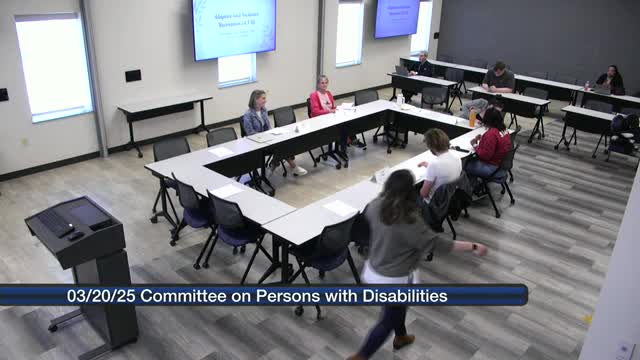
At a Committee on Persons with Disabilities meeting, Parks & Recreation staff described Adaptive Inclusive Recreation (AIR) offerings — dances, art classes, sensory rooms, nature walks and Special Olympics participation — and asked the committee to help recruit volunteers and spread word of upcoming events.
Tiffany Thompson, recreation coordinator for Denton Parks and Recreation’s Adaptive and Inclusive Recreation program, told the Committee on Persons with Disabilities that the department’s Adaptive Inclusive Recreation (AIR) offerings are growing and that staff need volunteers to sustain upcoming events.
Thompson said, "Adaptive and inclusive recreation programs are designed to provide individuals with physical and developmental disabilities a chance to participate in recreation programs with their peers while enhancing their physical, social, and emotional well-being." She outlined current programs, volunteer needs and how members of the public can sign up.
Thompson described a program mix that includes an adapted open gym, adapted nature walks, adaptive dances, adaptive art (two levels), social connections, pottery, sensory rooms at events, and planned adaptive fitness and youth programming. She said the art program drew about 30 participants from Denton ISD at one session and that an upcoming social connections event had 30 people signed up. "We have 30 people for our social connections," Thompson said.
Staff explained that adaptive programs take two forms: adaptive programs that modify activities for participants with specific needs and inclusive programs that allow people with and without disabilities to participate together. Reasonable accommodations are made for participants "in accordance with Title II of the Americans with Disabilities Act," Thompson said.
On volunteer recruitment, Thompson said volunteers can help with art classes, nature walks, dances and special events. She described the process: prospective volunteers can email her or register at any Recreation Center so staff can forward their information. She said background checks are required through the City of Denton before volunteers are assigned. Thompson estimated the background-check process is quick — "I want to say it took about 3 days" for a recent event — and said she would confirm timing in follow-up materials.
Thompson asked the committee to help amplify volunteer calls. Committee members offered to share volunteer links and asked staff to provide schedules in advance so they could attend or recruit volunteers. Thompson said event listings and calendars are posted on CivicRec and on the City of Denton "Adapt It Rec" Facebook page.
Staff identified two upcoming events explicitly in the meeting: a Special Olympics meet in Gainesville on April 5 (26 participants were signed up at the time of the meeting) and an adaptive "extravaganza" community event on April 12 from 9 a.m. to noon. For the Special Olympics trip, Thompson said the required coach-to-participant ratio is 1:4 and asked for adult (over 18) volunteers to serve as coaches; she said some volunteer roles accept ages 16 and up but that adult coaches for Special Olympics must be over 18.
Thompson said the program is funded primarily from Denton Parks & Recreation and staff are seeking sponsorships for some activities. She also said the program is actively expanding youth offerings (including a planned adapted swim session and youth soccer practice) and hopes to move from roughly four days of programming per week toward five days.
Committee members and staff discussed practical details: sensory-room accommodations (low lights, peapod, fidget toys, earplugs), volunteer training (informal pre-shift briefings rather than a formal course), and the city procedure for background checks and volunteer assignment. Thompson said she will provide the committee with volunteer-registration links and schedule details to help with outreach.
Thompson concluded by reiterating the department’s inclusion statement and its commitment "to creating and promoting inclusion across all public spaces, places, facilities, and programs the department manages." She asked the committee to help publicize opportunities and noted that volunteers — including high-school students seeking hours — have filled roles such as setting up dances and assisting in art classes.
Committee members pledged to circulate the volunteer information and to coordinate attendance for Special Olympics and other events.