Get Full Government Meeting Transcripts, Videos, & Alerts Forever!
Get email alerts on the Residential Workforce Housing topic
No spam. Unsubscribe anytime.
Maui committee amends workforce-housing draft, delays final vote on Bill 40
Summary
The Maui County Housing and Land Use Committee on March 20 heard public testimony on Bill 40 — an omnibus proposal to amend residential workforce‑housing rules — adopted several amendments including new deed‑restriction lengths for single‑family homes, and deferred final passage while staff prepares a revised draft.
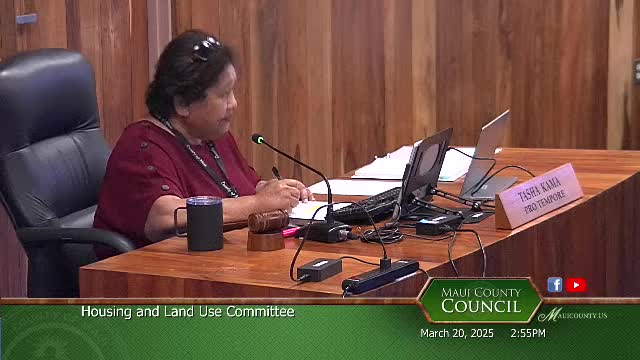
The Maui County Council's Housing and Land Use Committee on March 20 took public testimony on Bill 40, the committee's omnibus draft to revise residential workforce-housing rules in chapters 2.96, 2.97 and 3.44 of the Maui County Code, adopted a series of amendments and deferred final passage to a later meeting so staff and the Department of Housing can prepare a revised (CD1) draft.
The bill was presented to the committee as a vehicle for a broader discussion of attainable housing regulations. Scarlett Martin, a Kihei resident, urged the committee to prioritize housing that local workers can afford. "Kihei is dying," Martin said, adding rising rents keep young residents from returning after college.
Committee members focused much of the meeting on how long deed restrictions should last for workforce units and whether deed terms should differ for single-family versus multifamily units or for projects that do not take county housing funds. The committee unanimously removed a provision that would have halved deed-restriction periods for ownership units that did not receive the county's Affordable Housing Fund. The committee then adopted a separate amendment setting new deed-restriction terms for single-family ownership units at 15 years for below‑moderate income units, 12 years for moderate‑income units and 10 years for above‑moderate units.
The committee also adopted three other amendments by voice vote: (1) a director-level waiver to allow exceptions to a three‑year non‑ownership residency requirement in limited circumstances, (2) an option allowing owner units to be used as documented long‑term rentals in perpetuity provided the rental is capped at a HUD 100% AMI rental rate (family of four) regardless of the tenant's income, and (3) clarifying language to ensure staff can interpret subsidy references more broadly than a single county-managed fund. "I would keep it simple and keep it on the financial subsidies," Richard Mitchell, director of the Department of Housing, said during the meeting when members debated whether to limit the rule to the county Affordable Housing Fund or to include other government contributions. Mitchell told the committee he and staff would work on precise language.
Several members voiced differing views on deed‑restriction length. Member Rollins Fernandez said the council should only authorize new housing that is affordable, arguing that luxury development had previously been used to subsidize affordable units. "I don't think any more housing should be built unless it's affordable," she said. Other members said longer restrictions better preserve generational affordability; some argued that overly long or inflexible restrictions could disincentivize developers and reduce supply.
No final committee vote was recorded to pass Bill 40 out of committee on first reading. The meeting closed with the chair directing staff to prepare a revised draft that incorporates the committee's adopted amendments and to return after the upcoming budget work so Council staff, corporation counsel and the Department of Housing can refine language tied to subsidy definitions and federal funding rules (for example, CDBG-DR). Committee staff said the revised draft will be circulated as a CD1 after budget season.
The committee heard one full three‑minute public comment from Scarlett Martin and a brief ceremonial remark; staff confirmed no other remote testifiers were present.
The committee's conversation repeatedly noted dependencies on state and federal rules for certain subsidy sources. Members asked staff and counsel to clarify whether federal Disaster Recovery (CDBG-DR) or other government contributions would trigger the same requirements as county fund contributions and to check how deed restrictions would interact with those funding rules. Director Mitchell said his office would review administrative practice on owners'access to shared equity (the department currently permits refinances for better rates or terms but does not allow cash‑out loans while a unit remains deed‑restricted) and will report back.
What the committee did
- Deleted the draft clause that would have cut deed-restriction periods for ownership units that did not receive county Affordable Housing Fund money (motion passed unanimously).
- Set single-family deed‑restriction terms at 15 years (below moderate), 12 years (moderate) and 10 years (above moderate) after a reconsideration and roll‑call (final margin 5–4).
- Approved language allowing limited director waivers of the three‑year non‑ownership residency eligibility requirement.
- Approved an owner-occupied alternative that permits documented long‑term rental in perpetuity if the unit is leased at or below a HUD 100% AMI rental cap (family of four) regardless of tenant income.
- Deferred final committee action on the main motion to recommend Bill 40 for first reading and asked staff and the Department of Housing to prepare a CD1 draft incorporating the committee's changes for consideration after the budget process.
Ending
Committee members said they expect additional technical edits from corporation counsel and the Department of Housing before the bill returns. The committee closed the meeting and will resume consideration after budget season, with staff preparing a revised draft and answers to members' questions about subsidy definitions and how federal Recovery funds would interact with deed restrictions.