Get Full Government Meeting Transcripts, Videos, & Alerts Forever!
Get email alerts on the Community Solar topic
No spam. Unsubscribe anytime.
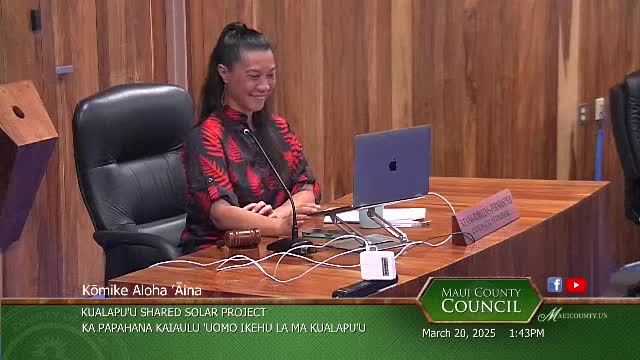
Molokai committee hears presentation on Kualapuʻu shared‑solar project; item deferred for later council action
Summary
The Maui County Council Molokai Committee heard details and public testimony on a proposed 250 kW community solar project at Kualapuʻu recreation center, including lease, permitting, workforce, subscriber and tree‑replacement plans. The committee deferred the item for later council consideration.
KUALAPUʻU, Molokai — The Maui County Council Molokai Committee on March 20 heard a presentation and public testimony on a proposed shared‑solar (community solar) project sited over the Kualapuʻu recreation center parking lot, and deferred formal action to a later council meeting.
The project, promoted by Oahu Energy Cooperative Molokai and developed with support from Shake Energy Collaborative, would place rooftop carport solar canopies and an on‑site battery in the rec center parking area and connect generation to Hawaiian Electric’s grid. Ali Andrews, chief executive officer of Shake Energy Collaborative, said the proposal participates in Hawaiian Electric’s Community Based Renewable Energy (CBRE) program and was awarded under a request for proposals in late 2022. “This project is under the community based renewable energy or CBRE program offered by Hawaiian Electric,” Andrews said.
Committee chair Kiani Rollins Fernandez opened the meeting and said the committee organized the session to allow questions and community input before the item returns to the council. Christy Rigglesworth, deputy (acting) who worked on the draft lease with the parks department, told the committee the lease is “drafted. It's for 20 years to, it allows for 1 extension to, run concurrently with the contract with Hawaiian Electric.” Patrick McCall, director of the Department of Parks and Recreation, said the parks department supports the project.
Why this matters: proponents describe the project as a locally owned, subscription‑based shared‑solar system aimed at expanding access to renewable energy for renters and low‑ and moderate‑income households who historically could not install rooftop panels. Committee discussion covered subscriber eligibility and sizing, expected household savings, workforce training and the project’s effect on parking and trees at the site.
Project scope and benefits The facility presented to the committee is one of two community‑owned projects proposed by Oahu Energy Cooperative Molokai (the other at Palaʻau). The Kualapuʻu site discussed at the Molokai Committee is a roughly 250‑kilowatt installation of four solar carport structures. Andrews said the two projects together represent about 20% of Molokai’s electrical load, while the Kualapuʻu site is a smaller portion. She said the project could serve households through subscriptions; based on average consumption, “we expect each household on average to sign up for, like, 1 and a half kilowatts,” and that subscribers could see “about 20%” savings off current electricity bills.
Cost and funding Andrews told the committee the two projects’ combined capital cost is about $20.5 million, with the Kualapuʻu site representing roughly $3.5 million of that total. She said funding sources would include a U.S. Department of Energy grant awarded to Oahu Energy Cooperative Molokai, a loan from the Hawaii Green Infrastructure Authority (referred to in the meeting as the Hawaii Green Authority), and private lending.
Workforce and local ownership Liliana Napoleon, workforce and training developer for Oahu Energy Cooperative Molokai, described local training efforts and said a majority of Molokai trainees come from Kualapuʻu and Poʻolehua ZIP codes. The presentation identified HNU Energy, a Maui‑based contractor, as the construction contractor; Andrews said HNU committed to hiring Molokai workers who complete the cooperative’s workforce program.
Site impacts and permitting The chosen footprint places canopies over approximately a one‑acre parking area within a roughly 6.5–7‑acre park parcel. Andrews said the carport pillars would eliminate about eight parking stalls from the existing count of about 104 and require removal of about 17 autographs (trees) from the parking lot; the project team proposed replanting roughly 30 trees elsewhere on park property. Committee members and staff identified outstanding permitting and lease details that still must be resolved, including grading and building permits, final lease acceptance by the parks department and routing of the lease to the mayor. Christy Rigglesworth said those lease and routing steps were underway.
Subscriber rules and equity goals Committee members emphasized the CBRE program’s emphasis on low‑ and moderate‑income and tenant households. Vice chair Cherrie (as discussed in the meeting) reminded the public that the CBRE model was designed to reach households and renters that lacked the upfront capital to install rooftop solar. Andrews described the outreach approach used in the cooperative’s design: rather than strict income verification at subscription, the cooperative plans to partner with local organizations that serve low‑ and moderate‑income households to prioritize outreach and enrollment.
Public testimony The committee heard multiple public comments all in support of the project. Kalaia Tonganan said, “I support the project and hoping that it will help us with our electric bills because mine is quite high with 8 people in my hallway.” Paul Hanley, a neighbor to the rec center, said he supported the development despite losing a few trees because “the solar panels will give the kind of same shade value for people parking.” Laurie Buchanan, identified in testimony as board president of Oahu Energy Cooperative Molokai, urged support for community control of projects and praised local workforce development.
Outstanding questions and next steps Committee members pressed on several implementation details: the committee sought clarification on the number of households that could subscribe (presentation cited both an estimate of about 50 families at one point and about 150 at another), the need for tree removal and replacement plans, potential code variances or amendments for parking‑lot landscaping, whether glare or aviation studies would be required (Andrews said the Federal Aviation Administration would not require a glare study for a project of this size), and the timing for revenue generation and maintenance staffing. Andrews estimated the project could begin construction in about a year and a half to two years and start generating subscriber revenue when it goes online.
Outcome With those questions noted and further lease and permitting work to be completed, the committee voted to defer the item to a later council meeting for formal consideration. No formal roll‑call vote on ordinance or resolution language occurred during the committee session.
The committee said staff would return the item to the council docket once the lease and permit materials were ready and advised cooperation between parks, corporation counsel and the cooperative on tree replacement, removal costs and any land‑use variances needed for landscaping.