Get Full Government Meeting Transcripts, Videos, & Alerts Forever!
Get email alerts on the Fraud Prevention Package 2025 topic
No spam. Unsubscribe anytime.
Minnesota agencies outline governor's anti-fraud package, seek new data-sharing, enforcement and AI tools
Summary
State agency leaders briefed a House committee on a governor-backed package that would expand data sharing, allow payment holds for suspected fraud, create a new theft-of-government-funds statute, and pilot AI tools to flag suspicious Medicaid activity; commissioners sought added staff and funding while lawmakers questioned timing and costs.
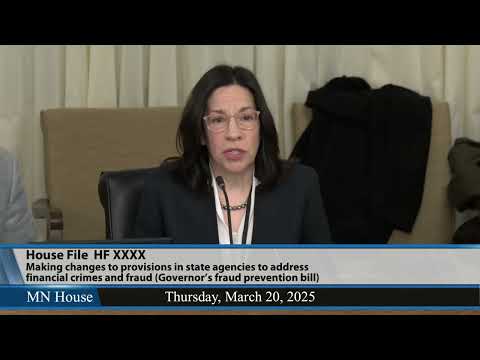
Members of a Minnesota House committee heard an overview of the governor's fraud prevention package during an informational hearing on March 14, when state agency leaders described proposals to expand investigative authority, improve data sharing and detection, and increase penalties for stealing public funds.
The package, presented by Erin Campbell, commissioner of Minnesota Management and Budget (MMB), and leaders from the Bureau of Criminal Apprehension (BCA), the Department of Human Services (DHS), Minnesota IT Services (MNIT), the Department of Children, Youth and Families (DCYF), the Department of Education (MDE), and the Department of Administration, would give agencies clearer authority to withhold payments to entities under credible allegation of fraud, broaden interagency data sharing, create a dedicated theft-of-government-funds statute, and pilot artificial-intelligence tools to detect anomalous claims.
The hearing offered specifics and agency requests. Campbell said the package focuses on three categories: "stronger investigative and enforcement authority, a better detection and oversight, increased criminal penalties." She told the committee the proposals would let agencies "withhold payments from potentially fraudulent actors if there is a credible allegation of fraud, prevent bad actors from getting state contracts across multiple agencies, and to bar entities from receiving state funds."
Drew Evans, superintendent of the BCA, described a recent consolidation: "On February 7 the BCA Financial Crimes Section and the Commerce Fraud Bureau combined our two entities into one new BCA Financial Crimes and Fraud Section." He said the reorganization centralizes investigative resources and that the governor's budget would add two attorneys general and one forensic accountant to support complex cases and assist greater Minnesota county attorneys.
Shereen Gandhi, serving as temporary commissioner for DHS, gave counts and outcomes from the department's program integrity work: DHS's Office of Inspector General oversees roughly 390,000 providers (142 of those are entities), conducted about 4,000 investigations in the last five years, stopped payments to about 600 providers, referred more than 400 cases to law enforcement, and recovered more than $18,000,000 per year on average. Gandhi said the proposal would add staff to program integrity, fund prepayment review contracts to check selected claims before payment, broaden data-sharing authority beyond the current "Limits on Receiving Public Funds" statute, and allow agencies to disqualify individuals under active fraud investigation from ownership or billing roles. She also described a proposal for provisional licensure and other measures aimed at EIDBI/autism providers and time-based billing clarification aligned to federal and state guidance.
Tarek Tomes, commissioner of Minnesota IT Services, said MNIT would pilot artificial intelligence and machine-learning tools to flag anomalies in Medicaid provider claims and build scalable data-warehouse capabilities so agencies can analyze and integrate identity, unemployment, vital records and other sources. "This pilot is a critical first step to build this capability across executive branch programs," he said.
Tiki Brown, commissioner of DCYF, described budget requests included in the package: $5,400,000 in fiscal 2026-27 and $2,800,000 in 2028-29 to enhance program integrity with two FTEs for compliance, improved internal controls, grant monitoring, and data analytics; DCYF would also require electronic attendance and enrollment record keeping for the child care assistance program (CCAP), a change aligned with a 2019 legislative auditor recommendation.
Willie Jett, education commissioner, requested $550,000 annually for three FTEs and software enhancements for the MDE Office of Inspector General to expand investigations, add two legal counsel positions focused on nutrition and charter schools, and strengthen charter-school oversight including requiring annual audits, published meeting minutes and market-need studies for site or grade changes.
Tamara Grumbaugh, commissioner at the Department of Administration, said the department would expand debarment authority so the Office of Grants Management could suspend or debar potential grantees (not only current grantees) for convictions or conduct that merit debarment. She also said the proposal would require state employees to report violations of grant laws or rules rather than merely encouraging reports under current practice.
Committee members raised concerns about timing, cost and whether agencies already had sufficient authorities or practices to report and act on fraud. Representative Kosnick questioned adding staff and whether requiring employees to report should already be standard. Representative Quam pressed for a shared, centralized mechanism to flag entities suspected of fraud across agencies and asked when MNIT would implement such a listing. Representative Davis and others asked why the measures were not implemented earlier and whether state culture encouraged reporting.
Committee members and the commissioners repeatedly framed the proposals as a mix of statutory clarifications (for example, a new theft-of-government-funds statute and a clearer scope for disqualifying individuals), operational investments (additional investigators, attorneys and forensic accounting support), and technology pilots (AI-driven anomaly detection for Medicaid claims). No formal action or vote occurred during the informational hearing.
Bills and next steps mentioned at the hearing included two related House files: Representative Elkins is carrying House File 2429 (data-sharing provisions) and Representative Pinto said she is carrying House File 2370 (authority to withhold program payments pending fraud review); committee members were told pieces of the package will move in separate bills and that this hearing was informational so there was "no bill to lay over at this time." The committee asked agencies for more details on procurement strategies for AI tools and for follow-up on how newly requested resources and authorities would be used.
The hearing highlighted both support and skepticism among lawmakers: several members supported enhanced data sharing and AI pilot tools as necessary steps to keep pace with evolving fraud schemes, while others urged the agencies to show how existing checks and federal best practices had been followed before requesting additional budget authority. Commissioners said many of the proposals build on earlier changes enacted in 2019 and 2023-24 and argued additional capacity and statutory clarity are needed to act sooner and more effectively.
Officials said next steps include introduction and movement of the package's component bills through the Legislature, further review of procurement options for pilot technology, and follow-up briefings to provide additional fiscal and operational detail.