Get Full Government Meeting Transcripts, Videos, & Alerts Forever!
Get email alerts on the Sixth Street Pilot topic
No spam. Unsubscribe anytime.
Sixth Street pilot keeps vehicle lanes open, deploys barriers and signal changes; APD reports fewer uses of force
Summary
A TPW and APD briefing described a multi‑phase Sixth Street vehicle access pilot implemented in January to reduce crowding and crime. APD reported declines in uses of force and simple assaults; staff described curb reconfiguration, rubber curbing, fencing and plans for sturdier midterm barriers.
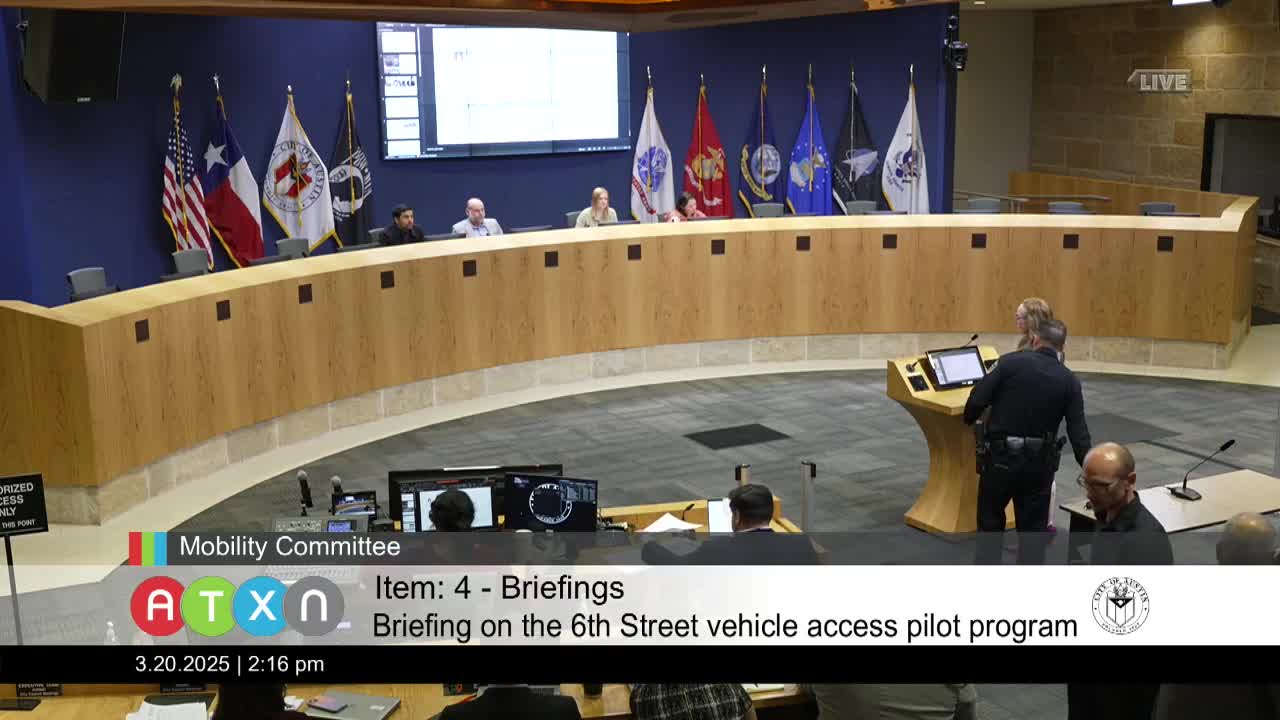
City transportation staff and Austin Police Department officials on March 20 briefed the Mobility Committee on a vehicle access pilot on Sixth Street that launched in early January and is intended to reduce crowding and improve safety in the downtown entertainment district.
Lee Austin, central area engineer in TPW, described the operational design: a three‑lane cross section in the busiest blocks (from Brazos to Red River) that reclaims the south curb lane and the north parking lane in certain blocks to create pedestrian queuing space. In the busiest two middle blocks (roughly the 300–400 blocks), staff installed rubber curbing behind which temporary fencing prevents mid‑block crosswalks. Austin said signal timing was adjusted to reduce vehicle speeds to about 20 mph and that additional “all‑red” time was added to improve pedestrian safety at intersections.
Commander Chancellor of the Austin Police Department said the pilot followed a cross‑departmental planning effort that included APD, TPW, Development Services and Economic Development, and that the changes were intended to reduce mid‑block jaywalking, improve crowd control and make enforcement more effective.
APD and operational outcomes
Commander Chancellor told the committee that use‑of‑force incidents in the downtown George sector have declined since the prior year; he presented comparative figures showing fewer uses of force and fewer simple assaults in the same early‑year period. APD also reported no measurable increase in crashes associated with the pilot and said traffic enforcement and a downtown rapid response team have been active in the pilot area.
Implementation details and adjustments
TPW reported the following operational details and near‑term adjustments: - The pilot keeps four lanes at Congress Ave. approach intersections to preserve necessary capacity, but uses three lanes through core blocks to create space for pedestrians and bicycle/pedicab use during non‑peak hours. - In busier blocks the pilot uses rubber curbing and temporary fencing; in lower‑activity blocks TPW used delineators and retained north‑curb parking. - A commercial vehicle loading program permits deliveries from travel lanes with a required hang‑tag; staff said deliveries and loading patterns informed the decision to retain three lanes rather than two. - TPW has purchased 65 Meridian barricades and reinstalled curbing after SXSW; staff are evaluating midterm options such as painted concrete barriers, decorative planters or more permanent crash‑resistant devices and will continue stakeholder engagement.
Business and council concerns
Committee members asked about vehicle and delivery conflicts during off‑peak hours and asked TPW and APD for more comprehensive operational metrics. Council members and staff noted trade‑offs between delivery access, curb management and pedestrian space; one council member said she had observed two trucks simultaneously unloading that reduced throughput to one lane during a morning period.
Ending
APD called the pilot a phased approach and described intent to move toward a midterm solution and ultimately a permanent, long‑term design if metrics and stakeholder coordination support it. The committee did not adopt a formal policy change at the March 20 meeting; staff said they will continue monitoring safety, crash and enforcement data and coordinate a midterm design.