Get Full Government Meeting Transcripts, Videos, & Alerts Forever!
Get email alerts on the Housing Incentive Fund topic
No spam. Unsubscribe anytime.
Lawmakers hear calls to expand Housing Incentive Fund as rural housing shortfall grows
Summary
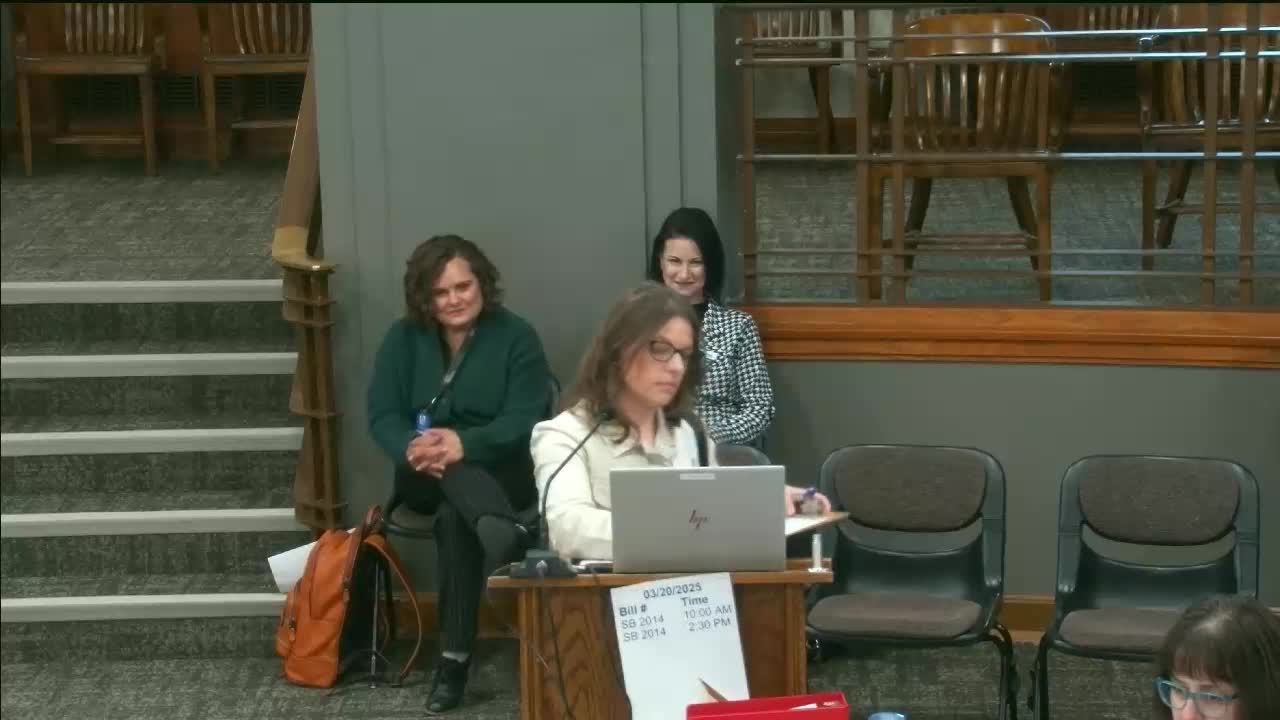
Jennifer Henderson, director of the Community Housing and Grants Management Division at the North Dakota Housing Finance Agency, told the House Appropriations committee that the division manages state, federal and agency-funded programs supporting multifamily and single-family development, homeless response and HUD project-based rental assistance.
Jennifer Henderson, director of the Community Housing and Grants Management Division at the North Dakota Housing Finance Agency, told the House Appropriations committee that the division manages state, federal and agency-funded programs supporting multifamily development, single-family development, homeless response and HUD project-based rental assistance."The Community Housing and Grants Management Division annually...manage state, federal, and agency funded programs that will assist with multi family development, multifamily compliance," Henderson said.
Henderson said the agency competitively awards funds and monitors compliance for long-term affordability. She told the committee the Housing Incentive Fund (HIF) has been critical as gap financing: state HIF grants helped the agency award about $11 million that supported roughly $84 million in total development costs and produced 323 affordable units in the last biennium. "For every dollar of HIF that went out the door this last biennium, you received a return of $7.30 of private investment," Henderson said.
The division reported a multifamily pipeline of roughly 23 projects under construction and said it annually receives 8–20 multifamily applications; limited HIF availability forced the agency to decline 14 projects (about 522 units) representing roughly $46 million in unmet requests. Henderson also described new uses of HIF for single-family development in small towns: the agency has committed about $1.8 million to support 21 new single-family homes (roughly $6 million in development costs) in towns including Lakota, Larimore, Hillsboro, Hatton, Devils Lake, Park River, Mayville and Minto. Community land trusts in Grand Forks, Fargo and Minot have received revolving lines of credit totaling $1,150,000 and have used those funds to purchase three homes.
Why it matters: rural housing advocates and nonprofit developers said the current HIF appropriation levels leave unmet demand and stall projects. Dawn Mant, executive director of the Red River Regional Council, asked legislators for larger, predictable funding for small towns: "I urge your strong consideration of $50,000,000 appropriation," she said, citing a regional study that forecasted a need for 4,800 rural housing units across the region studied. Lisa Rothvold, executive director of the Red River Community Housing Development Organization, described a "spark build" approach funded by HIF that produced four houses in two communities, triggered resales of existing homes and attracted builders where markets previously did not pencil out.
Private developers and nonprofit builders described how HIF fills the final financing gap for many projects. Don Sturhan, president of CR Builders LLC, said the fund operates as gap financing that enables projects to move from planning to construction: "We have the ability through other funding sources...but we're often still facing that gap. We're not quite there yet. So how do we get there? And that's where the HIF funding has been critically important." Dan Madler, CEO of Beyond Shelter Inc., urged increasing the Senate's proposed $25 million appropriation to $50 million to provide scale: "A $50,000,000 appropriation would be a strategic investment," he told the committee, citing projects in Minot and other cities with tight vacancy rates.
Community land trusts (CLTs) presented HIF as a complementary tool that preserves affordability across resales. Emily Contreras, executive director of the Grand Forks Community Land Trust and Minot Area Community Land Trust, explained CLT mechanics: a CLT reduces the buyer's mortgage through subsidy and retains ownership of the land to keep resale prices affordable. "With community land trusts, the homes remain affordable until the house itself actually needs a substantial rehab," she said, and a single subsidy can preserve affordability across multiple households over decades.
Committee context and requests: Henderson told lawmakers the agency's 2025 budget request includes a HIF appropriation of $40 million and proposed administrative changes to fold the North Dakota Homeless Grant into HIF for unified administration and interim reporting. She also described a $10 million North Dakota Homeless Grant identified in the Armstrong budget and said the agency is requesting one full-time equivalent to administer homeless programs. Several witnesses asked the committee to consider a larger HIF appropriation (commonly $50 million in testimony) and to retain HIF flexibility to assist small towns as well as larger cities.
What remained unresolved: witnesses and committee members repeatedly raised the need to balance distribution so smaller towns can access funds before larger city projects exhaust appropriation cycles. Builders and regional councils said the rural market needs time and predictable funding windows so local contractors and supply chains can scale.
Next steps: the Appropriations committee continued hearings. Advocates and developers asked lawmakers to consider enlarging HIF and coordinating other funding sources to move planned projects off the shelf.