Get Full Government Meeting Transcripts, Videos, & Alerts Forever!
Get email alerts on the Public Safety Pensions topic
No spam. Unsubscribe anytime.
Lawmakers hear support for adding state correctional officers to public safety retirement plan
Summary
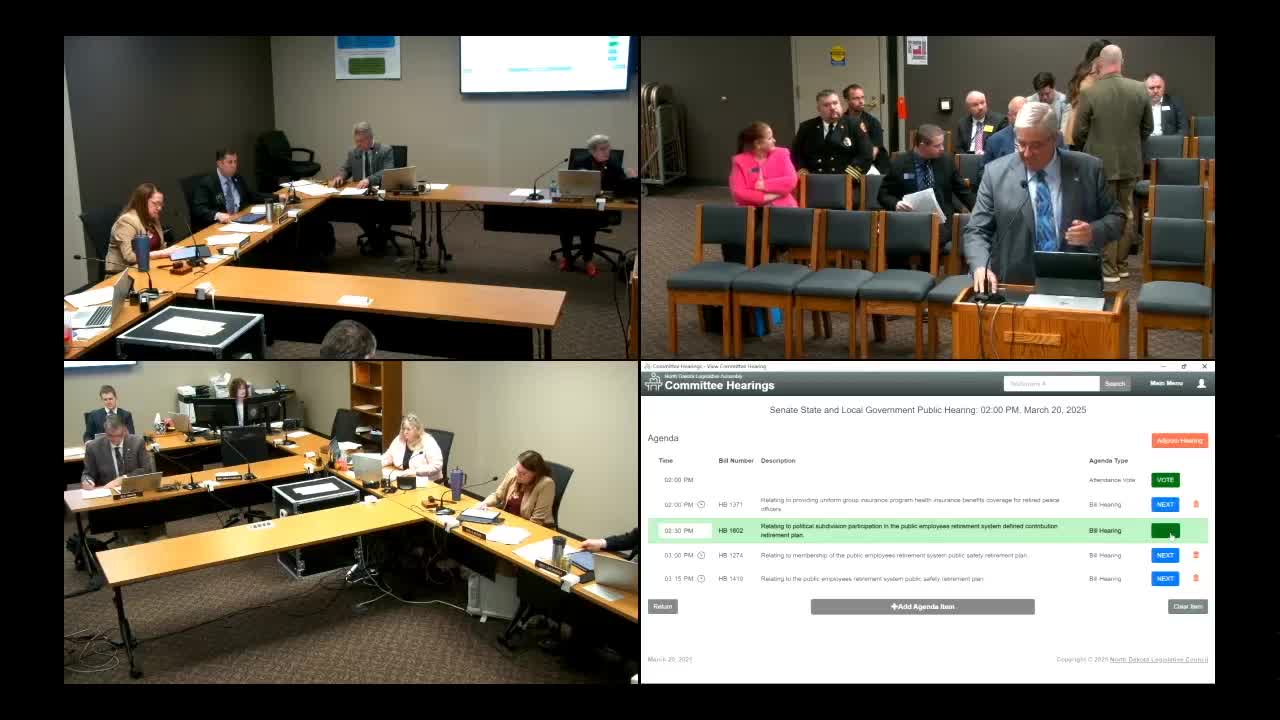
Representatives, corrections officials and PERS staff discussed House Bill 1274, which would allow state correctional officers to join the Public Safety Retirement Plan. Supporters framed the change as a parity and recruitment tool; PERS provided actuarial figures and said the move would increase contributions modestly across employers.
Representative Todd Porter told the committee House Bill 1274 seeks to add state correctional officers to the Public Safety Retirement Plan to achieve parity with other public safety professions and help recruitment and retention. "Correctional officers, like the rest of the first responder world, number 1, deserve to be in the same plan as other, first responders and law enforcement, officials," Porter said.
Colby Braun, director of the Department of Corrections and Rehabilitation, said the change is primarily a parity issue: political‑subdivision correctional officers are already eligible, but state correctional officers are not. He said the department anticipates approximately 450–500 DOCR team members would become eligible if the bill passes and highlighted the risks correctional staff face on the job.
Calvin Benson of the North Dakota Peace Officers Association told the committee the association "strongly supports this legislation." Derek Cobine (PERS chief operating and financial officer) provided a neutral analysis based on actuarial work. The actuary estimated the transfer of about 442 individuals would produce an actuarial gain of $12.2 million to the main plan and an actuarial loss of $17.4 million to the public safety plan; the net effect would require an increase of about 0.12% in employer contribution rates across all employers to recognize the moved liability. Cobine said the required general fund appropriation to cover initial costs was about $87,000 plus roughly $14,000 from other funds in the fiscal note.
Committee members asked clarifying questions about retirement eligibility (age 55 with three years of service or the "rule of 85"), portability and transferability between plans. PERS staff noted the IRS consultant had no concerns and that the change would not jeopardize plan qualification.
The hearing closed without a committee vote recorded in the transcript; PERS cautioned staff and lawmakers to coordinate drafting as other pension bills touch the same code sections.