Get Full Government Meeting Transcripts, Videos, & Alerts Forever!
Get email alerts on the Defined Contribution Plan topic
No spam. Unsubscribe anytime.
Committee recommends letting local governments opt out of state defined‑contribution plan
Summary
House Bill 1602 would let political subdivisions opt out of North Dakota's new state defined‑contribution plan and form their own DC plans; the committee recommended a due pass after hearing from cities, counties and PERS.
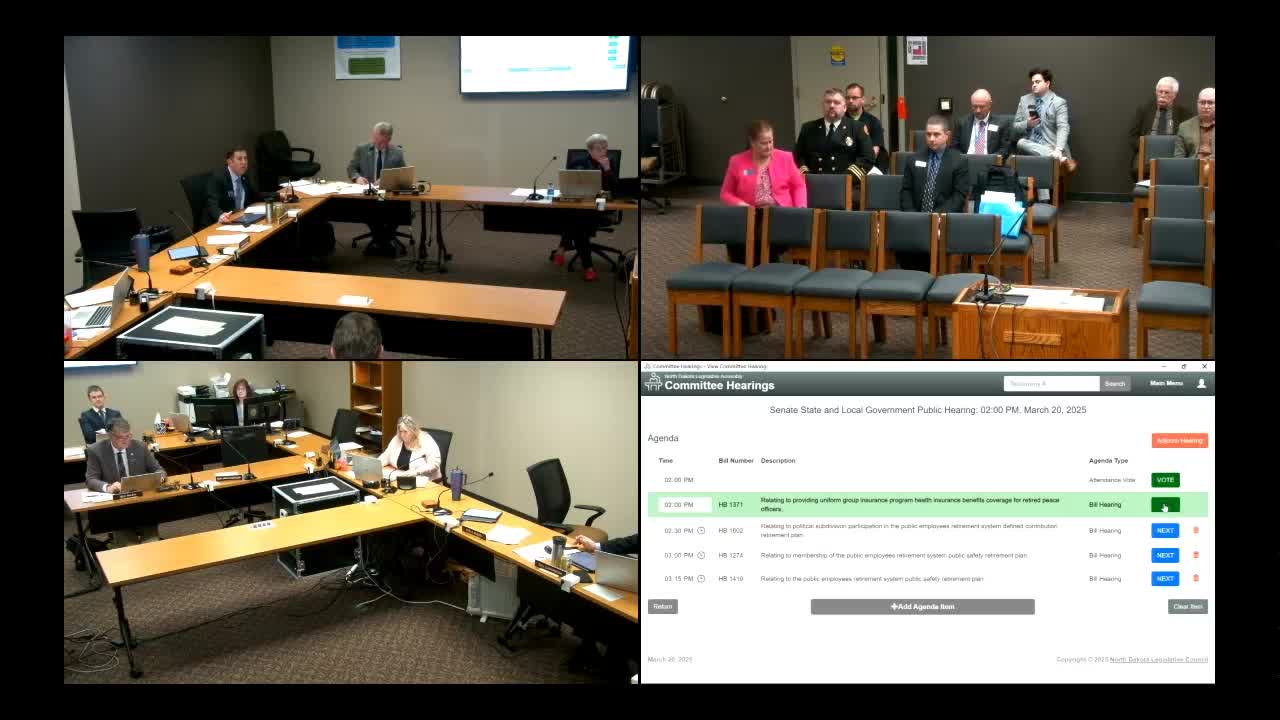
House Bill 1602, presented to the North Dakota Senate State and Local Government Committee, would allow political subdivisions that participated in the state's defined‑benefit plan to opt out of the state's new defined‑contribution plan and form their own DC plans. The measure also prohibits the Public Employees Retirement System (PERS) board from charging political subdivisions fees to withdraw from the state DC plan.
Representative Jim Casper, the bill sponsor, said the legislature closed the state's defined‑benefit (DB) plan effective Dec. 31, 2024 and replaced it with a DC plan akin to a 401(k). He told the committee the bill "clarifies current statute and allows political subdivisions to withdraw from the state defined contribution plan, and form their own plan if they wish." (Representative Casper)
Supporters — including the North Dakota League of Cities, the Association of Counties and several city officials — told the committee the bill is about local flexibility and giving cities and counties the option to choose a plan that best fits local recruitment and budgeting needs. Matt Gardner of the League of Cities said many local employers "would just like to have options," noting there are 98 cities that currently participate in PERS and that some already operate their own DC plans.
Derek Holbein, chief operating and financial officer for PERS, testified neutrally and warned that allowing political subdivisions to leave the pooled DC plan could change record‑keeper economics and investment‑fee dynamics. He noted the state switched record keepers to Empower in July 2024 and that a larger plan population gives more buying power and lowers per‑participant fees. "If you're spreading fees out across a population, the more people that are in the plan, the lower the fee should have to be per participant," he said.
Holbein said PERS has no objection to the bill's provision that the board may not assess withdrawal fees. He also urged the committee to recognize this is a policy choice: large pooled plans can produce scale benefits, but local governments may prefer different contribution structures or plan designs. The bill does not mandate any political subdivision change — local employers would have to elect to implement their own plans and may face administrative and contribution tradeoffs.
After testimony the committee voted to recommend a due pass for House Bill 1602. A recorded roll call showed Chair Rohrs, Vice Chair Castaneda, Senator Lee and Senator Wallin voting aye (vote 4‑0‑2).