Get Full Government Meeting Transcripts, Videos, & Alerts Forever!
Get email alerts on the Housing Homelessness topic
No spam. Unsubscribe anytime.
Lawmakers Hear Push for $10M Homeless Grant and Expanded Housing Incentive Fund
Summary
Nonprofits, housing developers and tribal advocates urged the House Appropriations Government Operations Division to fund a $10 million North Dakota homeless grant and increase the Housing Incentive Fund after testimony that both programs help match federal grants and fill gaps in affordable housing production.
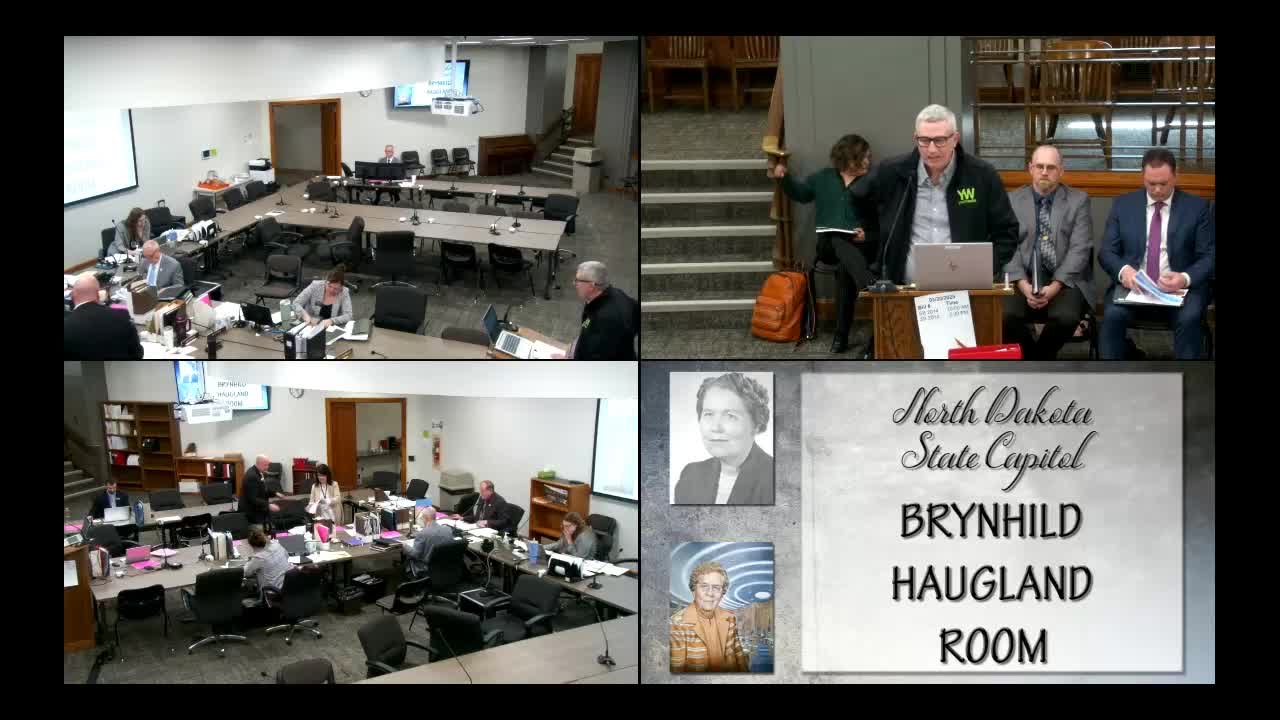
BISMARCK, N.D. — Witnesses urging state support for homelessness services and affordable housing told the House Appropriations Government Operations Division on April 16 that a proposed one‑time $10 million North Dakota homeless grant and larger Housing Incentive Fund (HIF) allocations would expand capacity across urban and rural communities.
Mark Heinert of YouthWorks told the committee the $10 million homeless grant included in Senate Bill 2014 is “an investment on young people” and said local match dollars are essential for organizations to leverage federal grants. Heinert said YouthWorks has federal contracts “upwards of $1,100,000,” which require a local match (about $266,000 annually) and that the group’s transitional housing beds (about 40 beds statewide) serve two people per year on average with a typical stay of six months.
The argument to fund both the homeless grant and HIF came from a mix of service providers, developers and tribal representatives who said state funds act as gap financing that leverages federal programs and private tax credit equity.
Why it matters: Witnesses told legislators that without state match dollars many federal awards cannot be accessed, and developers said HIF has been essential historically for producing deeply affordable units. Brent Dexter, executive director of the Lewis and Clark Development Group, told the committee that HIF funds have been a “gap filler” for projects the nonprofit has built and that, based on the group’s experience, “for every $30,000 we get in HIF, we can create one affordable housing unit.” Dexter said $25 million in HIF in a biennium could produce roughly 833 units; $50 million would double that output.
Testimony and figures presented
- Youth services and homelessness: Mark Heinert (YouthWorks) and Reagan Swind (Pathfinder Services) emphasized early intervention for youth and cited examples in Bismarck, Minot and Fargo. Heinert referenced a cost‑benefit study suggesting small success rates in preventing homelessness yield long‑term savings. Pathfinder’s Swind said rural homelessness is often hidden (doubling up, couch surfing) and gave concrete examples where modest security deposit assistance or short hotel stays prevented homelessness.
- Service capacity and outcomes: Heinert said YouthWorks served nearly 100 young adults last year with an average stay of six months and reported a 92% exit rate to “a safe and stable place.” Heinert and others argued this track record makes state investment likely to be cost‑effective.
- Housing Incentive Fund (HIF): Brent Dexter said Community Works North Dakota and related nonprofit subsidiaries have used HIF on 37% of their projects and that HIF contributed to about 50% (789) of the units they produced. Dexter provided statewide figures: about 29,415 extremely low‑income renter households in North Dakota, with roughly 18,191 units available for that population — a shortfall of about 11,000 units.
- Scale and rural capacity: Dexter said large multifamily projects can be delivered in the state and that his organization’s pipeline includes about $101 million in multifamily projects. He cautioned that small rural single‑family production faces contractor capacity limits but said multifamily construction has contractor interest and could absorb larger HIF allocations.
- Tribal and lived experience testimony: Lorraine Davis of Native Inc and Angela Buckley Totec, an enrolled member of the Standing Rock Sioux Tribe who described her seven‑year experience with homelessness and recovery, urged continuation of homeless grant funding and culturally competent services. Davis cited the North Dakota Continuum of Care and a 2025 Fair Housing Report noting disproportionate homelessness among Native Americans.
- Policy and allocation process: Dave (David) Flora of the North Dakota Housing Finance Agency explained that both the homeless grant and HIF use published allocation plans with public hearings and competitive application rounds; he said HIF includes rural priorities and can scale awards to community population bands (for example, under 5,000 and under 20,000 residents). Flora said the Senate placed $10 million in one‑time funding for the homeless grant and proposed transferring $25 million to HIF in the pending bills, with the transfer source differing from prior practice (using SIF rather than general fund in the Senate proposal).
Committee interaction and next steps
Committee members pressed witnesses on matching requirements, the number of beds and units, rural capacity and contractor bandwidth. Representative Bosch, Representative Meyer and others asked whether local municipalities and housing authorities contribute and how many projects could realistically be developed in a biennium. Dexter and others responded that multifamily projects could scale up and that rural single‑family construction faces capacity constraints.
Legislative direction in the hearing included requests for additional data and follow‑up: the Housing Finance Agency agreed to return with more detailed answers and pipeline data at a subsequent hearing. Several witnesses and at least one senator urged the committee to consider multi‑year commitments or budget triggers if revenues allow larger multi‑year bonds of HIF funding.
Ending
Supporters urged that modest state match dollars unlock federal grants and tax credit equity and that both the $10 million homeless grant and increased HIF allocations would expand services and build long‑term affordable housing stock across North Dakota. The committee did not take a vote; staff and agency follow‑up were requested and the issue will return to the committee in a future hearing.