Get Full Government Meeting Transcripts, Videos, & Alerts Forever!
Get email alerts on the Open Meetings Public Comment topic
No spam. Unsubscribe anytime.
Committee hears competing views on bill to require some public-comment opportunities at local meetings; decision deferred
Summary
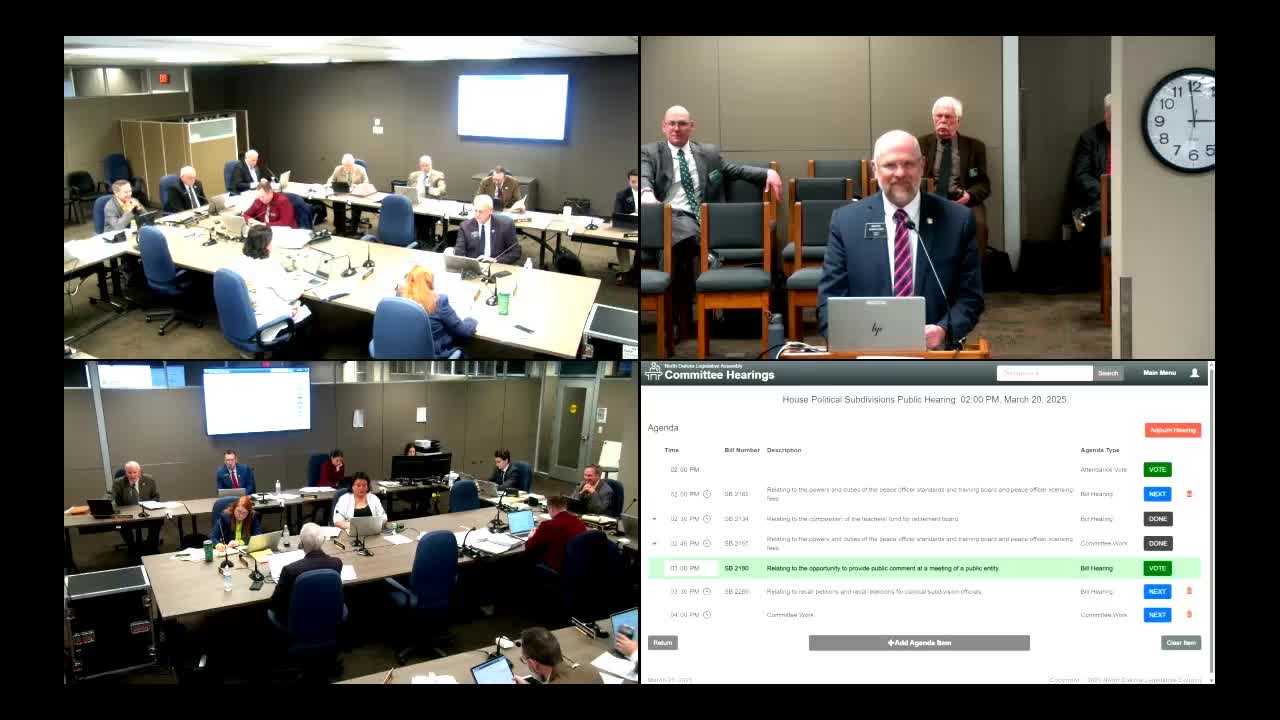
The House Political Subdivisions Committee heard testimony but did not take a vote on Senate Bill 21-80, which would require political subdivisions to provide public-comment opportunities at a portion of regular, publicly noticed meetings.
The House Political Subdivisions Committee took testimony on Senate Bill 21-80, a proposal that would require political subdivisions to provide opportunities for public comment at a portion of their regular, publicly noticed meetings. The committee did not vote and deferred further action to allow more work on the bill.
Senator Bob Paulson, sponsor of SB 21-80, said the bill is intended to protect citizens’ ability to “redress their government” and described examples in which parents or other residents were unable to speak at local governing-body meetings because comment opportunities were limited to annual meetings or constrained by agenda rules. The amended version presented to the committee would require that at least one-quarter of a political subdivision’s publicly noticed regular meetings per year provide an opportunity for public comment, that commenters provide a name and address, and that political subdivisions may limit comment by time-per-speaker or total time and adopt policies to keep comments pertinent and orderly. The amendment also permits comment on topics from the current and immediately preceding meetings to address situations where citizens learn of prior discussions only after they occur.
Opponents included Chris Ann Norby Jonner, house legal counsel for the North Dakota School Boards Association, and Kevin Hoert of the North Dakota Council of Educational Leaders. They urged caution and additional drafting, noting that many school boards already adopt policies limiting public comment to agenda items in order to preserve orderly conduct, ensure adequate notice, comply with open-meetings obligations and to allow inclusion of materials in the public meeting packet. Norby Jonner said the Senate amendment’s “may” language is permissive but that school boards typically limit comments to noticed agenda items and that allowing comments on previous meetings could conflict with local policies and expectations. Hoert said his group would prefer limiting comments to items on the current meeting’s agenda and suggested grievance processes and administrator-level meetings as alternatives for unresolved disputes.
Committee members asked questions about residency requirements, the purpose of collecting name and address, and the tension between public access and orderly governance. Representative Jonas asked whether the bill allowed speakers from outside a district to address a local school board; Senator Paulson said collecting name and address was intended to allow verification of residency consistent with local policies. Representative Boyer and others raised scenarios where citizens could not attend a specific meeting because of scheduling conflicts; opponents cited grievance policies and notice provisions as reasons to keep comments tied to current meeting agendas.
After hearing testimony and questions, the committee did not vote on SB 21-80 and said it would revisit the bill in a later meeting to allow additional drafting and stakeholder work.