Get Full Government Meeting Transcripts, Videos, & Alerts Forever!
Get email alerts on the School Performance topic
No spam. Unsubscribe anytime.
Colchester Middle School principal reports gains on several measures, highlights instructional and behavioral initiatives
Summary
Principal Tara Sharkey presented the middle school’s 2023–24 report and outlined current-year actions: instructional coaching in math and literacy, PLC focus, restored student voice activities, use of STAR growth data and a restorative practices approach to behavior. She also reviewed enrollment trends, assessment results and discipline data.
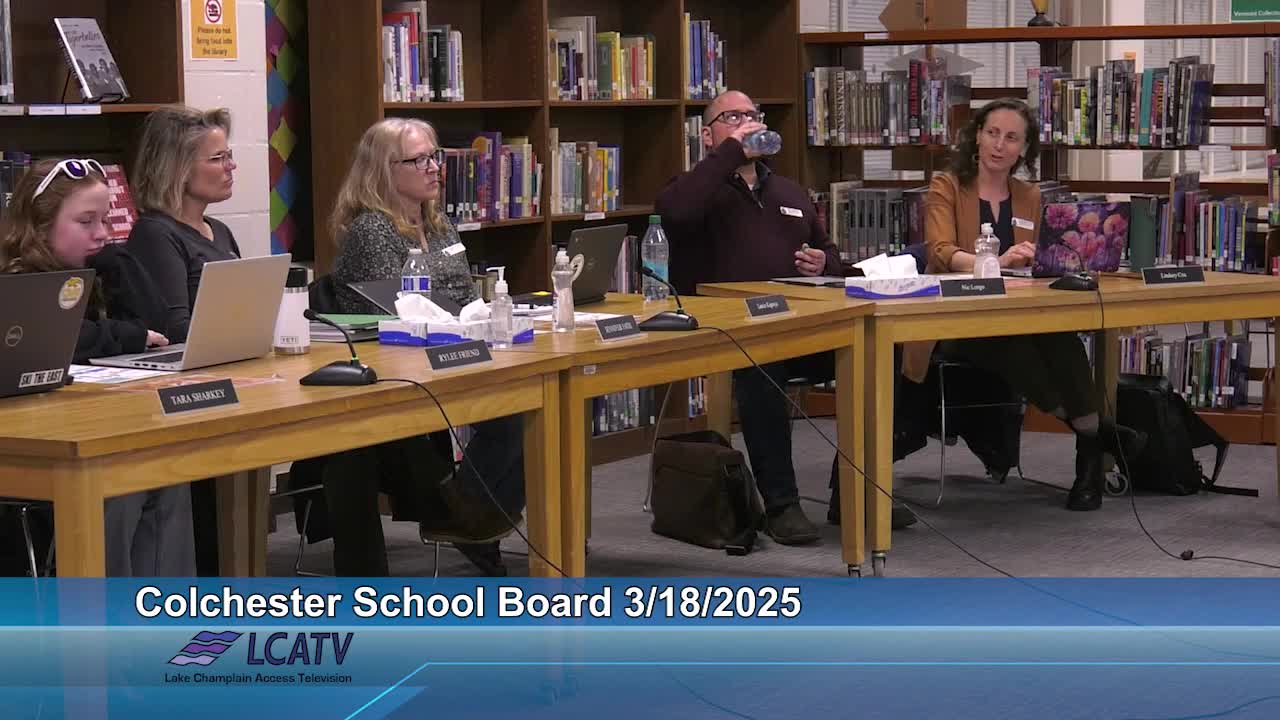
Tara Sharkey, principal of Colchester Middle School, presented the school’s official report for the 2023–24 school year and described work underway in the current year to act on that data.
Using October enrollment figures for average daily membership, Sharkey said enrollment at the middle school rose about 6 percent year-over-year and that average class size increased by roughly one student. She summarized assessment results from STAR screening and state assessments: according to the STAR spring data for 2023–24, about 63 percent of students were proficient or above in reading and about 60 percent were proficient or above in math. Sharkey also described STAR’s student growth percentiles, which showed that “about 68 percent of our students grew at or more than we would expect,” a metric the school uses to guide instruction and targeted supports.
Sharkey reviewed VT cap (state) results and noted that the middle school performed above state averages in most grade/subject combinations for 2024, with the exception of last year’s sixth-grade English language arts result. She showed subgroup breakdowns and said the school saw notable gains for students experiencing poverty and some changes for students with disabilities (where percentage changes represent small absolute counts and should be interpreted cautiously).
On discipline, Sharkey presented 2023–24 state-reportable metrics including total suspensions and students suspended, and additional referral-level data the school tracks. She described the planning room and restorative approach the school expanded with outside consultant John Kiddo to provide consistent, educational responses to misbehavior, and said minor defiance, minor disruption and inappropriate language were among the most common referral categories.
Sharkey described three core strategies guiding current work: middle-level instructional practices, teaming, and professional learning communities (PLCs). The school has two instructional coaches (math and literacy) who support PLCs, alignment to standards, formative assessment and targeted interventions. Action-plan committees address social-emotional learning, diversity/equity and student engagement; high-school students have been partnered to run TA (advisory) circles and leadership activities in the middle school.
Board members asked about details of the discipline tracking and whether repeats are monitored. Sharkey and other staff explained referral tracking via a “Fast Pass” Google form, PowerSchool entries for state-reportable incidents, and HR tracking for staff injuries; they said the planning-room staff and behavior interventionists add follow-up notes so records can be sorted by student, behavior, location and outcome. Sharkey also noted an apparent increase in recorded bullying incidents year to year in part because the district changed its counting (counting incidents by victim rather than by alleged perpetrator).
On enrollment projections, district staff reported a current cohort of 179 fifth-graders projected to enter sixth grade next year; the district noted earlier birth-year declines and increases in families moving into the district affecting different grade cohorts. The district is piloting Panorama software to create dashboards that integrate academic, behavioral and social-emotional data and track interventions over time.
Sharkey said the “magic-wand” priority would be more mental-health wraparound supports for students, which she described as an outsized need that affects learning and behavior.
No board action was required on the report; the presentation concluded with questions from trustees and thanks to the principal.