Get Full Government Meeting Transcripts, Videos, & Alerts Forever!
Get email alerts on the Home Care Sif Duals topic
No spam. Unsubscribe anytime.
Home‑care groups and dual‑eligibility advocates warn FY2026 cuts will worsen workforce and services
Summary
Providers and advocates testified against budget language that would remove the annual cost‑inflation factor for home‑care Medicaid rates and end funding for a dual‑eligibility ombudsman program, saying the changes would hamper recruitment and harm vulnerable clients.
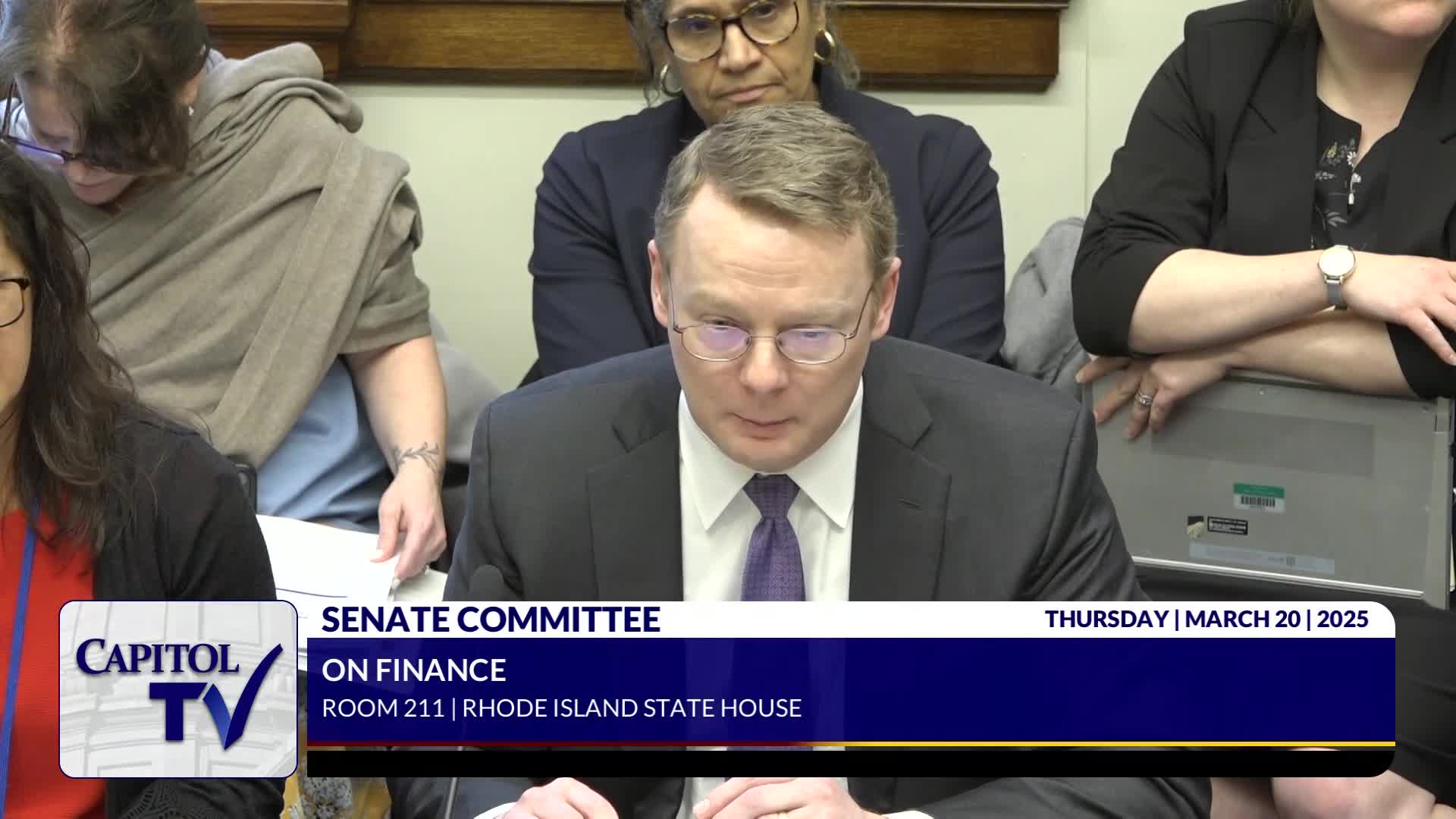
Home‑care providers, advocates for people who are dually eligible for Medicare and Medicaid, and community programs told the Senate Finance Committee on March 20 that proposed FY2026 budget changes would undermine a fragile home‑care workforce and cut services used by low‑income, elderly and disabled residents.
Nicholas Oliver, executive director of the Rhode Island Partnership for Home Care, said the governor's proposal would sunset the annual cost inflation factor (SIF) for Medicaid home‑care services, a statutory adjustment providers use to preserve labor competitiveness. "Removing the SIF in perpetuity will further weaken Rhode Island competitiveness in attracting and retaining Homecare's direct service and operational staff," Oliver told the committee, and he illustrated the immediate effect by explaining that a projected SIF this year would have added roughly 20¢ per 15‑minute unit (about 80¢ per hour) to the common personal‑care billing code.
Why it matters: Home‑care agencies compete for direct‑care workers with neighboring states where wages and demand may be higher; witnesses said incremental per‑unit adjustments matter for retention. Administration witnesses said selected HCBS (home and community‑based services) annual adjustments will be folded into OHIC's biennial rate review to align with other human services rates.
Other testimony addressed smaller but longstanding community programs. Seamus Durek of RIPE (Rhode Island Parent/Provider Education — transcript uses RIPE) said the governor's proposal would defund the RI dual‑eligibles ombudsman program, a service that the witness said has returned more to clients than it costs to operate. Durek asked for $59,000 in state funds to maintain the program through the fiscal year end, saying the program handled hundreds of client contacts a year and helped low‑income duals with complex eligibility and enrollment issues.
Committee members also discussed MRSS (mobile response and stabilization services) and CCBHC financing. The administration said Medicaid currently covers MRSS only within the CCBHC demonstration and would need federal approval to expand reimbursement outside that model; the administration indicated that changing reimbursement methodology requires a schedule that might push implementation into FY2027.
Providers urged the committee to preserve the SIF and to avoid changes that would weaken the workforce and shift demand to higher‑cost institutional care. EOHHS staff said they will work with the committee on language and timing; no final decisions were taken at the hearing.
Provenance: Testimony by home‑care provider associations and dual‑eligible advocates during the March 20 hearing on HB 5,076 informed this account.