Get Full Government Meeting Transcripts, Videos, & Alerts Forever!
Get email alerts on the Agriculture topic
No spam. Unsubscribe anytime.
Committee hears HB 119 to create Montana Cattle Committee; proponents back referendum, opponents cite governance and tribal representation concerns
Summary
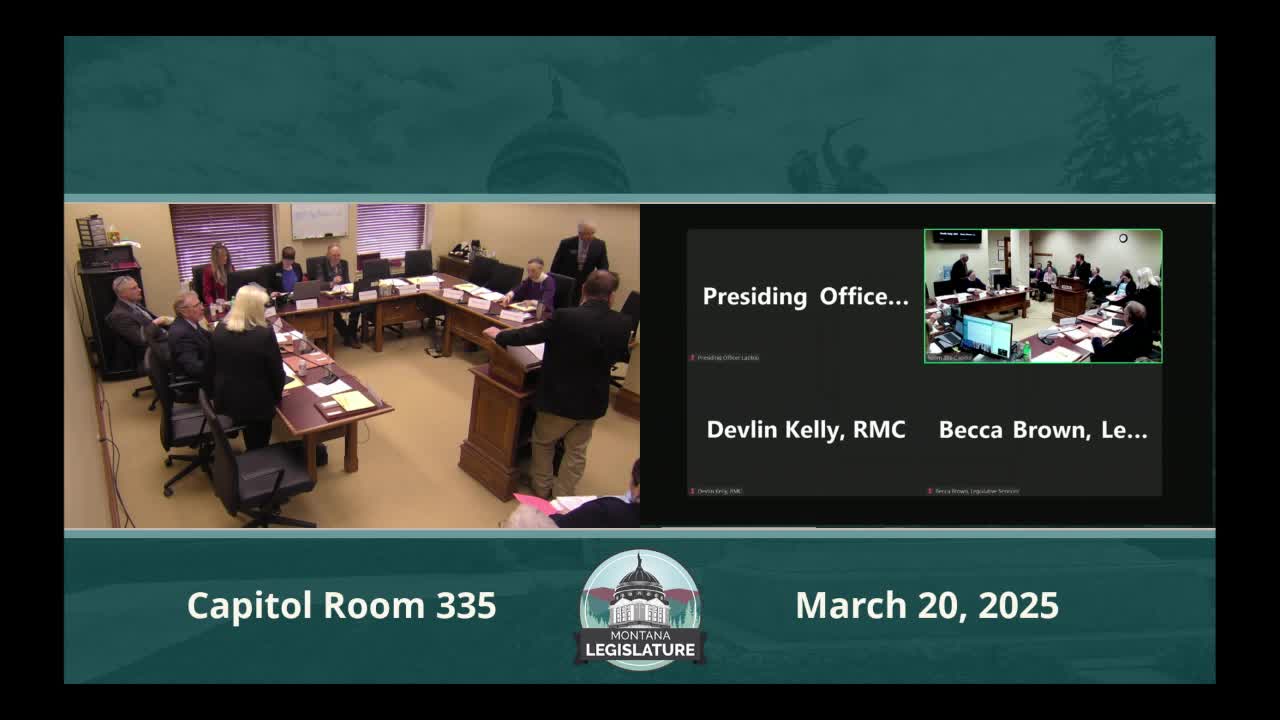
Montana Senate Agriculture, Livestock & Irrigation Committee Chair Senator Gillespie presided over a hearing on House Bill 119, a proposal to establish a Montana Cattle Committee and create the legal framework for a producer referendum on a potential $1-per-head assessment.
Montana Senate Agriculture, Livstock & Irrigation Committee Chair Senator Gillespie presided over a hearing on House Bill 119, a proposal to establish a Montana Cattle Committee and create the legal framework for a producer referendum on a potential $1-per-head assessment.
The bill’s sponsor introduced HB 119 as a vehicle to allow producers to decide whether to impose an assessment on themselves. “This bill here, let me preface this by saying this bill is not introducing the $1 tax. $1 tax would be voted on by a referendum of producers,” said Karli Johnson, spokesperson for the Montana Farm Bureau Federation. Johnson told the committee the Farm Bureau’s membership passed policy in support of creating a framework and that the measure is intended to let producers “ask their neighbors and fellow ranchers if they would support this and find value in it.”
Proponents described HB 119 as modeled on other commodity committees and checkoffs. Jim Curry, who said he is chairman of the Board of Livestock but testified “as a rancher, representing Curry Cattle and private enterprise,” said a working group of producers studied other states’ laws and tried “to not reinvent the wheel.” John Grande, a commercial cow-calf operator, and other proponents told the committee the committee would allow Montana producers to fund promotion, research and market-development activities that the national beef checkoff cannot perform because federal rules limit promotion to ‘‘U.S. beef,’’ not Montana-specific programs.
Supporters said the bill has amendments intended to broaden nomination sources for committee seats, clarify language, remove some exemptions from state procurement and allow producers to request refunds twice a year. Taylor Brown, a multigenerational cattle owner, said the group planned outreach to inform producers before any referendum: “The first, we envision that in the next 6 to 8 months we would start a program to inform the whole industry what exactly the idea would be.”
Opponents raised governance, transparency and representation concerns. Walter Schweitzer, president of the Montana Farmers Union, argued the Montana Beef Council could administer a state checkoff and said HB 119 “creates a second bureaucracy to manage this.” Several opponents asked for tighter guardrails around appointments and spending, and multiple speakers urged a higher voter-turnout threshold for a valid referendum. Members of the Montana Cattlemen's Association, Rocky Mountain Stock Growers Association and conservation and family-farming groups also testified in opposition.
Tribal representatives asked for explicit tribal representation in the bill. Patrick Kawaki, speaking for multiple tribes, said "House bill 119 does not provide adequate Native American representation" and requested adding a Native organization to the nomination process, citing the Intertribal Agriculture Council as an example that could provide nominations.
Other concerns cited by opponents included: the potential for the Department of Livestock to administer collections and the related administrative costs; whether assessments could be redirected to national organizations; and whether a new board appointed by the governor would politicize the program. Ken Morris, secretary of the Montana Cattlemen's Association, said the MCA opposed the bill in its current form, arguing it “allows Montana Department of Livestock to remove around a hundred 90,000 from this tax revenue each year for the hiring of 1 full time employee,” a figure he said represented predicted administrative draw but that opponents disputed.
Committee members were presented with a variety of proposed amendments during testimony: proponents described a sponsor amendment package intended to broaden nominating groups and adjust refund processes; opponents proposed changes including a higher participation threshold for a referendum (for example, 40% of eligible ballots returned) and explicit tribal representation in nominee pools. No formal committee vote on the bill occurred during the hearing record provided.
The hearing included proponent testimony from state commodity leaders, ranchers and producers and opposition from producer groups, tribal representatives and conservation and family-farming organizations. Senator Gillespie indicated further amendment work was planned; multiple speakers asked the committee to delay final action until additional amendments on nomination processes, referendum thresholds and spending rules were considered.
The committee record shows the hearing focused on whether the state should create a statute enabling producers to hold a referendum on a voluntary producer-assessed program and, if so, how to structure nominations, refunds and oversight. The transcript does not show a final committee vote on HB 119 during the session covered by this record.