Get Full Government Meeting Transcripts, Videos, & Alerts Forever!
Get email alerts on the Early Literacy And Numeracy topic
No spam. Unsubscribe anytime.
House Bill 628 would expand early‑literacy program to include numeracy and allow limited on‑target student enrollment
Summary
House Bill 628 would broaden Montana’s early literacy targeted intervention into an "early scholastic" program, add early numeracy and permit optional enrollment of a limited number of on‑target students to participate alongside eligible children, the bill sponsor told the Senate Education Committee.
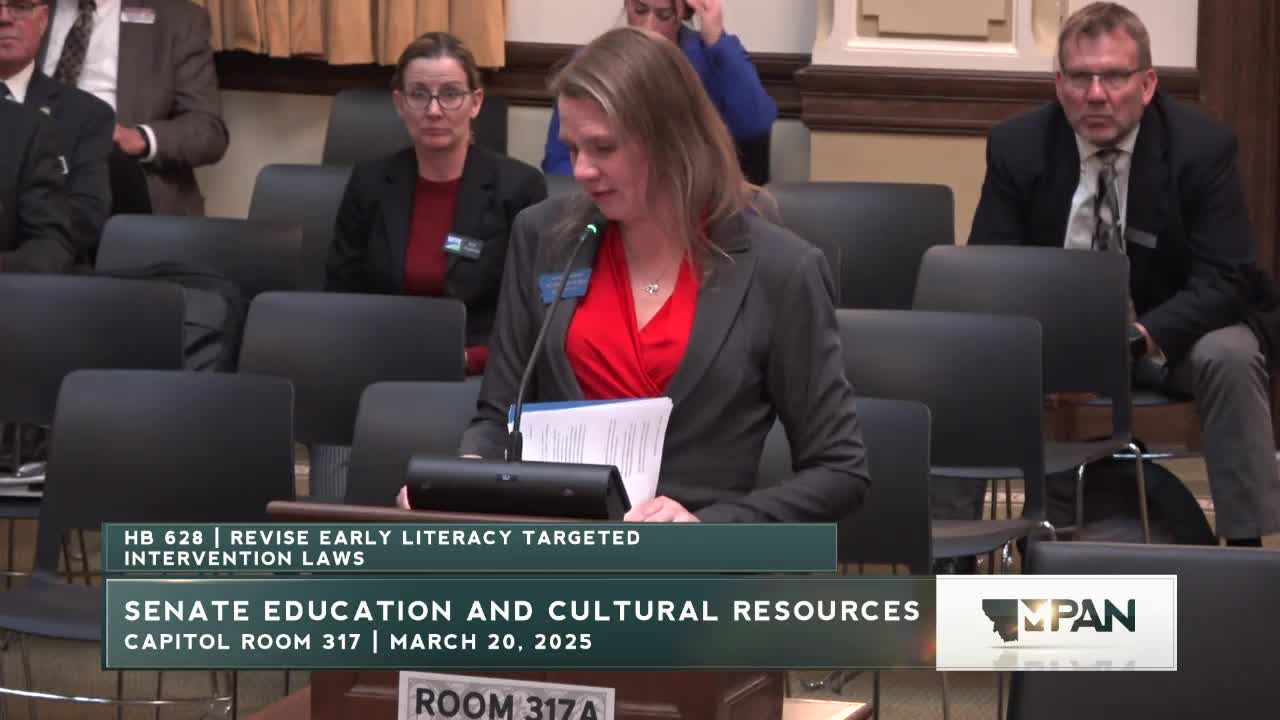
Representative Melissa Nicholas introduced House Bill 628 to refine Montana’s targeted early‑literacy intervention program by renaming it to encompass broader scholastic skills, adding numeracy, and allowing limited enrollment of ‘on‑target’ (not‑at‑risk) children as models in classrooms and summer jump‑start programs.
Nicholas told the committee the bill "gives schools an option to have a few model students in the early literacy classrooms only" and that model participation would be capped at a ratio of no more than one on‑target child for every five eligible children. She provided handouts summarizing research showing positive impacts from heterogeneous classrooms and a list of current participating schools and their enrollment; she noted many classrooms are already at statutory caps (18 students), so district capacity will constrain expansion in some places.
Proponents included Marissa Graybill (educator and parent), Caitlin Jensen (0 to 5 Montana), Rob Watson (Coalition of Advocates for Montana’s Public Schools), Katie Bloodgood (OPI legislative liaison), Kim Popham (MFPE), and Rob Watson and others. Testimony emphasized peer learning benefits and family‑friendly logistics for siblings. OPI’s Katie Bloodgood told the committee the bill would expand eligibility to math and other scholastic skills and that the agency supports the change.
Supporters said the change could make it easier for some districts to start or sustain programs by allowing a small number of on‑target children (family logistics, summer access), while still keeping the program targeted at children who need intervention. Several speakers noted the 18‑student cap and current district capacity constraints.
The committee closed the hearing; no committee action appears in the transcript provided.