Get Full Government Meeting Transcripts, Videos, & Alerts Forever!
Get email alerts on the Environment Water Quality Mepa topic
No spam. Unsubscribe anytime.
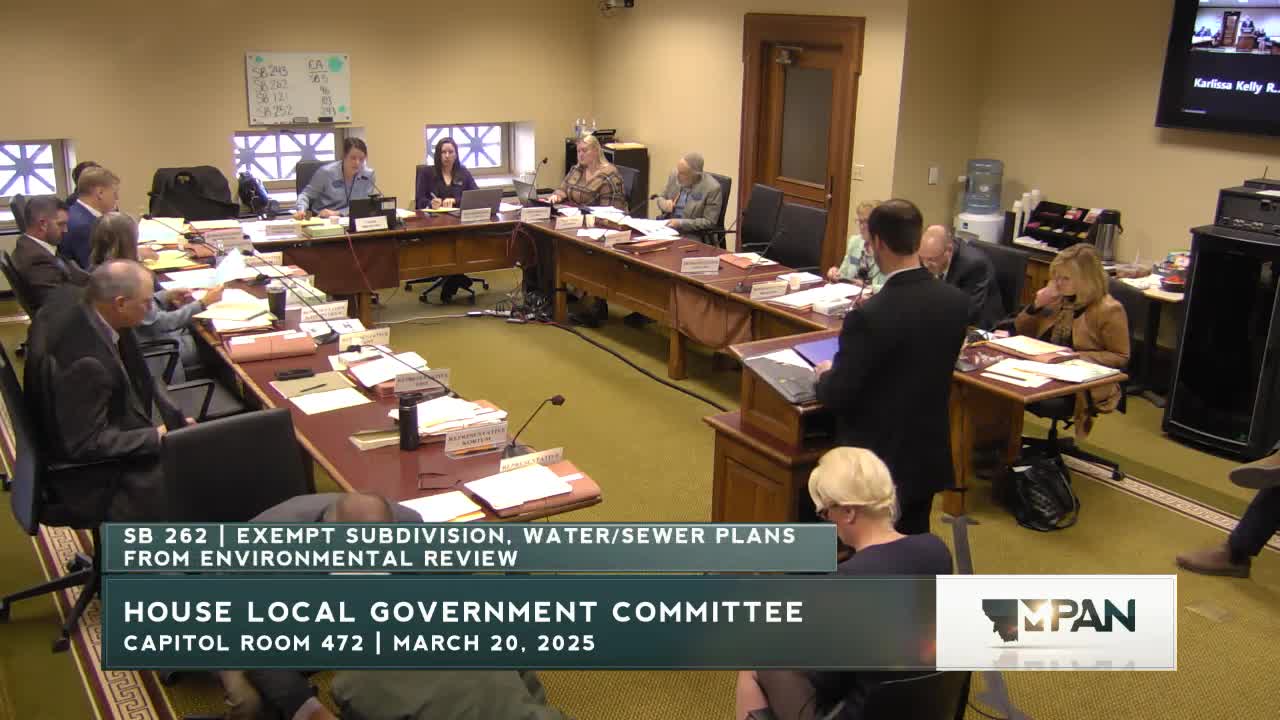
Bill to exempt subdivisions from MEPA review draws sharp opposition over water concerns
Summary
Senate Bill 262 would remove certain subdivision reviews from the Montana Environmental Policy Act (MEPA) requirement tied to DEQ sanitation reviews; supporters say it eliminates duplicative review, while opponents warn it could weaken cumulative watershed analysis and public participation.
Senate Bill 262, introduced by Sen. Forrest Mandeville, would remove certain subdivision reviews from the Montana Environmental Policy Act (MEPA) requirement that accompanies Department of Environmental Quality (DEQ) sanitation reviews. The sponsor said the change is meant to streamline DEQ review and lower time and cost burdens on subdivisions that already face local review and septic permitting.
Proponents included the Montana Building Industry Association, county planners and a Flathead County planning board chair, who said DEQ MEPA reviews add time and paperwork without changing final permit outcomes and that the bill would allow local and independent reviewers to process applications more efficiently. Jeff Larson, a civil engineer and Flathead County planning board chair, said the DEQ sanitary review currently duplicates extensive environmental review and that removing the MEPA checklist would free staff time and make independent review more feasible.
Opponents included the Montana Environmental Information Center, the Greater Yellowstone Coalition and multiple private citizens who described wells that went dry and urged caution. Derf Johnson of the Montana Environmental Information Center said the sanitation review evaluates a single project’s non-significance criteria but does not substitute for a cumulative watershed analysis under MEPA; he warned the bill would “sectionalize” review and could miss cumulative impacts on aquifers and streams.
Several speakers described recent wells going dry in the Blackfoot Valley and other rural areas and said exempting subdivisions from MEPA could harm long-term water security for existing residents. Gary Aitken told the committee his and three neighbors’ wells went dry during a recent dry period and said the proposed exemption could leave long-term residents exposed to downstream consequences of new subdivisions.
DEQ staff testified in an informational capacity that DEQ’s current sanitation review focuses on physical water availability and sanitation design and that removal of MEPA would not eliminate sanitation design, septic permitting or some water-quality safeguards. Lindsey Krivaruchka, DEQ’s water quality division administrator, said the DEQ program is funded through state special revenue and that the agency would continue to review for physical availability and ensure water quality protections under current statutes.
Committee members probed potential public-participation impacts and legal risk. Opponents flagged Montana’s constitutional right to a clean and healthful environment and warned that broad exemptions from MEPA could invite legal challenges. The sponsor said the bill does not remove local review or septic permitting and argued that MEPA adds time and cost for little gain on the projects that trigger sanitation review.
No final committee vote occurred during the hearing; members requested follow up and additional information on cumulative impacts and public-notice mechanisms.