Get Full Government Meeting Transcripts, Videos, & Alerts Forever!
Get email alerts on the Housing Density Height Reform topic
No spam. Unsubscribe anytime.
Committee weighs bill to allow up to six-story buildings in commercial zones to boost housing supply
Summary
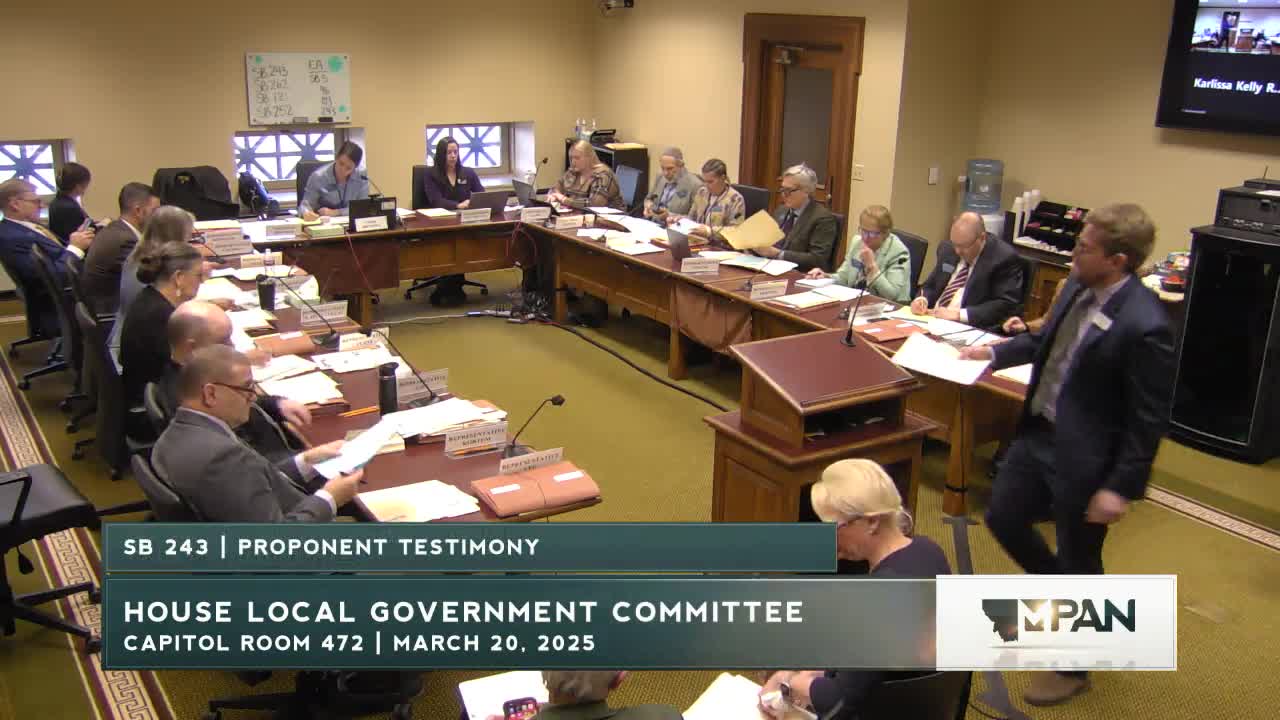
Senators and representatives on the House Local Government Committee heard testimony for and against Senate Bill 243 on whether cities should be required to allow up to six-story buildings by right in commercial zones in larger Montana cities.
Senators and representatives on the House Local Government Committee heard testimony for and against Senate Bill 243 on whether cities should be required to allow up to six-story buildings by right in commercial zones in larger Montana cities.
Proponents told the committee the bill would create “predictability” for developers and encourage investment in housing. Opponents said raising allowable height without affordability requirements could increase land values and construction costs and would strip local governments of tools to manage transitions to lower-density neighborhoods.
Supporters, including Jake Brown of Shelter Whitefish and Tanner Avery of the Frontier Institute, said the measure builds on last session’s housing reforms and would allow “5-over-1” mixed-use designs and other mid-rise configurations in commercial areas where people shop and work. Brown told the committee the change would reduce per-unit land costs by allowing more units on the same footprint, while Avery described the bill as “low-hanging fruit” to increase supply without mandating taller buildings.
Opponents included Kelly Lynch, executive director of the Montana League of Cities and Towns; local planners and officials from Bozeman and Billings; and members of the public. Lynch said commercial zones in local zoning practice include many types of areas — including neighborhood commercial areas — and warned the bill could force communities to allow taller buildings in places that currently use step-down height limits to transition to single-family neighborhoods. Wyeth Friday, planning and community services director for Billings, described existing local tools such as step-backs and lower maximums in transition zones and said a state-mandated six-story floor could eliminate those context-sensitive rules.
Several witnesses from Bozeman described the city’s recent development: a large amount of new housing, a roughly 10% vacancy rate in one speaker’s account, and continued concerns about affordability. David Fine, an economic development manager for Bozeman, said taller buildings tend to be built where land is expensive and that building higher often raises per-square-foot construction costs because of structural and fire-safety code requirements; he told committee members that “4 stories is the sweet spot” in many markets because it can be built using stick-frame construction.
Committee members asked whether increased height alone would produce affordable housing. Sponsor Senator [Senator Boldman] (identified in testimony as the bill sponsor) and proponents repeatedly said the bill was meant to increase supply and predictability for developers, not to impose affordability mandates; several committee members asked whether the sponsor would accept amendments tying additional height to affordability conditions, and the sponsor said she would be open to amendments.
The hearing included questions about infrastructure, with the sponsor noting language in the proposed bill that requires a “will-serve” letter for water and sewer from municipal providers for projects using increased heights. Proponents said denser infill generally reduces per-capita infrastructure footprint compared with large suburban sprawl.
The committee did not take a final vote on the bill during the hearing. The discussion highlighted a common theme across testimony: supporters argued that permitting taller construction in commercial cores could add units where demand already exists, while opponents argued that without affordability requirements the market response likely would not produce lower-cost housing for local workers.
The committee may consider amendments and additional data in follow-up work.