Get Full Government Meeting Transcripts, Videos, & Alerts Forever!
Get email alerts on the Health Insurance Subsidy topic
No spam. Unsubscribe anytime.
Subsidy to replace reinsurance fails in committee on 5–5 roll call after extended debate
Summary
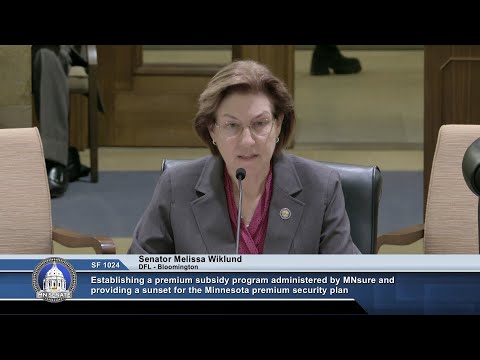
Senate File 1024, proposing a 20% direct premium subsidy to replace the state's reinsurance program, was debated at length and failed on a tie roll call in the Commerce Committee.
Senate File 1024, introduced March 20, 2025, would have repealed Minnesota’s reinsurance program and established a direct 20% premium subsidy for individual‑market enrollees who do not receive advanced premium tax credits (APTCs). After extended testimony from the bill author, industry representatives and MNsure and Department of Commerce witnesses, the Commerce Committee voted on the motion to advance the bill and the motion failed on a 5–5 roll call.
Senator Wicklund, the bill’s author, said the subsidy is designed to replicate reinsurance’s market‑stabilizing effect for consumers who do not receive federal premium tax credits and to avoid dependence on a 1332 waiver that draws federal pass‑through funds. "The subsidy is set at 20% because reinsurance has lowered the underlying rates for the individual market by about 20%," Wicklund said.
Witnesses and committee members debated the relative efficiency of the subsidy approach versus reinsurance. Dan Andreesen of the Minnesota Council of Health Plans and MNsure staff noted practical and operational challenges: MNsure’s fiscal note predicted substantial upfront program administration needs, possible manual enrollment in year one, and an implementation timeline that likely would not allow full operation until plan year 2027, creating a potential gap if reinsurance funding ends before the subsidy is operational. Andreesen also noted the subsidy could be treated as taxable income for recipients and that a state subsidy outside the 1332 waiver would forgo federal pass‑through funds used under reinsurance.
Senator Wicklund and others argued the subsidy could be more targeted and could reduce state exposure to federal waiver risks that in past years affected MinnesotaCare funding. Senator Rasmussen and other senators pressed for more actuarial modeling, clarity on MNsure staffing and implementation costs, and assurance there would be no coverage gap between the programs.
Having heard testimony and responses, the committee took a roll call. The clerk recorded five aye votes and five nay votes; the committee announced that with a 5–5 split the motion was not adopted and the bill did not pass out of committee.