Get Full Government Meeting Transcripts, Videos, & Alerts Forever!
Get email alerts on the Manufactured Housing Parks Regulation topic
No spam. Unsubscribe anytime.
Committee advances bill to cap lot‑rent increases at 3% and expand resident purchase rights for manufactured‑home parks
Summary
Senate File 26‑91 would cap annual lot‑rent increases at 3% absent a narrow health‑and‑safety exception, expand residents’ notice and purchase opportunities, and require greater owner transparency and maintenance obligations.
St. Paul — Lawmakers advanced a broad bill (Senate File 26‑91) Thursday aimed at protecting manufactured‑home residents from steep lot‑rent increases, expanding notice and transparency when parks are for sale, and clarifying owner maintenance responsibilities.
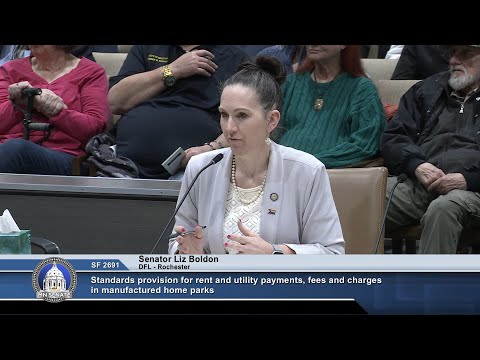
Senator Bolden, the bill’s sponsor, told the Senate Committee on Housing and Homelessness Prevention the measure would impose a presumption that a rent increase above 3% is unreasonable, establish an enhanced "opportunity to purchase" process for residents and nonprofits, and require clearer owner responsibilities for common‑area maintenance and payment policies.
"This bill tackles excessive rent increases by finally defining what is reasonable — no more than 3% annually — and creates real opportunities for residents to purchase their parks," Bolden said in opening remarks.
The hearing drew a large and sometimes emotional group of testifiers. Resident witnesses described recent rent spikes and management practices they said threaten longtime homeowners. Andres Hernandez, who identified himself as a resident of Evergreen Estates, told the committee a $50 lot‑rent increase had strained his family’s budget after his hours at work were reduced.
"It seems like every these companies look at us as money machines instead of real people who are trying to make a life," Hernandez said.
Several witnesses described rapid private‑equity acquisition of parks, lawsuits and enforcement actions in different cities, and steep rent jumps at specific communities. Bree (Bree Mafi) Mafi, president of a residents association in Lake Elmo, said her community now faces lot rent she described as the highest in the state and reported a dramatic rise in evictions since 2020.
Industry groups and community owners expressed opposition, focusing on rent control’s potential effects on financing, investment and park maintenance. Cecil Smith, president and CEO of the Minnesota Multi Housing Association, said in testimony "the vast majority of economists...raise red flags about rent control" and warned of broader disinvestment. Several owner and operator witnesses described sharply higher operating costs in recent years — property taxes, insurance, wages and storm damage — and said a strict cap would be difficult to administer.
The bill contains a statutory presumption of reasonableness for a 3% increase and language that would allow owners to prove by clear and convincing evidence that a larger increase is needed "for the health and safety of residents." Sponsor Bolden said that exception preserves a pathway for necessary repairs or infrastructure work.
A previous "opportunity to purchase" law enacted in 2024 requires park owners to provide notice to Minnesota Housing and residents when an owner receives an offer; several witnesses said the 2024 law has not had time to be fully implemented. Opponents argued the proposal would impose delays and additional obligations on owners selling their properties; proponents said the market advantage currently favors out‑of‑state investors who can make all‑cash offers.
The committee considered multiple amendments in a lengthy discussion. An oral amendment by Senator Drayheim that would have deleted the bill’s rent‑control section (section 8) failed on a voice vote. Senator Bolden accepted several technical and drafting revisions during the hearing.
After extended debate, Bolden moved that the file, as amended in committee, be recommended to pass and be referred to the Senate Commerce Committee. The motion carried by voice vote; the measure was forwarded to Commerce for further consideration.
Why it matters: An estimated 180,000 Minnesotans live in manufactured‑home communities and many own their homes but rent the lots beneath them. Advocates say the bill is intended to protect low‑ and fixed‑income homeowners from sudden rent hikes and displacement; owners argue the limits on rent increases create financing and maintenance challenges.
What’s next: The bill is recommended to pass out of this committee and was re‑referred to the Commerce Committee; it will face additional committee review and possible amendment there.