Get Full Government Meeting Transcripts, Videos, & Alerts Forever!
Get email alerts on the Campaign Finance topic
No spam. Unsubscribe anytime.
Senate panel advances bill to limit inaugural fundraising, extend transition grants to other statewide offices
Summary
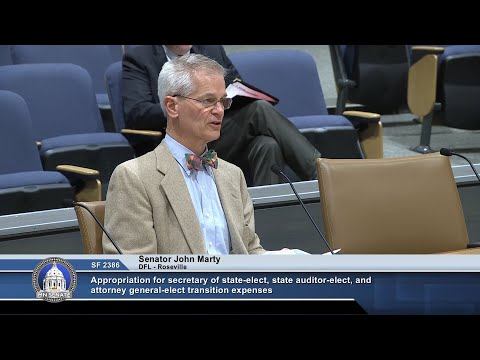
The Minnesota Senate Elections Committee voted to recommend passage of Senate File 2386, which would extend transition expense grants to newly elected constitutional officers and treat inaugural and transition expenses as campaign disbursements subject to existing contribution limits.
The Senate Elections Committee on March 20, 2025, voted to recommend passage of Senate File 2386, as amended, sending the bill to the Senate State and Local Government Committee. The bill would extend transition-expense grants to newly elected statewide constitutional officers and require inaugural and transition expenses to fall under existing campaign contribution limits.
Senator Marty, author of the measure, told the committee the bill would “simply help address a couple of things,” including recognizing transition costs for newly elected constitutional officers. He said Minnesota already provides transition funds for governors — “the state puts a whopping $162,000 in for all of their transition expenses” — and the bill would create similar, discretionary grants “up to $50,000” for a newly elected secretary of state and state auditor and “$75,000” for a newly elected attorney general, with unused funds returning to the contingency fund.
The bill also would change how campaign-related disbursements for inaugural events are treated. Under the proposal, inaugural and transition expenses would be categorized as noncampaign disbursements that must comply with existing contribution limits, and thus be reported to the state’s campaign finance regulator. Marty said the change is intended to curb large, opaque gifts to inaugural committees, citing recent federal-scale examples in which inaugural spending grew from about $3.5 million in the Jimmy Carter era to roughly $70 million in a recent presidential inauguration and noting corporate gifts at the federal level, including donations he said were “$1,000,000 from Boeing, $500,000 from Chevron.”
Senator Limmer, a committee member, questioned the growth in inaugural spending and noted a 2009 news estimate that a presidential inauguration that year cost about $170 million. The committee recorded no other testifiers.
The committee adopted an A2 author’s amendment offered by Marty before considering the bill. The committee then voted by voice to recommend passage of Senate File 2386, as amended, and to refer it to the Senate State and Local Government Committee. The motion was approved on a voice vote with no recorded opposition.
The bill text cited by the author includes provisions to (1) authorize discretionary transition grants for newly elected constitutional officers (amounts specified in the bill), (2) classify inaugural and transition expenses under the state's campaign contribution limits and reporting rules, and (3) align rulemaking timelines for the Campaign Finance and Public Disclosure Board with the new statutory timing. The transcript did not provide the bill’s full fiscal note; the author said the proposal does not require an additional appropriation because the contingency fund would cover the grants.
If advanced by the next committee, the bill would move through the standard legislative process; the committee did not set implementation dates or further deadlines during the recorded hearing.