Get Full Government Meeting Transcripts, Videos, & Alerts Forever!
Get email alerts on the Higher Education Finance Policy topic
No spam. Unsubscribe anytime.
Minnesota higher-education package would tighten grant rules, consolidate reports and boost licensing fees to address shortfalls
Summary
The governor’s higher-education policy and budget packages presented to the Minnesota Senate Higher Education Committee would change how the state awards and manages student aid, consolidate several program reports, increase licensing and registration fees for institutions, and tighten eligibility for the North Star Promise tuition program.
The governor’s higher-education policy and budget packages presented to the Minnesota Senate Higher Education Committee would change how the state awards and manages student aid, consolidate several program reports, increase licensing and registration fees for institutions, and tighten eligibility for the North Star Promise tuition program.
Nikki Oliver, director of government relations and community engagement for the Office of Higher Education, summarized the policy bill’s changes, saying, “Section 3 is consolidation of competitive grant and student loan repayment reporting.” Oliver also told the committee the bill would add a grievance-resolution process for campus misconduct protections and extend statutory protections for pregnant and parenting students to private institutions.
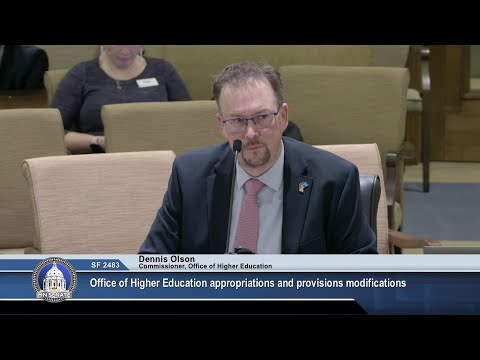
Commissioner Dennis Olsen described the governor’s proposals for the Minnesota state grant, saying the package pairs statutory changes with a recommended investment of “$7,500,000 a year, or $15,000,000 over the biennium.” Olsen said the changes are intended to “bring projected spending back within available appropriated resources and eliminate the need to ration state grant awards.”
Office of Higher Education staff described specific parameter changes the package proposes. Olsen and agency staff said the proposal would allow the agency to set a minimum parental or student contribution at zero in the state-grant award calculation when required by federal guidance, eliminate negative student-aid-index effects in award calculations, reduce the living and miscellaneous expense allowance to 110% of the federal poverty guideline, increase assigned student responsibility to 51% (beginning in fiscal 2027), and set family contribution parameters to 100% of the federal need-analysis standard beginning in fiscal 2026. The bill also would revert the deadline for state-grant receipt to the 30th day of the term used to award aid and would clarify the agency’s authority to reduce awards if a program deficit is projected.
Carrie Schneider, research director for the Office of Higher Education, told the committee enrollment increases and late changes to the FAFSA needs-analysis formula intensified pressure on the state grant. “Enrollment in Minnesota increased by 18,000 from fall of 23 to fall of 24,” Schneider said, and she pointed to sudden changes in the federal needs analysis that increased projected spending for the program.
On institutional oversight, Andrew Wald, general counsel and director of compliance at the Office of Higher Education, said the licensing and registration unit licenses and registers more than 400 institutions and “we do this with a staff of 3 people.” Wald described proposed fee-structure changes that would shift some fees to be based on full-time-equivalent enrollment rather than program level, raise fees for licensed schools and solicitors, simplify renewal fees and timelines, and eliminate many current exemptions in order to focus the office’s work. Wald told the committee the proposal would generate about $341,000 in increased fees annually to reduce program backlogs and support hiring an additional full-time academic program reviewer.
Committee members also questioned provisions affecting the North Star Promise program, which helps low-income students with tuition. Commissioner Olsen said the governor’s proposal would “eliminate instances where North Star Promise is paying for out-of-state tuition” and prevent payment for courses that are ineligible for financial aid. Olsen said the change would align North Star Promise residency definitions with the statutory resident definition used for other state financial aid programs.
The presentation also included technical and program changes: clarifying eligible institutions for the traumatic brain injury research grant, repealing several rarely used reports (including the study-abroad and certain transfer reports), and a proposal to increase the amount reserved for student loan bonds from $10,000,000 to $25,000,000 per year in the agency’s tax-exempt small-issue pool. The agency requested a modest operating increase to its general fund appropriation—$162,000 in fiscal 2026 and $328,000 in subsequent years—to cover compensation, insurance and IT costs.
Committee members pressed the agency on whether eliminating individual statutory report deadlines would harm oversight. Oliver and Wendy Robinson, assistant commissioner for programs, policies and grants, said the statute would repeal multiple statutory reporting requirements and replace them with a consolidated report containing the same information and a single due date. “We are recreating a report with all the same information for these programs,” Robinson said.
Committee action on the bills was procedural during the hearing. The committee adopted an A-1 amendment by voice vote, later adopted an eighth amendment, and the bill was laid over for further consideration.
If enacted, the package would change how the state calculates and distributes need-based grant dollars, alter reporting requirements for multiple grant programs, increase fees for institutional licensing and registration to fund enforcement capacity, and tighten North Star Promise eligibility to limit payments for nonresident tuition and certain ineligible courses. Lawmakers on the committee flagged the trade-offs: several members urged prioritizing funding and policies that would direct aid to students with the greatest needs while others emphasized capacity and consumer-protection benefits from additional licensing staff.
The Office of Higher Education told the committee it expects the proposed fee changes and consolidated reporting to improve timeliness and reduce backlogs in program approvals and student-complaint investigations, but staff and several senators said the policy choices for the state grant will reduce award amounts for some students as the program is balanced against available appropriations.