Get Full Government Meeting Transcripts, Videos, & Alerts Forever!
Get email alerts on the Consolidation And Workers topic
No spam. Unsubscribe anytime.
Minnesota Senate panel hears how consolidation can squeeze workers across industries
Summary
Witnesses at a Senate Labor Committee informational hearing described how industry consolidation and business models such as misclassification and vertical integration can reduce wages, limit choices for patients and communities, and constrain opportunities for small businesses and contractors.
The Minnesota Senate Committee on Labor convened March 20 for an informational hearing on consolidation and workers, hearing testimony from labor leaders, a former federal antitrust official and representatives of farmer, construction and health-care organizations.
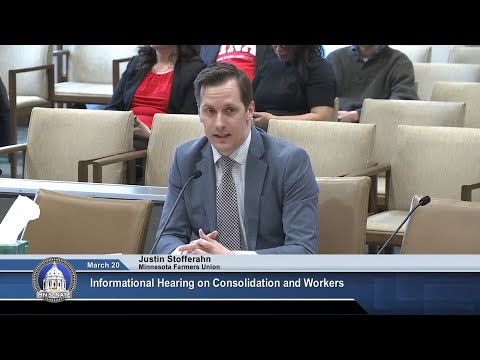
Committee Chair McEwen opened the session and introduced the first witness, saying the committee had “a really interesting, informational hearing” on consolidation and workers. Justin Stofran, anti‑monopoly director at the Minnesota Farmers Union, told the committee that consolidation is pervasive across the economy and urged broader enforcement of antitrust laws that consider impacts beyond consumer prices. “We know that monopoly power does not just harm consumers,” Stofran said, noting studies showing growing industry concentration and lower pay for workers where competition is weak.
The hearing included a virtual appearance by Doha Mekki, who served most recently as acting assistant attorney general in charge of the Antitrust Division at the U.S. Department of Justice. Mekki outlined the federal Antitrust Division’s recent labor‑market work, including criminal and civil cases brought against no‑poach and wage‑fixing schemes and litigation and briefs protecting workers’ market opportunities. “Antitrust law is at least as concerned with the market opportunities of workers as it is for the consumer products and services,” Mekki said, and she urged states to consider antitrust tools that evaluate labor‑market harms.
Union and worker witnesses described local effects of consolidation in health care, construction and logistics. Leslie Kout, speaking for SEIU Healthcare Minnesota and Iowa, traced changes in Albert Lea after Mayo Clinic purchased the local hospital: services including an intensive care unit, overnight medical and surgical care and a birthing unit were eliminated over several years, leaving residents with more limited local options and, in her view, fewer choices for care. “We need choices for our health care, not a monopoly,” Kout said.
Kevin Pranas of LiUNA Minnesota and North Dakota described how the construction sector remains diverse but highlighted one segment—thin decorative stone veneer installation—where a vertically integrated manufacturer plus installer has allegedly consolidated control of both product and labor. Pranas said the company pushed employees into independent‑contractor arrangements, producing low piece rates and limited protections for immigrant workers; he identified the manufacturer/installer as Environmental Stone Works and its parent Cornerstone Building Brands and said the company’s market position made it difficult for other contractors to compete.
Kelly Higgins, a physician assistant and member of the Essentia Advanced Practice Provider Union, told the committee that Essentia Health’s acquisitions in northern Minnesota have reduced local choices and left some providers subject to noncompete clauses. “Essentia’s practices restrict workers’ options, limit provision of care to our communities, and effectively drive health care workers out of our communities or out of working in health care altogether,” Higgins said.
Hannah Allstead, political director for Teamsters Joint Council 32, urged lawmakers to consider business models used by Amazon that rely on delivery‑service partners (DSPs). Allstead argued that Amazon’s control over routes, quotas and branding while treating drivers as independent contractors exerts downward pressure on wages in warehousing and logistics. “Either they are the employers of their drivers for purposes of labor and employment law, or they are not employers and should therefore be subject to penalties under antitrust and unfair competition laws,” Allstead said.
Committee members asked witnesses about possible state remedies. Mekki and other witnesses pointed to (1) clarifying state antitrust statutes to address monopsony and worker harms, (2) expanding state enforcement capacity, and (3) state merger review processes that explicitly assess labor‑market impacts. Stofran said Minnesota Farmers Union has discussed statutory definitions of monopsony and other tools that could make enforcement clearer. Mekki recommended the 2023 DOJ/FTC merger guidelines and federal labor‑market policy statements as models for states seeking to evaluate worker impacts in merger review.
Several senators used the hearing to discuss health‑care consolidation and its downstream effects on reimbursement, hospital services and staffing. Senator Gernhagen and others raised concerns about government reimbursement levels and administrative costs; other members emphasized the role of unions and joint bargaining in maintaining diverse local contractor ecosystems.
The committee did not take formal action on legislation during the hearing portion. Members thanked witnesses and moved on to the committee’s agenda, beginning with bills scheduled for consideration.
Why it matters: Witnesses linked concentrated market power to lower wages, reduced local services and weakened bargaining leverage for workers, and they urged state policymakers to consider clearer statutory definitions and stronger enforcement tools that account for labor‑market harms.