Get Full Government Meeting Transcripts, Videos, & Alerts Forever!
Get email alerts on the Consumer Protection topic
No spam. Unsubscribe anytime.
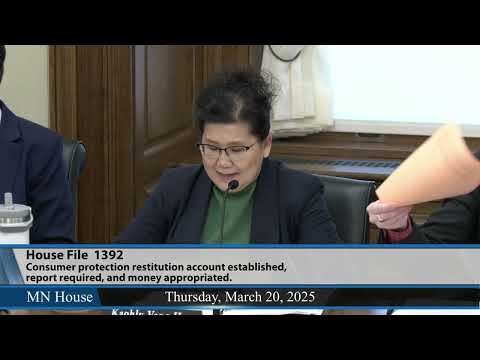
House committee hears bill to create consumer fraud restitution fund, adopts amendment and lays bill over
Summary
Lawmakers and testifiers described a proposed Consumer Fraud Restitution Fund that would divert up to $5 million a year from certain civil recoveries to pay restitution to defrauded Minnesotans; committee adopted an A3 amendment capping annual deposits at $5 million and laid the bill over for possible omnibus inclusion.
A Minnesota House Commerce Committee on March 19 heard testimony on House File 1392, legislation from Rep. Liz Lee to create a consumer fraud restitution fund that would pay restitution to victims when a court has ordered restitution but the defendant is insolvent.
The bill, as amended by an adopted A3 amendment, would direct 50 percent of non-restitution civil recoveries (civil penalties, attorneys’ fees and similar amounts that currently flow to the state general fund) into a dedicated fund, up to $5,000,000 per fiscal year. Representative Liz Lee, the bill’s author, and AARP Minnesota testified in favor of the proposal.
The measure’s backers said the fund aims to encourage reporting of fraud, give the attorney general additional incentive to bring consumer-enforcement cases, and provide an avenue for monetary restitution when defendants cannot pay. “Minnesotans are tired of being scammed,” Thomas Elnis, state advocacy director for AARP Minnesota, told the committee, adding that the fund “would provide monetary restitution to those who have lost funds to criminals.”
Testimony described typical scam scenarios and the emotional and financial consequences for victims. Dennis Anderson of Maplewood recounted losing $20,000 to an impersonation/bail scam and said, “My initial $20,000 was never recovered.” Dawn Patton of Savage described a remote-access tech scam in which scammers tried to coerce her into turning over nearly $20,000; she said bank staff intervened and prevented a loss.
Jessica Whitney, a deputy attorney general, told the committee the attorney general’s office supports the bill and called it a “good” fix for a gap in delivering restitution when defendants are unavailable or insolvent. Whitney explained the office currently recovers restitution when feasible but often cannot collect from defendants located overseas or from businesses that have gone bankrupt. Under the bill, she said, the attorney general would be required to bring consumer enforcement actions and would file an annual report identifying cases that put money into or drew from the fund.
Committee members asked how far $5 million would go. Whitney said it was an estimate and acknowledged uncertainty: “We could always come back and lift it,” she said, adding the AG’s office would try to use the fund fully to benefit victims if it could. Representative Lee said the bill’s reporting provision is intended to help answer questions about recoveries in future years.
The committee adopted the A3 amendment, which set the annual deposit cap at $5 million and made technical changes, by voice vote. Members then laid House File 1392, as amended, over for possible inclusion in an omnibus bill.
The record for the hearing included multiple personal accounts of fraud, testimony from AARP Minnesota and the attorney general’s office, and questions from committee members about case selection, likely caseload and interactions with existing consumer-protection resources.
The committee did not vote the bill out; its next procedural status is “laid over for possible inclusion” pending further action.