Get Full Government Meeting Transcripts, Videos, & Alerts Forever!
Get email alerts on the Education Workforce Alignment topic
No spam. Unsubscribe anytime.
Duluth Promise initiative wins local and higher‑education support in committee hearing
Summary
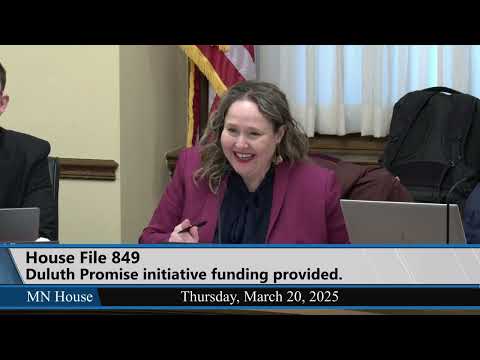
House File 8‑49, the Duluth Promise initiative, drew bipartisan support and testimony from Duluth Public Schools and local colleges about expanding dual credit, technical training, and employer partnerships; the committee laid the bill over for further consideration.
The House Workforce, Labor and Economic Development Policy and Finance Committee heard testimony on House File 8‑49, a bipartisan proposal to establish the Duluth Promise initiative — a locally coordinated effort to expand dual‑credit, technical training and career pathways for Duluth students.
Proponents said the initiative would align K‑12, higher education and local employers to create equitable access to postsecondary and career options. John Magus, superintendent of Duluth Public Schools, told the committee the plan would expand dual credit and technical training and “provide robust career counseling and mentorships” that connect students to local employers such as Cirrus Aircraft and healthcare employers.
Barbara McDonald, president of the College of St. Scholastica, testified by Zoom that the college and partner institutions including Lake Superior College and the University of Minnesota Duluth would collaborate on “stackable credentials” and early work experiences to retain graduates in the region’s workforce. Magus said the funding would support coordination and staffing to weave employer partnerships into K‑12 programming rather than treating industry engagement as an afterthought.
Committee members asked practical questions about rollout and staffing; Magus said the effort would require several full‑time staff to coordinate partners and that many employer and institutional contributions would be in‑kind. Representative Kozlowski, a bill author, described the initiative as a “common sense, bipartisan approach to aligning education with economic growth.”
The chair laid House File 8‑49 over for further consideration in a future omnibus bill.