Get Full Government Meeting Transcripts, Videos, & Alerts Forever!
Get email alerts on the Education Unemployment Ui topic
No spam. Unsubscribe anytime.
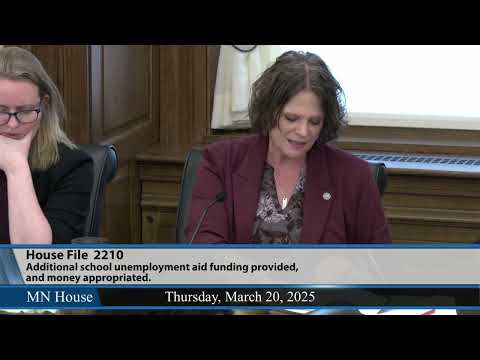
Committee hears HF2210 to fund summer unemployment for hourly school workers; bill laid over
Summary
A Minnesota House committee considered House File 2210, a bill to add one-time state funding and a future local levy option to cover unemployment insurance claims for hourly school employees during summer terms, and laid the bill over for possible inclusion in an education finance package.
A Minnesota House committee considered House File 2210, a bill to add one-time state funding and a future local levy option to cover unemployment insurance claims for hourly school employees during summer terms, and laid the bill over for possible inclusion in an education finance package.
Representative Sandra Ream, sponsor of HF2210, told the committee the measure builds on a 2023 change that extended unemployment insurance to hourly school workers and the special revenue fund created to reimburse districts. “The 2023 legislature appropriated $135,000,000 for this purpose,” Ream said, and HF2210 would appropriate $30,000,000 in fiscal year 2026 and $70,000,000 in fiscal year 2027 to cover remaining and projected summer costs.
The bill would also authorize school districts to include summer-term unemployment costs in a local unemployment insurance levy beginning in fiscal year 2028. Ream asked the committee to take testimony and said she intended to lay the bill over “for possible education bill” inclusion.
The Minnesota Department of Education urged support for the aid as a stability measure. “This aid is being utilized and our hourly school workers deserve this benefit other hourly workers across the state have access to,” Sami Grama, Assistant Director of Government Relations at the Minnesota Department of Education, said, citing projected UIA use of about $44,000,000 in fiscal year 2024 and a projected $58,000,000 in fiscal year 2025 based on feedback from local education agencies.
Several school employees and district representatives testified about the program’s role in retaining staff and the fiscal consequences of shifting costs locally. Ann Kramfitz, a behavioral interventionist with Owatonna Public Schools, said unemployment benefits make it feasible for long‑time hourly staff to return each fall: “The unemployment benefit have made that easier,” she said, adding that the benefit provides a needed mental‑health break and helps staff who cannot find short‑term full‑time summer work.
Kristen Scott, a special education paraprofessional in the Elk River School District, said the summer UI benefit “helps me bridge the gap and assist many other hourly school workers in providing for our families” and warned that without the benefit districts risk losing trained paraprofessionals.
Kat Briggs, an ISD 196 school bus driver, described how partial and full weekly benefits during summer gaps “meant that I didn’t have to choose between taking care of my school children and my grandbabies.” Briggs said giving districts levy authority “doesn’t mean that they have to use it,” and supported the bill despite personal reservations about property taxes.
The Minnesota School Boards Association urged continued state funding rather than shifting costs to local taxpayers. “The levy authority now being proposed under this bill means the local school boards will be asked to shift the rising costs onto local property taxpayers,” Denise Dietrich, speaking for MSBA, said, warning that the impact would vary by district property wealth and could force districts to cut general‑fund spending or raise property taxes.
Noel Schmidt, superintendent at Rock Ridge, described the strain on smaller or poorer districts, saying some communities already face local unemployment from industry layoffs and that his district has had to cut staff to cover these costs.
Committee members pressed on equity and affordability. Representative Pete Johnston asked whether there were reasons to exclude this class of workers from UI; Ream replied that hourly school employees had previously been ineligible and that UI requires claimants to be actively seeking work when not offered comparable district employment. Representative Hudson and the committee chair raised fiscal constraints and warned that making the levy permanent could divide districts when boards decide whether to raise local taxes.
The committee recorded a voice vote on a DE1 amendment before testimony; the transcript records the committee calling for “aye” and “no” and the chair saying, “The DE 1 has stopped it.” The committee finished the hearing by agreeing to lay HF2210 over for possible inclusion in an education finance bill.
Taken together, testimony and agency estimates framed HF2210 as an effort to make funding predictable while lawmakers weighed the state’s fiscal capacity and the equity effects of shifting costs to local property taxpayers. The committee did not take a final substantive vote on the bill; the next step is consideration as part of the education finance process.