Get Full Government Meeting Transcripts, Videos, & Alerts Forever!
Get email alerts on the Ohe Budget topic
No spam. Unsubscribe anytime.
Governor’s OHE budget includes state grant changes, agency operating funds and licensing fee reforms
Summary
OHE commissioners outlined the governor’s proposals in House File 2431, including a $15 million biennial investment in the state grant program with formula changes to limit award growth, agency operating increases, licensing and registration fee restructuring, and several technical program clarifications; the bill was laid over.
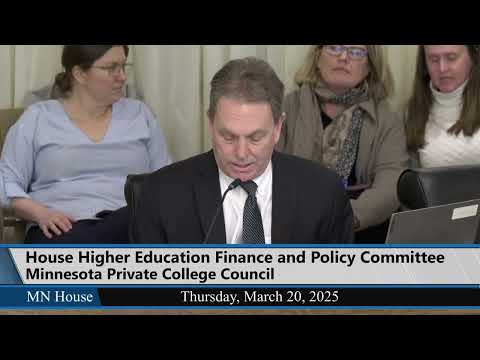
The Office of Higher Education (OHE) presented the governor’s budget proposals in House File 2431 to the House Higher Education Finance and Policy Committee, describing targeted changes to the Minnesota State Grant program, agency operations and regulatory fees.
Commissioner Michael Olsen (presenting with staff) said the governor proposes $7.5 million in general‑fund support each year (a $15 million biennial increase) and a set of formula parameter changes designed to keep projected spending within appropriated resources and avoid award rationing. The changes include setting a floor of zero for negative Student Aid Index (SAI) values when calculating awards, reducing the living and miscellaneous expense (LME) allowance to 110% of the federal poverty guideline, increasing assigned student responsibility to 51% beginning in fiscal 2027, and aligning assigned family responsibility with 100% of the federal need analysis for families with positive parent contributions beginning in fiscal 2026.
Olsen explained that the SAI change responds to the FAFSA overhaul: because federal aid reform allows negative SAI values, some students received larger state awards than previously intended, which stressed the program budget. He summarized the governor’s approach as a combination of modest new investment and parameter adjustments to prevent mid‑year cuts.
The proposal also would change the state’s deadline for OHE to record grant receipt to the 30th day of the academic term, rather than at the end of the fiscal year, so the agency can estimate demand earlier. Committee members asked for estimates of the financial effect of that timing change; OHE staff said they would provide numbers to the committee.
On agency operations, the governor proposed additional general‑fund support for OHE operating costs — $162,000 in fiscal 2026 and $328,000 annually thereafter — to cover compensation, IT and other fixed costs. OHE also requested statutory and fee changes for institutional licensing and registration: the changes would consolidate many program fees into an enrollment‑based renewal fee, adjust fees for the State Authorization Reciprocity Agreement, increase some solicitor and multiple‑location fees, and remove certain exemptions from the Private Career School Act to clarify scope and reduce administrative complexity.
Additional budget or technical elements included: transitioning tribal college annual operations and maintenance funding into the tribal college supplemental assistance program with a floor of $1,000,000 per tribal college; clarifying the North Star Promise program's eligibility (removing out‑of‑state tuition coverage language and ineligible course payments); authorizing the emergency assistance program (EAPS) to be routed directly through the University of Minnesota and Minnesota State for efficiency; and increasing the Minnesota Self Loan Program bond cap from $10 million to $25 million per year within OHE’s tax‑exempt allocation.
Ending
Committee members asked follow‑up questions and requested additional fiscal detail; OHE said it would supply requested numbers and follow up with the committee. The committee laid the bill over for further consideration.